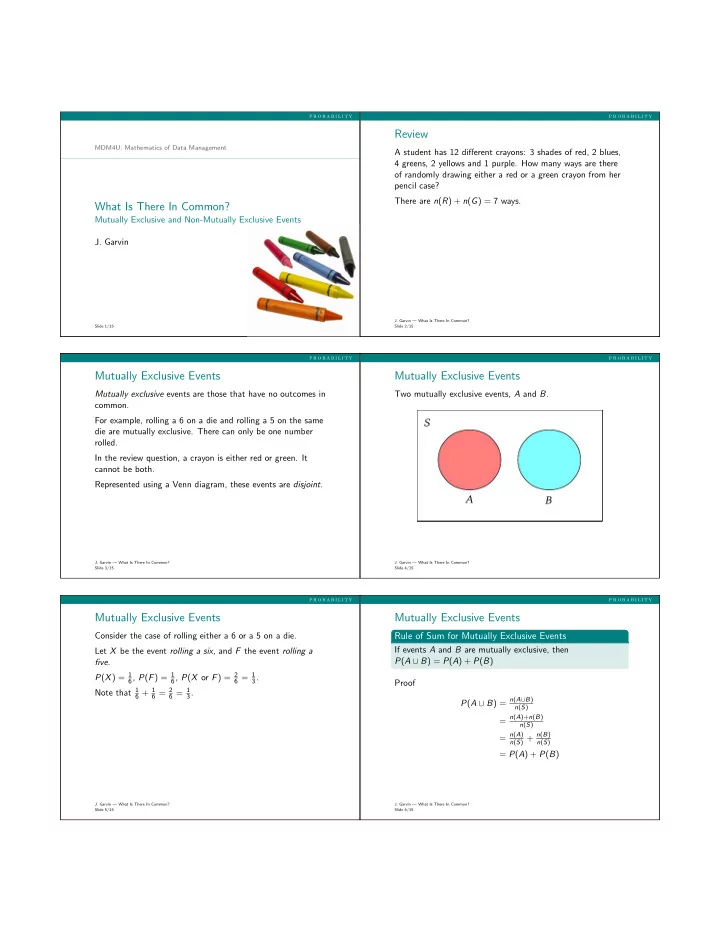

SLIDE 1
p r o b a b i l i t y
MDM4U: Mathematics of Data Management
What Is There In Common?
Mutually Exclusive and Non-Mutually Exclusive Events
- J. Garvin
Slide 1/15
p r o b a b i l i t y
Review
A student has 12 different crayons: 3 shades of red, 2 blues, 4 greens, 2 yellows and 1 purple. How many ways are there
- f randomly drawing either a red or a green crayon from her
pencil case? There are n(R) + n(G) = 7 ways.
- J. Garvin — What Is There In Common?
Slide 2/15
p r o b a b i l i t y
Mutually Exclusive Events
Mutually exclusive events are those that have no outcomes in common. For example, rolling a 6 on a die and rolling a 5 on the same die are mutually exclusive. There can only be one number rolled. In the review question, a crayon is either red or green. It cannot be both. Represented using a Venn diagram, these events are disjoint.
- J. Garvin — What Is There In Common?
Slide 3/15
p r o b a b i l i t y
Mutually Exclusive Events
Two mutually exclusive events, A and B.
- J. Garvin — What Is There In Common?
Slide 4/15
p r o b a b i l i t y
Mutually Exclusive Events
Consider the case of rolling either a 6 or a 5 on a die. Let X be the event rolling a six, and F the event rolling a five. P(X) = 1
6, P(F) = 1 6, P(X or F) = 2 6 = 1 3.
Note that 1
6 + 1 6 = 2 6 = 1 3.
- J. Garvin — What Is There In Common?
Slide 5/15
p r o b a b i l i t y
Mutually Exclusive Events
Rule of Sum for Mutually Exclusive Events
If events A and B are mutually exclusive, then P(A ∪ B) = P(A) + P(B) Proof P(A ∪ B) = n(A∪B)
n(S)
= n(A)+n(B)
n(S)
= n(A)
n(S) + n(B) n(S)
= P(A) + P(B)
- J. Garvin — What Is There In Common?
Slide 6/15