Review of DNA ( D eoxyribo n ucleic a cid) What do you remember from - - PowerPoint PPT Presentation

review of dna
SMART_READER_LITE
LIVE PREVIEW

Review of DNA ( D eoxyribo n ucleic a cid) What do you remember from - - PowerPoint PPT Presentation

Review of DNA ( D eoxyribo n ucleic a cid) What do you remember from Biology? Who are these people? James Watson and Francis Crick 1953 Determined the structure of DNA using Rosalind Franklins data Awarded the Nobel Prize in 1962


slide-1
SLIDE 1

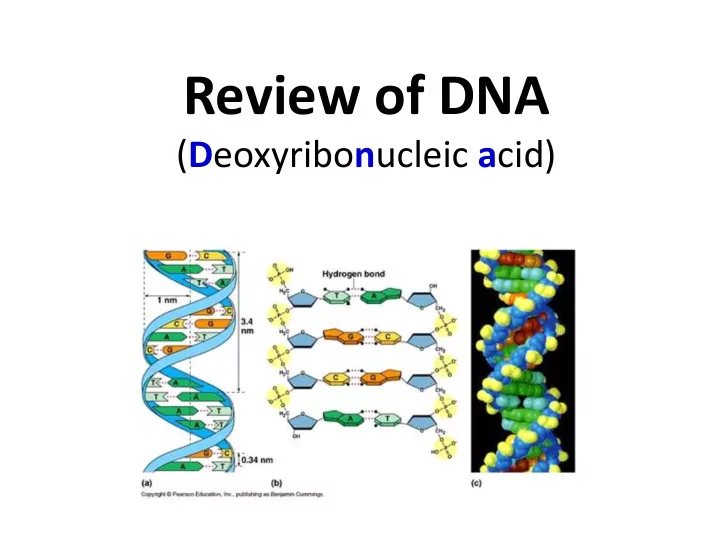
Review of DNA

(Deoxyribonucleic acid)
slide-2
SLIDE 2

What do you remember from Biology?

slide-3
SLIDE 3

Who are these people?

slide-4
SLIDE 4

James Watson and Francis Crick

  • 1953 – Determined the structure of DNA using

Rosalind Franklin’s data

  • Awarded the Nobel Prize in 1962
slide-5
SLIDE 5

What is DNA?

slide-6
SLIDE 6

DNA (Deoxyribonucleic acid)

  • Nucleic acid
  • Consists of monomers called nucleotides
  • Found in all cells, some organelles, and some

viruses

slide-7
SLIDE 7

DNA (Deoxyribonucleic acid)

  • Stores genetic

information

  • Determines an
  • rganisms traits by

directing the synthesis of proteins

  • Each organisms

genome is unique

slide-8
SLIDE 8
slide-9
SLIDE 9

Structure of DNA

slide-10
SLIDE 10

Structure of DNA

  • Double helix
  • Consists of a double strand of nucleotides
  • Sides: Alternating deoxyribose sugars and

phosphates

  • Center: Complementary nitrogenous bases
  • Two strands are anti-parallel

– 5’ to 3’ – 3’ to 5’

slide-11
SLIDE 11
slide-12
SLIDE 12

A Note About the Phosphates

  • DNA is a negatively charged molecule because
  • f the phosphate groups
  • Important property in gel electrophoresis
slide-13
SLIDE 13

Gel Electrophoresis

slide-14
SLIDE 14

Nucleotide Composition

  • Three parts of a nucleotide

– 5 carbon sugar called deoxyribose –Phosphate group –A single nitrogenous base

slide-15
SLIDE 15

Four Nitrogenous Bases

  • Purines (double ring)

– Adenine (A) – Guanine (G)

  • Pyrimidines (single ring)

– Thymine (T) – Cytosine (C)

slide-16
SLIDE 16

Purines pair with Pyrimidines

slide-17
SLIDE 17

Chargaff’s Rules (Base Pairing)

  • A-T (2 hydrogen bonds)
  • C-G (3 hydrogen bonds)
slide-18
SLIDE 18

Bonds Within a DNA Molecule

slide-19
SLIDE 19
  • Phosphodiester bonds

join nucleotides together along the sides of the DNA molecule (type of covalent bond)

  • Hydrogen bonds join

the two DNA strands together in the center

  • f the molecule
slide-20
SLIDE 20

Phosphodiester Bond

slide-21
SLIDE 21

DNA and Genes

  • Only 2% of the human genome is protein coding
  • A gene is a sequence of nucleotides that contains

instructions for synthesizing a particular protein

  • The sequence of nucleotides in an organisms genome

is unique

slide-22
SLIDE 22

Human Genome Project

  • Began in 1990, completed in April 2003
  • Approximately 20,000 genes in the human genome
  • 3 billion base pairs