Review Introduction - Stage II College of Management Most - - PDF document

review introduction stage ii
SMART_READER_LITE
LIVE PREVIEW

Review Introduction - Stage II College of Management Most - - PDF document

Providence University Review Introduction - Stage II College of Management Most individuals seem to agree that the microcomputer will continue to hold an important role in education. Gubser (1980) and Hinton (1980) suggested phenomenal


slide-1
SLIDE 1

1

Providence University

College of Management

Method and Materials

Wu-Lin Chen (wlchen@pu.edu.tw) Department of Computer Science and Information Management

Technical Writing S03

Providence University 2

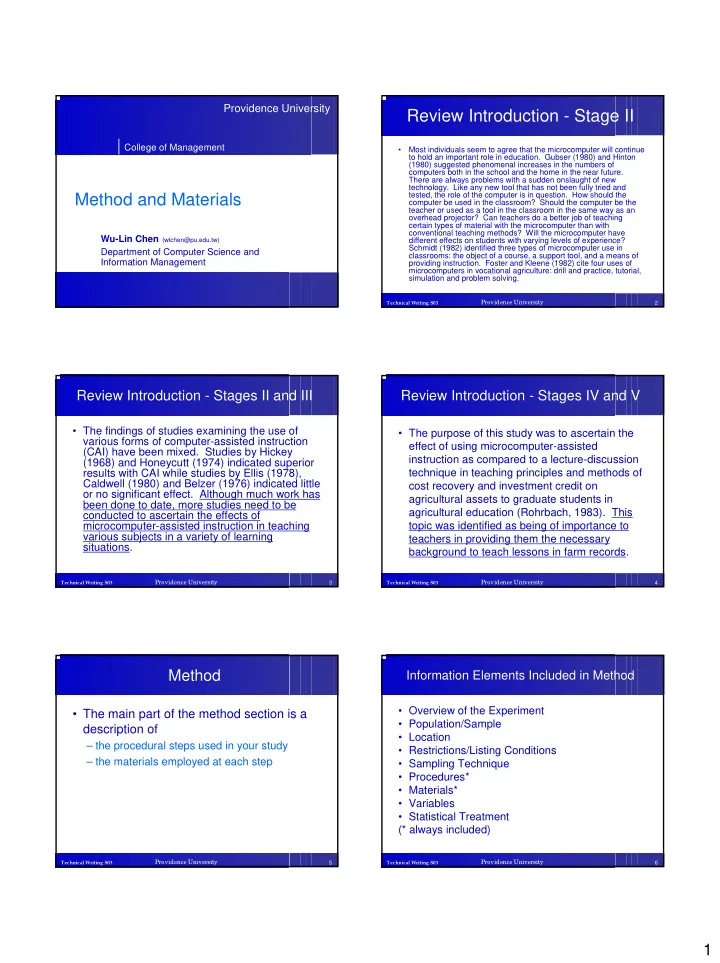
Review Introduction - Stage II

  • Most individuals seem to agree that the microcomputer will continue

to hold an important role in education. Gubser (1980) and Hinton (1980) suggested phenomenal increases in the numbers of computers both in the school and the home in the near future. There are always problems with a sudden onslaught of new

  • technology. Like any new tool that has not been fully tried and

tested, the role of the computer is in question. How should the computer be used in the classroom? Should the computer be the teacher or used as a tool in the classroom in the same way as an

  • verhead projector? Can teachers do a better job of teaching

certain types of material with the microcomputer than with conventional teaching methods? Will the microcomputer have different effects on students with varying levels of experience? Schmidt (1982) identified three types of microcomputer use in classrooms: the object of a course, a support tool, and a means of providing instruction. Foster and Kleene (1982) cite four uses of microcomputers in vocational agriculture: drill and practice, tutorial, simulation and problem solving.

Technical Writing S03

Providence University 3

Review Introduction - Stages II and III

  • The findings of studies examining the use of

various forms of computer-assisted instruction (CAI) have been mixed. Studies by Hickey (1968) and Honeycutt (1974) indicated superior results with CAI while studies by Ellis (1978), Caldwell (1980) and Belzer (1976) indicated little

  • r no significant effect. Although much work has

been done to date, more studies need to be conducted to ascertain the effects of microcomputer-assisted instruction in teaching various subjects in a variety of learning situations.

Technical Writing S03

Providence University 4

Review Introduction - Stages IV and V

  • The purpose of this study was to ascertain the

effect of using microcomputer-assisted instruction as compared to a lecture-discussion technique in teaching principles and methods of cost recovery and investment credit on agricultural assets to graduate students in agricultural education (Rohrbach, 1983). This topic was identified as being of importance to teachers in providing them the necessary background to teach lessons in farm records.

Technical Writing S03

Providence University 5

Method

  • The main part of the method section is a

description of

– the procedural steps used in your study – the materials employed at each step

Technical Writing S03

Providence University 6

Information Elements Included in Method

  • Overview of the Experiment
  • Population/Sample
  • Location
  • Restrictions/Listing Conditions
  • Sampling Technique
  • Procedures*
  • Materials*
  • Variables
  • Statistical Treatment

(* always included)

slide-2
SLIDE 2

2

Technical Writing S03

Providence University 7

Writing the Procedural Description

  • The description of the steps you followed

in conducting your study should be written clearly.

  • How clear?

– It should be clear enough for a reader in your field could accurately replicate your procedure and get the same results.

Technical Writing S03

Providence University 8

Describe the Procedure

  • The best way to describe a procedure is

– Step-by-step – Chronologically

Technical Writing S03

Providence University 9

Correct Verb Tense in Procedural Descriptions

  • The procedures you used in carrying out

your study should usually be described in the simple past tense.

  • Sentences included under method that are

not written in the past tense usually do not refer to the procedures used in the study being reported.

Technical Writing S03

Providence University 10

Procedural Descriptions: Past Tense

  • For examples:

–Surveys were sent to student health services at 180 colleges. –The study was carried out on a marine laboratory research vessel. –The generators supplied about 14,000 amps when fully operational.

Technical Writing S03

Providence University 11

Appropriate Verb Voice – Active or Passive

  • Either the active or the passive voice can be used.

Subject Main verb (passive) Agent Complement + + + Stress was applied (by the investigators) to the rubber segments … Agent Main verb (active) Object Complement + + + We applied stress to the rubber segments in gradually increasing increments.

Technical Writing S03

Providence University 12

Conditions for Deciding Verb Voice – Active

  • r Passive
  • The passive voice is conventionally used to

describe procedure in order to depersonalize the

  • information. The passive construction allows

you to omit the agent (usually “I” or “we”), placing the emphasis on the procedure and how it was done.

– EX A: For reasons related to personal safety, the test facility was constructed (by us) in a remote area 4 miles from the main road. – EX B: Tests were conducted (by me) with four different types of reactors.

Note: You advisor may ask you not to use the passive voice since he or she prefers a more personal style with frequently use of the pronouns “I” or “we.”

slide-3
SLIDE 3

3

Technical Writing S03

Providence University 13

Conditions for Deciding Verb Voice – Active

  • r Passive
  • Intermix the active and passive voices
  • Place old information near the beginning of the

sentence and new information at the end.

– EX: The four reactors we tested in the work reported here are all contained a platinum catalyst (ACTIVE). Each reactor-catalyst configuration will be described separately (PASSIVE). The quartz reactors were manufactured by the Wm. A. Sales Company of Wheeling, Illinois (PASSIVE).

Technical Writing S03

Providence University 14

Materials

  • Any item used to carry out a research

project.

  • Beside method, you also have to describe

any equipment or other materials used with each step in your procedure.

Technical Writing S03

Providence University 15

Information Conventions

  • Materials

– laboratory equipment – field equipment – human or animal subjects – natural substances – fabricated materials – surveys, questionnaires and tests – computer models – mathematical models

Technical Writing S03

Providence University 16

What To Describe

  • If the materials you used are well known to

researchers in your field, it is conventional to identify them only.

  • If you used specially designed or

unconventional materials in your research, it is common to write a detailed description

  • f them in your paper.

Technical Writing S03

Providence University 17

Describing Specially Designed Materials: Three Steps

  • Overview: This step consists of one or two

sentences that give a general idea of the material and the purpose for which it is intended.

  • Description of principal parts: Each major part or

characteristic of the material is described in logical sequence.

  • Functional description: This last step shows how

the various features described in previous step function together.

Technical Writing S03

Providence University 18

Description of Principle Parts

  • Spatial arrangement: Describe the features from

top to bottom, front to back, left to right, from the center to the outside, or in some other spatial

  • way. This arrangement is especially useful for

describing equipment consisting of various connected parts.

  • Functional arrangement: Describe the principle

features in the order in which they function, from beginning to end. This arrangement is best for describing parts that operate in a fixed sequence.

slide-4
SLIDE 4

4

Technical Writing S03

Providence University 19

Verb Tense and Voice in Describing Materials

  • Sentence describing the subjects or

materials used in a study require either the past or the present tense.

  • When we describe the sample used in a

study we commonly use the past tense.

Technical Writing S03

Providence University 20

Describing Samples: Past Tense Verbs

Sample Main verb (past) Description The subjects were 18 Arabic-speaking students attending classes at the American University in Cairo. The men interviewed were primarily from St. Louis, Mo. The boys were between the ages of 7 and 13.

Technical Writing S03

Providence University 21

Describing Populations: Present Tense Verbs

Sample Main verb (present) Description They enter the English Language Institute where they follow an intensive program of English language training. All students who apply for admission to the American University of Cairo take the Michigan Test of English Language Proficiency.

  • When describing the general population from

which the sample subjects were selected, the present tense is normally used.

Technical Writing S03

Providence University 22

Verb Tenses in Describing Specially Designed Materials

  • If you use equipment in your study which is

standard or conventional in your field and probably familiar to most other researchers, you should describe it using the present tense.

  • If you describe specially designed materials with

which other researchers in your field may not be familiar, the descriptions are usually written in the past tense. Common devices that you modified in some special way for use in your study are also sometimes described in the past tense.

Technical Writing S03

Providence University 23

Describing Conventional Material: Present Tense Verb

Conventional material Main verb (present) Description A typical chemical reactor includes a helical, tube-in-tube heat exchanger. The Auditory Test for Language Comprehension (Carrow 1968) permits the assessment of oral language comprehension of English and Spanish.

Technical Writing S03

Providence University 24

Describing Specially Designed Or Modified Materials: Past Tense Verbs

Modified material Main verb (past) Description For the testing program this collector was protected from weather by an outer window of .10 mm tedlar.

slide-5
SLIDE 5

5

Technical Writing S03

Providence University 25

Active and Passive Voice in Describing Materials

  • Both active and passive voice verb

constructions are used in describing experimental materials.

  • Your decision to use active or passive

voice depends on partly on whether the verb is transitive or intransitive.

– Only transitive verbs can be used in the passive voice.

Technical Writing S03

Providence University 26

Active and Passive Voice in Describing Materials

  • The passive voice is usually used when a

human agent (the experimenter) is manipulating the materials.

  • The active voice is usually used when no human

is directly responsible for manipulating the materials – that is, when the materials operate “by themselves.”

  • The passive voice may be used to describe an

action involving a nonhuman agent, but a phrase must be included to indicate the agent.

Technical Writing S03

Providence University 27

Human Agent Involved: Passive Voice

  • Example: The temperature inside the

chamber was increased from 0° to 20 °C.

– The researcher increased the temperature.

  • Example: Four thermocouples were

monitored hourly.

– A researcher monitored them.

Technical Writing S03

Providence University 28

No Human Agent Involved: Active Voice

  • Example: A 200 hp generator provided

power to the piezometers.

  • Example: Control gauges monitored air

pressure inside the chamber.

– In above two examples, the use of active voice indicates that the experimenters were not directly involved in the functioning of the equipment.

Technical Writing S03

Providence University 29

No Human Agent Involved: Passive Voice

  • Example: Power was supplied by 14

generators with capacities ranging from 90 to 300 KW.