Rethinking the Internet and the telecommunications market today Why - - PowerPoint PPT Presentation

rethinking the internet and the telecommunications market
SMART_READER_LITE
LIVE PREVIEW

Rethinking the Internet and the telecommunications market today Why - - PowerPoint PPT Presentation

Rethinking the Internet and the telecommunications market today Why the Internet just works Why the Internet just works Departure from the e2e M. Handley, BT Technology journal, 2006 Network neutrality Trilogy consortium


slide-1
SLIDE 1

Rethinking the Internet and the telecommunications market today

Why the Internet just works Departure from the e2e Network neutrality Designing for tussle The market today

Why the Internet just works

  • M. Handley, BT Technology journal, 2006

Trilogy consortium The Future of the Internet - 3 Costas Courcoubetis

The history of changes

TCP separated from IP (1983) DNS (1982) Congestion control in TCP (mid 80s) BGP (policy routing) 1990s CIDR (1993)

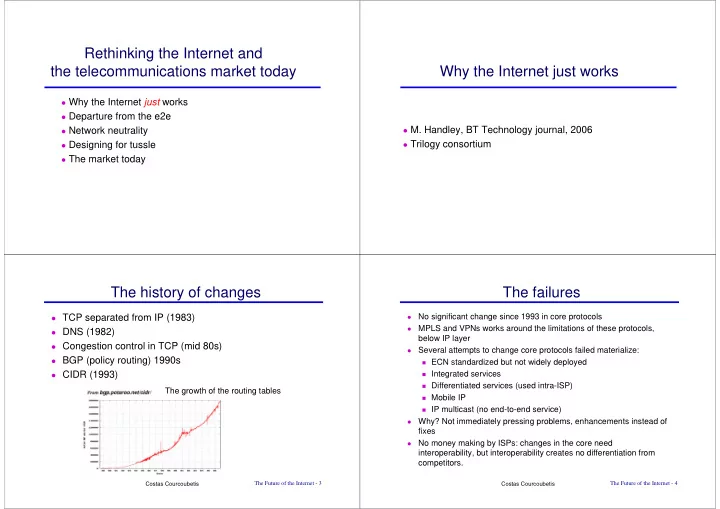
The growth of the routing tables

The Future of the Internet - 4 Costas Courcoubetis

The failures

  • No significant change since 1993 in core protocols
  • MPLS and VPNs works around the limitations of these protocols,

below IP layer

  • Several attempts to change core protocols failed materialize:

ECN standardized but not widely deployed Integrated services Differentiated services (used intra-ISP) Mobile IP IP multicast (no end-to-end service)

  • Why? Not immediately pressing problems, enhancements instead of

fixes

  • No money making by ISPs: changes in the core need

interoperability, but interoperability creates no differentiation from competitors.

slide-2
SLIDE 2

The Future of the Internet - 5 Costas Courcoubetis

The future

Key issue: decrease of transparency end-to-end Security concerns -> firewalls everywhere! NAT: modify e2e flows, not explicit part of Internet

  • architecture. Basic reason: ISPs charge for IP

addresses, differentiate between home and biz users

Hard to develop new applications and transport

protocols! Vicious circle!

No substantial change at layers 3 (10y) ,4 (20y) Ossification?? Convergence? Is the internet up the challenge of video? The Future of the Internet - 6 Costas Courcoubetis

Architectural problems

  • Short term problems

SPAM (SPIT) Security Denial-of-service attacks Application deployment

  • Medium term problems

Congestion control

– 1Gbps link, 150ms RTT: 20’ for filling the pipe! Fairness…

BGP: slow to converge, error prone, easy to misconfigure,

difficult to debug, no privacy. It mostly works…

Mobility

– DHCP provides a solution – Solve it at layer 4 or above instead of layer 3?

The Future of the Internet - 7 Costas Courcoubetis

Architectural problems (cont.)

Medium term (cont) Multi-homing

– Robustness vs cost of routing tables

Fast path through router forwarding engines: packets

with IP options are forwarded slower

IPv4 lost its use of extension mechanisms! Long term Address space depletion IPv6: no economic incentive to deploy Mobile devices: create walled gardens instead of

  • ffering e2e connectivity

The Future of the Internet - 8 Costas Courcoubetis

Some of the new challenges

inter-domain routing & addressing:

multi-homing by most businesses and residential users for their own resilience (otherwise when access fails,

they find they can’t work, play, communicate, etc)

different access providers specialise in different

applications

businesses and residential users switch connectivity

regularly between providers

networks frequently re-route subsets of routes to the

cheapest neighbours

slide-3
SLIDE 3

The Future of the Internet - 9 Costas Courcoubetis

Challenges (cont.)

multicast routing

currently globalisation is shrinking the distance between

humans, but this will extend to things...

the Internet of things will create a more virtualised world,

where physical things can be present virtually in other parts of the planet

layered multicast for congestion control of multimedia

distribution

huge number of disjoint routing groups within core of

network

huge churn in subscription to multicast routing groups The Future of the Internet - 10 Costas Courcoubetis

Challenges (cont.)

Mobility

combining the Internet of things with mobility (e.g.

sensing devices in cars)

frequent re-connection to new providers frequent creation of VPNs continual re-location of large numbers of devices relative

to network topology

instantaneous authentication, accounting (AAA) &

dynamic config

why does it take so long to set up a VPN tunnel? or to

complete connectivity negotiation following powerup?

The Future of the Internet - 11 Costas Courcoubetis

Challenges (cont.)

Traffic management

  • ‘click and it’s there’ video
  • channel hopping (assuming not all channels served from the same

cache) and generally many more much larger flows starting & stopping (youTube, video calling, 3-D remote presence)

  • the Internet of things
  • time-division multiplexed dedicated use of high capacity link

technologies, co-ordinated end-to-end

  • large amounts of sudden increases of traffic along different paths
  • a traffic mix dominated by huge numbers of short transfers (eg.

single packet events)

  • generally much higher flow data rates

The Future of the Internet - 12 Costas Courcoubetis

Challenges (cont.)

disasters & unrest

major flooding (e.g. global warming) frequent power outages traffic surges due to mobile comms during major civil

unrest (both co-ordinating the unrest, co-ordinating between innocent bystanders and coordinating the

  • fficial response)

survival of remaining infrastructure, perhaps with affected

machines coming back on and off line frequently

protection of inelastic flows in progress and prioritisation

  • f authority-authority and authority-people

communications

slide-4
SLIDE 4

The Future of the Internet - 13 Costas Courcoubetis

Challenges (cont.)

co-ordinated attacks

  • zero day worm infects large proportion of devices (TVs, PCs, cell-

phones, PDAs, iPods)

  • large proportion of routers infected
  • infrastructural services (DNS, certification, search, location etc)

infected

  • access network has to cut off nearly all hosts; how do they get online

to be cleaned

  • healthy routers have to detect who to isolate and simultaneously

prioritise remaining service

  • perhaps combined with attacks on caching infrastructure intended to

insulate against loss of connectivity to services

The Future of the Internet - 14 Costas Courcoubetis

Challenges (cont.)

disconnectivity

resilience during extended periods of disconnectedness

  • pportunistic connectivity

fast exploitation of capacity immediately when available graceful cache/cookie expiry The Future of the Internet - 15 Costas Courcoubetis

Perspective

Internet’s strength: general-purpose net Provides 80% of capability for 20% of the cost New challenge: how to add an extra 10% of functionality? No good track record! It only just works! The Future of the Internet - 16 Costas Courcoubetis

E2e principle

Application-level functions should not be implemented in

the core protocols

Implications: Complexity of core network reduced Easy to add new apps, no dependence on network Applications on the net instead than in the net

slide-5
SLIDE 5

The Future of the Internet - 17 Costas Courcoubetis

Moving away from e2e

  • New Internet requirements not compatible with e2e
  • Operation in an untrustworthy world

make the network more trustworthy instead of the edges -> add more

complexity in the core

  • More demanding apps for QoS

Current solution: intermediate storage sites -> apps depend on

intermediate 2-stage delivery

  • ISP service differentiation

Promote enhanced service models within ISP boundary, weaken

incentives for open e2e services (inter ISP)

Value-based pricing

  • The rise of 3d party involvement
  • Less sophisticated users

More functionality in the network, becomes part of the execution

model

  • Innovation by larger players backed by more money?

The Future of the Internet - 18 Costas Courcoubetis

How will the Internet evolve?

ISPs control the evolution, have their own incentives to

place new mechanisms, invest, control customer traffic

Global connectivity with local trust? Where will be the

new mediation mechanisms?

Ossification? A new network will eventually evolve?? The Future of the Internet - 19 Costas Courcoubetis

Network neutrality

The Future of the Internet - 20 Costas Courcoubetis

The big debate: Net neutrality

  • We don't want to create a world like television where in order to get

your voice heard, you really need to have the backing of a major corporate network

  • When companies have both strong business incentives and the

technical ability to interfere with Web content, it doesn't take a crystal ball to predict that they will do so

  • the government must ensure that [broadband] operators do not

encumber relationships between their customers and destinations on the network

  • many corporations are "speaking out of both sides of their mouths,"

claiming to support consumer choice, but promoting a deregulatory agenda that would clear the way for more consolidation of ISPs, less competition and fewer choices

  • Competitive broadband distribution would allow us to rely upon

market forces, rather than government regulation, to govern market structure and service provision (!!)

slide-6
SLIDE 6

The Future of the Internet - 21 Costas Courcoubetis

Why network neutrality

1. Network Neutrality protections have existed for the entire history of the Internet. 2. Network discrimination through a “tiered Internet” will severely curtail consumer choice, giving consumer control over the Internet to the network owners. 3. Network discrimination through a “tiered Internet” will undermine innovation, investment, and competition. 4. Network discrimination through a “tiered Internet” will fundamentally alter the consumer’s online experience by creating fast and slow lanes for Internet content. Network prioritization is a zero-sum game. 5. No one has a “free ride” on the Internet. Network operators have the revenue streams to support infrastructure development. 6. Telephone companies have received billions of dollars in public subsidies over the years to support network build-out. 7. There is little competition in the broadband market, certainly not enough to punish anti-competitive behavior. 8. Consumers will bear the costs for network infrastructure regardless of whether there is Network Neutrality or not. 9. Investing in increased bandwidth is the most efficient way to solve network congestion problems; discrimination creates an incentive to maintain scarcity.

  • 10. Network owners have explicitly stated their intent to scrap Network Neutrality

guarantees and build business models based on network discrimination.

The Future of the Internet - 22 Costas Courcoubetis

Basic theory

  • Network Neutrality is a controversial theory of network design closely

related to the end to end principle

  • a neutral network promotes innovation or evolutionary innovation of

information technology

  • Critics of Internet regulation in the name of "net neutrality“: the

Internet is much less neutral than proponents claim

Type of Service header in the IP Datagram active queuing described in RFC 2309 Integrated Services and Differentiated Services enabling Quality

  • f Service over IP

They warn that sober policy formulation is impeded by emotional

attachments to idealized notions of network architecture

The Internet is still very weak at meeting the needs of real-time

and multimedia applications, and its continued evolution is stymied by the efforts made by network neutrality advocates

The Future of the Internet - 23 Costas Courcoubetis

Basic arguments

  • Main argument in favor of network neutrality: a discriminatory network

distorts markets that depend on the network, and ultimately may slow national economic growth

  • arguments against network neutrality:
  • packet-level discrimination is absolutely necessary in order to provide

Quality of Service on any packet network

service bundling is necessary to encourage investment in the

networks of the future

economics of congestion. A neutral network is like a public good,

leading to collective action or tragedy of the commons-like problems. Hence a provider may need to discriminate as between users or usage to ensure maximum network performance.

network neutrality is a fine idea but will require government

intervention, and intervention will invariably and inevitably lead to unintended consequences

The Future of the Internet - 24 Costas Courcoubetis

Some trends affecting the debate

  • The increasing use of Voice over IP, VoIP, and its latency

requirements.

  • The increasing use of high bandwidth applications, such as online

games, and music and video downloading.

  • Improvements in networking technology, which make providing

broadband service, on the aggregate, cheaper.

  • The trend of governments funding the construction of high-speed

networks in countries like South Korea, France, and for cities to build their own, wireless networks.

  • The increasing use of wireless home networks, which allow for

neighbors to share an internet connection, thereby reducing revenues for the service providers. In urban areas this factor can be very large, with a great deal of people sharing one individual person's connection.

  • High bandwidth video and audio telecommunications over the

internet (for example Voice Over IP technology) which threaten the landline revenues of telco internet service providers

slide-7
SLIDE 7

Designing for tussle

  • D. Clark et all

The Future of the Internet - 26 Costas Courcoubetis

The tussle concept

Successful engineering: provide robust, predictable,

desirable behaviour

Successful societies: dynamic management of evolving

and conflicting interests

Internet: need to accommodate social aspects Technical architecture must accommodate tussles of

society while providing good engineering

The Future of the Internet - 27 Costas Courcoubetis

Some principles

Modularize along tussle boundaries Separate functions in different tussle spaces Tussle A should not distort tussle B Design for choice Users select SMTP, IMAP server The Future of the Internet - 28 Costas Courcoubetis

Tussle spaces

Economics: Internet providers are competitors; consumers

need to make choices

Provider lock-in from IP addressing Value pricing for customers Residential broadband access

– What tussle modularity will improve investment

  • utcome?

Competitive wide area access

– Source routing, customers pay for it

slide-8
SLIDE 8

The Future of the Internet - 29 Costas Courcoubetis

Tussle spaces

Trust: Internet should be able to choose with whom to

interact and the level of transparency offered to others

Control which parties to exchange packets Who chooses firewall policies? Select third parties for mediation Who will protect users from SW running on his own

machine?

Openness: how to protect innovation Vertical integration (less openness) does not block

necessarily innovation (at network level or at the edge)

Separate tussle of vertical integration from desire to

sustain innovation

Transparency (of packets) is not equal to openness The Future of the Internet - 30 Costas Courcoubetis

Some remarks

Future of e2e? Transparency is eroding Lost of trust->firewalls ISP control: packet filters… 3d parties observe flows: data capture in the net Improve app performance: caches, mirrors,… Allow user choice, design what happens when

transparency fails, evaluate benefits of encryption

Separation of policy and mechanism Learn from the past The failure for QoS paradigm. Why? What is missing? No value transfer mechanism, no customer choice

  • ver providers offering better services

The situation in telecoms

The Future of the Internet - 32 Costas Courcoubetis

The new market situation

The impact of the Internet and web driving data growth

more rapid than what the telcos predicted

New data-oriented network technologies cheaper than

SONET

Optical networks Gigabit Ethernet Wireless New players with newer and cheaper networks offer less

costly connectivity and transport services

New carriers rent resources instead of owning

slide-9
SLIDE 9

The Future of the Internet - 33 Costas Courcoubetis

ILECs on the pre-IP Era

Past: Monopoly, high revenue from voice Data a small share of traffic Expensive voice-centric network infrastructure

investments (300b$): Copper pairs, SONET

Today? ILECs have a high cost network suitable for voice Demand for broadband, voice replaced by email, web While ILEC data growth continues, data does not

bring in anywhere the revenue that voice does

Voice [in number of access minutes] declining

Revenues going down while costs are not

The Future of the Internet - 34 Costas Courcoubetis

The new situation (2004)

mobile operators: fastest penetration, 22% market share (1T)

(fixed voice: (50-80% of revenue, 50% of traffic) declining

incumbents: share < 50-70% money comes from voice, true fixed voice declining due to

mobile, VoIP

Termination charges: 1/3 of total revenue, artificially high how can telcos use a new disruptive technology which

cannibalizes their revenues?

current telco model: 10% content creation, 30% transport,

50% aggregation and delivery, 10% service bundling and customization

strategy: retain control by reducing access BW The Future of the Internet - 35 Costas Courcoubetis

Local loop competition: Cable TV (I)

Industry analysts have been predicting the entry of cable

television in telephony for many years

Despite numerous trials, such entry in traditional

telecommunications services has not materialized

Reasons for this: Cable television providers needed to upgrade their

networks from analog to digital

Second, they need to add switching Third, most of the cable industry has taken a high

debt load and is unable to make the required investments in the short run

The Future of the Internet - 36 Costas Courcoubetis

Cable TV (II)

Cable television will have a significant advantage over

regular telephone lines.

Cable TV lines that reach home have higher

bandwidth than regular phone lines. This is crucially important for web applications.

Cable companies are utilizing this capacity to provide

bundles of Internet and traditional TV services. – But often (soon to change) no two-way communication, services rely on a telephone line for transmissions from the home to the ISP which are expected to require low bandwidth.

slide-10
SLIDE 10

The Future of the Internet - 37 Costas Courcoubetis

Horizontal and vertical integration

Mergers and coalitions not any more the trend! mergers tend to break! Examples:

– AT&T and BT – Sprint and MCI/WorldCom (intended) – Bell Atlantic and Vodafone Airtouch

With content providers [infotainment industry]

– AOL and Time Warner

Largest merger in history (will break)

– Comcast bid for Disney

A perspective on the future of communications

The Future of the Internet - 39 Costas Courcoubetis

The future of the market

To each home a single broadband IP pipe? Japan Yahoo BB: 45Mbps 37$, Korea 80% broadband what is the effect on the communication market? Who is the leader? cable companies!

– coax cable: easy to transport voice, data,…

ILECs in worst position

– cooper worst than cable – heavily regulated (unbundling) – disincentive to invest

The Future of the Internet - 40 Costas Courcoubetis

The future of voice

Will there be a long-term stand-alone business for voice? in an all-IP network, marginal cost of voice = zero under competition, price of voice will be almost zero existing free p2p solutions: Skype Not free voice because access not very competitive (changes with WiFi) customers lack choice possible taxation by local authorities Killer strategy of the cable companies vs. the ILECs

  • ffer free voice!

but they love to charge… prolong life of ILECs

slide-11
SLIDE 11

The Future of the Internet - 41 Costas Courcoubetis

Strategy of cable

Power of content distribution falls vs content provisioning in all-IP world content providers can establish direct

relationships with customers, have more choices

no cable operators wants to become a IP packet pusher degrade standard internet access, offer differentiated

services, premium IP for content

incentives to “break” the IP network! The Future of the Internet - 42 Costas Courcoubetis

The ILECs

Difficult position current IP access too thin to provide video excess regulation

– allow access to competitors to physical assets

Cellular, VoIP an other threat Only alternative: begin investment in optical-IP networks no regulation for new assets enter video market! still high market capitalization Best example: BT 21CN project The Future of the Internet - 43 Costas Courcoubetis

New players

Microsoft: WM9 codec + DRM control user interface Who will make money from video over IP aggregation

and distribution?

Microsoft… cable companies (one click ordering)

  • ther content aggregators

Important topics

slide-12
SLIDE 12

The Future of the Internet - 45 Costas Courcoubetis

Customer-Owned IP Networks (I)

New kind of `bottom-up’ network, users controlled DWDM allows customers to own and control lambdas

(as part of a condominium, municipality)

The network is an asset Core of the network not optimally designed (waste of

bandwidth)??????????

Built in Canada, Sweden, USA, Holland Municipalities take the risk: build networks and lease IRU Participation of universities and research institutions The Future of the Internet - 46 Costas Courcoubetis

Customer-Owned IP Networks (II)

Market drivers: Low cost [1000% reduction of current telecom prices] LAN easily connects with WAN (no SONET/ATM) New applications and services can be provided Governments role: support and subsidize their construction regulate access conditions to ensure free and fair

competition (carrier-neutral interconnection facilities)

The Future of the Internet - 47 Costas Courcoubetis

Wireless access

BWIA and fiber: near perfect complements low maintenance, high bandwidth License exempt wireless 802.11b (`WiFi’)

  • ther technologies for BWIA

Spectacular failures in the past but new cheaper and more effective technologies No expensive spectrum licenses, different philosophy A p2p paradigm create local blankets of bandwidth outside the control

  • f local loop providers

Could it unleash the bottled-up bandwidth genie? The Future of the Internet - 48 Costas Courcoubetis

The future of 802.11

Open standard: same as Ethernet in the 80s, x86

computing architecture

WiFi will likely be embedded in every electronic product

under the sun: pervasiveness!

Vendors that build supporting infrastructure and

applications will come to assume that WiFi is on board, further entrenching the standard.

As a client technology, 802.11 will increasingly be

considered "free."

slide-13
SLIDE 13

The Future of the Internet - 49 Costas Courcoubetis

802.11 and 3G

Not completely competitive or complementary Balance of power? Strong similarity between the rise of 802.11 and that of

the personal computer: the commitment of an entire industry to a single open-standard- architecture

802.11 is very versatile Economics of 802.11 extremely favourable

  • perates on unlicensed spectrum

the price of 802.11 customer equipment is rapidly approaching

zero

PC industry has a vested interest in seeing 802.11 dominate over

3G

Primary locations for 3G already taken up by 802.11 The Future of the Internet - 50 Costas Courcoubetis

Summary: the big picture

  • Internet initially conceived as a bottom-up network
  • decentralized, edge value-adding, no central control besides congestion management
  • Telcos need user control, top-down definition of services
  • ‘no money in the middle’, `the paradox of the stupid network’, telephony service business

model, do more value adding

  • monopoly (duopoly) in access, control interconnection as much as possible
  • Economic picture currently grim
  • Telcos: large investments in expensive voice-centric infrastructure, fear of new data

business, keep prices high for data, impede competition

  • CLECs: hard to compete with ILECs
  • IXCs: high investments in fiber, wrong business models

– no broadband `ramps’ (no holistic approach) – low demand for BW (last mile problem, high prices by ILECs) – extremely competitive

  • large amounts (200b$) paid for spectrum licenses, slow 3G penetration
  • Key factor the introduction of broadband: the chicken and the egg problem
  • New technologies may be disruptive
  • ptical IP networks, p2p, broadband wireless LANs
  • decrease possibilities of central control, community owned optical networks, asset based
  • Customer role: consumer vs, user (active communication vs. passive reception)
  • Demand and infrastructure aggregation, publicly owned, competition in services?
  • New cash-rich players enter the picture?