Machine vs. Human: A Cross-Discipline Study on Synthetic Speaker - - PowerPoint PPT Presentation

machine vs human a cross discipline study on synthetic
SMART_READER_LITE
LIVE PREVIEW

Machine vs. Human: A Cross-Discipline Study on Synthetic Speaker - - PowerPoint PPT Presentation

Machine vs. Human: A Cross-Discipline Study on Synthetic Speaker Age Recognition Eva Lasarcyk, Michael Feld, Christian Mller FEAST May 6, 2009 Saarbrcken Lasarcyk, FEAST May 6, 2009 WHAT are we trying to achieve?! Idea of a


slide-1
SLIDE 1

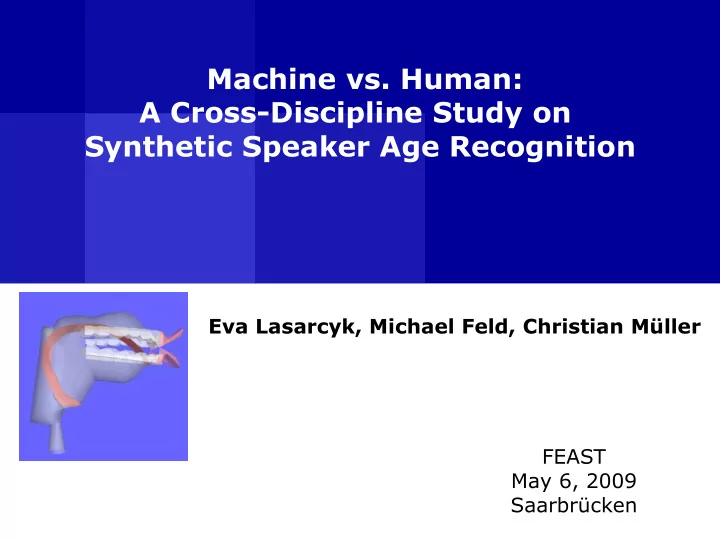
Machine vs. Human: A Cross-Discipline Study on Synthetic Speaker Age Recognition

Eva Lasarcyk, Michael Feld, Christian Müller FEAST May 6, 2009 Saarbrücken

slide-2
SLIDE 2

Lasarcyk, FEAST May 6, 2009

WHAT are we trying to achieve?! Idea of a cross-discipline study on vocal age

 Imagine you are talking on the phone to someone you

don‘t know. Without seeing the person you can make some reasonable assumptions about e.g. their age. But you can never be sure that the young lady you think you‘re talking to is in reality an elderly woman with a ‘‘young‘‘ voice impression.

 How well does age recognition work over the phone

anyway? (Limited bandwidth; already a tough task)

 Exploratory nature of study with synthetic voices.

(Limited experience, since we are very experienced only in the natural world; makes it an even tougher task.)

 Plus: Comparing the ''human ear'' with an age classifier.

slide-3
SLIDE 3

Lasarcyk, FEAST May 6, 2009

Motivation of This Talk

 Show an example of collaboration between speech

sciences (aka phonetics) and speech technology

 Present an explorative model of synthetic vocal

aging

 Compare human listeners and an automatic age

classifier

 Discuss what we can learn from this approach in

  • rder to improve the age classification system
slide-4
SLIDE 4

Lasarcyk, FEAST May 6, 2009

Our Goals/Research Questions

1.

Can age cues that are derived from the literature be implemented into synthetic voices in order to let human listeners recognize the age class Young, Adult, Senior?

2.

What is the relative importance of individual cues for human perception of speaker age?

3.

Would a speaker age recognition system, which is solely trained on natural voices, produce meaningful results when presented with the same synthetic voices?

1.

Are the voices natural enough to “fool” the system?

2.

Does the system (with its statistical model based on short-term cepstral features) in fact catch up some of the theoretically motivated age cues?

slide-5
SLIDE 5

Lasarcyk, FEAST May 6, 2009

Problem

 A person’s voice changes due to

  • Aging
  • Emotional conditions
  • Pathological conditions

 Knowledge applicable for

  • Security
  • Medical applications
  • Speech technology
  • Scientific curiosity
slide-6
SLIDE 6

Lasarcyk, FEAST May 6, 2009

Physiological Changes

 Vocal tract lengthening  Reduction in pulmonary function  Ossification of laryngeal cartilages  Increased vocal fold stiffness  Reduced vocal fold closure  Habits? Sicknesses?

slide-7
SLIDE 7

Lasarcyk, FEAST May 6, 2009

Acoustic Changes

 Mean F0  Raised in old males  Increased F0 variability  Lower formant frequencies  Greater noise  Slower speaking rate

Findings in the literature are sometimes contradictory

Müller 2005/Linville 2001

slide-8
SLIDE 8

Lasarcyk, FEAST May 6, 2009

Outline

 Anatomy of Vocal Aging  Modeling of synthetically aged voices  Evaluation ''Systems'': Listeners and age classifier  Results  Conclusions and Discussion (work in progress)

slide-9
SLIDE 9

Lasarcyk, FEAST May 6, 2009

Modeling with VocalTractLab

3 age classes: Young (15-24), Adult (25-54), Senior (55-80) 12 ''voices'' per age class Contents: aI-aU, aU-OI Glottis model Vocal tract shape

F0 = F0base+sin(A1*2pi*JF)+sin(A2*2pi*JF2)+...

(Birkholz 2006, Birkholz&Kröger 2006)

slide-10
SLIDE 10

Lasarcyk, FEAST May 6, 2009

Evaluation ''Systems'' I

 Forced-choice classification task

  • Web-based listening test with warm-up procedure
  • 12 voices in 3 age classes, with two wordings
  • 2 presentations of each stimulus (144 total)
  • Possibility to provide feedback at end of test

 26 Listeners (1 Young, 20 Adult, 5 Senior)

  • More or less naive to synthetic voices
  • Thanks to the ones of you who participated!
  • Ex. 2
  • Ex. 3
  • Ex. 1
slide-11
SLIDE 11

Lasarcyk, FEAST May 6, 2009

Young Adult Senior 10 20 30 40 50 60 70 80

Young Adult Senior

Samples/Stimuli Listeners' votes (%)

Results I: Listeners' Classification Accuracy

 Confusion matrix (3744 votes)

Young: High Young F0, Senior: Low F0

 Verbal feedback of participants

  • Human/synthetic/mechanical
  • Tuning in, discrimination/identification
  • Jittery = old, young/adult hard
  • Fitness

 Consistency of answers (Which were the ''hard'' voices?)

slide-12
SLIDE 12

Lasarcyk, FEAST May 6, 2009

Evaluation ''Systems'' II

 Age classification system

  • Trained on conversational telephone speech
  • Not tuned for test data (synthetic)
slide-13
SLIDE 13

Lasarcyk, FEAST May 6, 2009

Results II: Age classifier

 Mean scores per age model

  • Reasonable output in general (''male'' models)
slide-14
SLIDE 14

Lasarcyk, FEAST May 6, 2009

Results II:

Scores of ''male models'' for YOUNG samples

 As a function of synthetic age cues: Clear effect  Only if target model scores highest = Correct classification

Curve of target model

slide-15
SLIDE 15

Lasarcyk, FEAST May 6, 2009

 Content largest effect, other cues not so clearly sorted  Within-class variance higher than for YOUNG in training (?)

Results II:

Scores of ''male models'' for ADULT samples

slide-16
SLIDE 16

Lasarcyk, FEAST May 6, 2009

 Similar picture as with ADULT samples

Results II:

Scores of ''male models'' for SENIOR samples

slide-17
SLIDE 17

Lasarcyk, FEAST May 6, 2009

Results II: Age Classifier Accuracy

 Confusion matrix  ADULT wins often  Jittery = Old?

Young Adult Senior 10 20 30 40 50 60 70 80 90

Young Adult Senior

Samples/Stimuli Model (Class vote) (%)

Young Adult Senior 10 20 30 40 50 60 70 80

Young Adult Senior

Samples/Stimuli Listeners' votes (%)

slide-18
SLIDE 18

Lasarcyk, FEAST May 6, 2009

Our Goals/Research Questions Revisited

1.

Can age cues that are derived from the literature be implemented into synthetic voices in order to let human listeners recognize the age class Young, Adult, Senior?

2.

What is the relative importance of individual cues for human perception of speaker age?

3.

Would a speaker age recognition system, which is solely trained on natural voices, produce meaningful results when presented with the same synthetic voices?

1.

Are the voices natural enough to “fool” the system? (Meaningful scores)

2.

Does the system (with its statistical model based on short-term cepstral features) in fact catch up some of the theoretically motivated age cues?

slide-19
SLIDE 19

Lasarcyk, FEAST May 6, 2009

Conclusions and Discussion

 Limits of the stimuli set due to design reasons  Indications of quality of the age model (consistency)  General topic of synthetic ''world'' and naive listeners  Ways to improve the age classifier? (Control conditions)  Successful collaboration between speech sciences and

speech technology

slide-20
SLIDE 20

Lasarcyk, FEAST May 6, 2009

References

  • P. Birkholz. 3D-Artikulatorische Sprachsynthese. Dissertation, published

by Logos (Berlin), 2006.

  • P. Birkholz and B.J. Kröger, “Vocal tract model adaptation using magnetic

resonance imaging,” in Proc. 7th ISSP, Ubatuba, 2006, pp. 493–500. S.E. Linville, Vocal Aging, Singular, 2001.

  • C. Müller, Zweistufige kontextsensitive Sprecherklassifikation am

Beispiel von Alter und Geschlecht [Twolayered Context-Sensitive Speaker Classification on the Example of Age and Gender], Ph.D. thesis, Computer Science Institute, University of the Saarland, Germany, 2005.