Ret inal Prot eins (Rhodopsins) Molecular Mechanisms of - - PDF document

ret inal prot eins rhodopsins
SMART_READER_LITE
LIVE PREVIEW

Ret inal Prot eins (Rhodopsins) Molecular Mechanisms of - - PDF document

Ret inal Prot eins (Rhodopsins) Molecular Mechanisms of Photoactivation and Spectral Membrane prot eins Seven t ransmembrane helices Tuning in Retinal Proteins Ret inal chromophore bound t o a lysine via a Schif f base Emad


slide-1
SLIDE 1

1

Emad Tajkhorshid

Theoretical and Computational Biophysics Group Beckman I nst it ut e University of I llinois at Urbana- Champaign

Computational Chemistry GRI D Conf erence, 2003

Molecular Mechanisms of Photoactivation and Spectral Tuning in Retinal Proteins

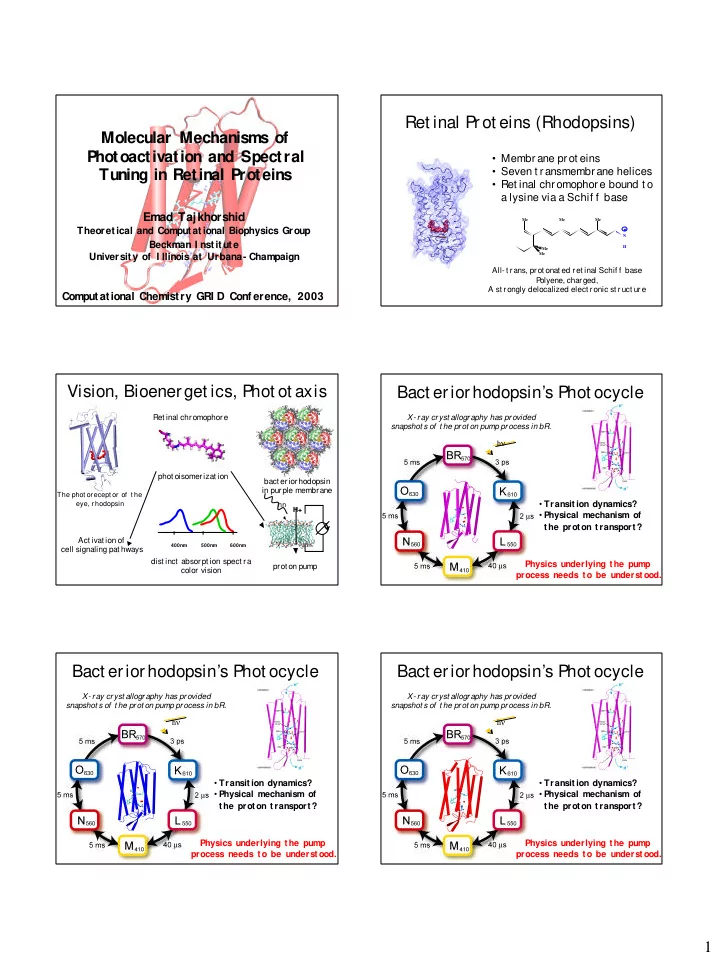
Ret inal Prot eins (Rhodopsins)

All- t rans, prot onat ed ret inal Schif f base P

  • lyene, charged,

A st rongly delocalized elect ronic st ruct ure

  • Membrane prot eins
  • Seven t ransmembrane helices
  • Ret inal chromophore bound t o

a lysine via a Schif f base

N Me Me Me Me Me H

Vision, Bioenerget ics, Phot ot axis

V H+ hn

bact eriorhodopsin in purple membrane

500nm 600nm 400nm

dist inct absorpt ion spect ra color vision

The phot or ecept or of t he eye, r hodopsin

phot oisomerizat ion Ret inal chromophore prot on pump Act ivat ion of cell signaling pat hways X- ray cryst allography has provided snapshot s of t he prot on pump process in bR.

  • Transit ion dynamics?
  • Physical mechanism of

t he prot on t ransport ?

Physics underlying t he pump process needs t o be underst ood.

Bact eriorhodopsin’s Phot ocycle

X- ray cryst allography has provided snapshot s of t he prot on pump process in bR.

  • Transit ion dynamics?
  • Physical mechanism of

t he prot on t ransport ?

Physics underlying t he pump process needs t o be underst ood.

Bact eriorhodopsin’s Phot ocycle

X- ray cryst allography has provided snapshot s of t he prot on pump process in bR.

  • Transit ion dynamics?
  • Physical mechanism of

t he prot on t ransport ?

Physics underlying t he pump process needs t o be underst ood.

Bact eriorhodopsin’s Phot ocycle

slide-2
SLIDE 2

2

X- ray cryst allography has provided snapshot s of t he prot on pump process in bR.

  • Transit ion dynamics?
  • Physical mechanism of

t he prot on t ransport ?

Physics underlying t he pump process needs t o be underst ood.

Bact eriorhodopsin’s Phot ocycle

X- ray cryst allography has provided snapshot s of t he prot on pump process in bR.

  • Transit ion dynamics?
  • Physical mechanism of

t he prot on t ransport ?

Physics underlying t he pump process needs t o be underst ood.

Bact eriorhodopsin’s Phot ocycle

X- ray cryst allography has provided snapshot s of t he prot on pump process in bR.

  • Transit ion dynamics?
  • Physical mechanism of

t he prot on t ransport ?

Physics underlying t he pump process needs t o be underst ood.

Bact eriorhodopsin’s Phot ocycle Phot ocycle of bR

+

H D85-COO HOOC-E204 HOOC-D96 N

+

H D85-COO HOOC-E204 HOOC-D96 N K216 K216

bR568 K603

+

H D85-COO HOOC-E204 HOOC-D96 N K216 D85-COOH OOC-E204 HOOC-D96 N K216

L543 M410

+

H D85-COOH OOC-E204 OOC-D96 N K216

N550

+

H D85-COOH OOC-E204 HOOC-D96 N K216

O645

3ps 1µs 40µs 5ms 5ms 5ms

The phot ocycle is init iat ed by phot oisomer izat ion of t he r et inal chr omophor e, and ef f ect ively pumps a pr ot on in every cycle (ms).

H N + H N +

500 fs

Quest ions

  • What det er mines t he maximal absor pt ion of

r et inal in dif f er ent pr ot ein envir onment s? (spect r al t uning in bact er ial r hodopsins)

  • What ar e t he dynamics of phot oisomer izat ion

and t he mechanism of light ener gy st or age? (excit ed st at e QM/ MM MD)

  • How does t he isomer izat ion is coupled t o
  • t her molecular event s in t he pr ot ein?

(pr ot ein act ivat ion mechanism in bR and Rh) Combined quant um mechanical / molecular mechanical (QM/ MM) calculat ions

  • Ret inal and several key residues are

described by ab initio QM (HF/ C ASSC F).

  • P

rot ein environment is t reat ed by a molecular mechanics f orce f ield, (AMBER94).

Comput at ional Met hodology

Molecular dynamics simulat ions Modif ied f orce f ield paramet ers

slide-3
SLIDE 3

3

N O H N H

MM QM N H

QM H H

H

dummy H at om Hamilt onian of t he QM/ MM syst em

M M M M M M M M QM ap p a a p ap a p ap p a ap j i B A A B B A ij i A iA A i i

V V r q Z k r q q k g r Z Z r r Z p H + + + + + + + =

− > >

∑∑ ∑∑ ∑ ∑ ∑∑ ∑

ˆ 1 2 1 ˆ

2

N O H MM O O QM

Lys216-R ET Asp85 Asp212

QM/ MM Calculat ions Color Vision

Visual recept ors of t he rhodopsin f amily are classif ied based on t heir color sensit ivit y

cone cells

Color Vision

500nm 600nm 400nm

How does t he prot ein t une t he absorpt ion maximum?

Color is sensed by red, green, and blue rhodopsin visual recept ors.

Their chromophores are the same! 11- cis prot onat ed ret inal Schif f base

absorpt ion spect rum

Spect ral Tuning in Bact erial Rhodopsins

sRI I bR

500nm 600nm

  • Large blue shif t of

absor pt ion maximum in sRI I (70 nm)

  • A prominent sub-band

Sensory Rhodopsin I I (sRI I ) phot ot axis Bact er ior hodopsin (bR) prot on pump

St r uct ur es of bRand sRI I

Very similar protein structures; Same chromophore: all trans protonated retinal Schif f base

X-ray st ruct ures: bR: Luecke et al. , Belrhali et al. sRI I : Luecke et al. , Royant et al.

sRI I bR

Ver y Similar Binding Sit es

Similar st r uct ur e

  • Ar omat ic r esidues.
  • Hydr ogen-bond net wor k.

(count er -ion asparat at es, int er nal wat er molecules) Mut at ion of t he ent ir e binding sit e can account f or only 50%

  • f t he spect ral shif t !

What is t he main det erminant

  • f spect ral t uning?

sRI I bR

T204A/ V108M/ G130S of sRI I pr oduces only 20 nm (30%) spect ral shif t .

slide-4
SLIDE 4

4

QM/ MM Calculat ions

  • Ref inement of X - ray st ruct ures

by HF (ret inal, 2Asp, 3H2O)

  • Excit at ion energy calculat ions by

CASSCF f or ret inal

retinal- K205/ K216 D201 D212 helix G helix G retinal- K205/ K216 D201 D212

QM/ MM-opt imized X-ray st ruct ures

Excit at ion Ener gies

∆E(S1- S0) : 6.1 (exp. 7.2) kcal/ mol ∆E(S2- S0 ): 1.7 (exp. 4.0) kcal/ mol

500nm

bR sRI I

600nm

Calculated spectra Spect ral shif t

∆E(S1- S0) A sub-band in sRI I is due t o t he second excit ed st at e (S2).

Hayashi, Taj khor shid, Schult en, J PC- B (2001)

Cont r ibut ions f r om Residues

T204 in sRI I gives a blue- shif t T142 in bR gives a red- shif t Consistent with mutagenesis experiment s

T142

sRI I bR

Mechanism of Spect r al Tuning

S2 S0 S1 isolat ed

St rong elect ronic reorganizat ion upon excit at ion

+ +

N Me Me Me Me Me H

S0 S1 S2

Mechanism of Spect r al Tuning

S2 S0 S1 S0 S1 S2 isolat ed in protein

Excit ed st at es and t he ground st at e receive dif f erent st abilizat ion f rom a count erion inside t he prot ein

+ +

O C O Asp (Glu)

N Me Me Me Me Me H

S0 S1 S2

St rong elect ronic reorganizat ion upon excit at ion

St r uct ur al Det er minant of t he Spect ral Shif t

retinal- K205/ K216 D201 D212 helix G Hayashi, Taj khor shid, Schult en, J PC- B (2001)

This is why mut agenesis experiments cannot restore the maximal absorpt ion. Same residue!!!!

N16 –C

γ (Asp201: sRII) : 4.5 A

N16 –C

γ (Asp212: bR) : 5.2 A

Dist ance bet ween t he Schif f base and t he count er ion is shor t er in sRI I .

Decomposed elect r onic r eor ganizat ion ener gies

slide-5
SLIDE 5

5

Phot oisomer izat ion of Ret inal

H N + H N +

<500 f s

13 14

One of t he f ast est r eact ions in nat ur e Femt osecond r esolut ion spect r oscopy measur ement s

  • Ult raf ast rat e (240- 500 f s)
  • High bond select ivit y in prot ein:

100% 13- cis phot oproduct

  • I n solut ion:

9- cis (2%), 11

  • cis (14%), 13 - cis (1

%) energy all-trans 13-cis

Ab I nit io Excit ed St at e QM/ MM MD Simulat ion

  • Two low- lying st at es (S 0 and S 1) in bR
  • An analogue of ret inal (t hree double bonds,

20 at oms) wit h CASSCF(6,6)/ DZV

  • AMBER94 f orce f ield f or t he prot ein
  • 11 t raj ect ories st art ing f rom init ial

conf igurat ions generat ed by classical MD QM

Hayashi, Taj khor shid, Schult en, Biophys. J . (2003)

Dynamics of Curve Crossing

A t ypical t r aj ect or y in bR

I n sit u dynamics

  • Relat ively slow isomerizat ion
  • Mult iple crossing event s
  • Larger energy dif f erences

and smaller nonadiabat ic couplings at crossing point s Gas phase dynamics

  • Fast isomerizat ion
  • A single crossing event

cis trans cis trans

Hayashi, Taj khor shid, Schult en, Biophys. J . (2003)

Ensemble of Tr aj ect or ies

Emission and absor pt ion ener gies

I somerizat ion event s

  • Bond select ive
  • Unidirect ional isomerizat ion

P roduct f ormat ion:

  • Cis product f ormat ion is dominant

at t he f irst crossing point .

H N +

energy all- t r ans 13- cis

Hayashi, Taj khor shid, Schult en, Biophys . J . (2003)

Dynamic Spect r al Modulat ions

200 fs oscillation

Gate delay time ( fs)

Ye et al.

Stimulated emission at 800 nm (pump-probe)

Rocking around the isomerizing bond Kobayashi et al.

(pump-probe at 610 nm) Low freq. shift of C

13=C 14 str

Time dependent coupling between C-C str. (in-plane H

14

bending) and H

14-HOOP

Time evolut ion of emission spect rum along a non- isomerizing t raj ect ory

Spectrogram of fast

  • scillations on a decay curve

emission energy

Hayashi, Taj khor shid, Schult en, Biophys . J . (2003)

Pr ot ein Act ivat ion Pr ocess in Bact eriorhodopsin

ps

slide-6
SLIDE 6

6

Hydr ogen Bond Net wor k (HBN)

HBN rearrangement can induce t he primary prot on t ransf er.

HBN Rear r angement and Pr ot on Tr ansf er

proton transf er energy (kcal/mol)

zwit t erionic neut ral

HBN rearrangement induces t he prot on t ransf er. I somerizat ion!

Ab init io QM/ MM calculat ion, Hayashi and Ohmine, J PCB 104, 10678 (2000) r1 (ang.)

Modeling of Ear ly I nt er mediat es

S0 S1 K BR

C13=C14-trans C13=C14-cis

Step 2: I somerization (MD) Step 3: Geometry ref inement (QM/ MM) Step 1: Equilibration in BR (MD) St ep 4: Spect roscopic properties (QM/ MM)

Two dist inct st at es! K and KL

Hayashi, Taj khor shid, Schult en, Biophys . J . (2002)

Ear ly I nt er mediat es of bR

3 ps

  • Signif icant st r uct ur al changes in t he binding pocket .
  • Discr epancies bet ween t he X-r ay and FTI R st udies.

D85 T89

C13=C14 cis

bR ground st at e (1C3W; Lueckeet al.) KLT int ermediat e st at e (1QKO; Edman et al.) KL

80 ps

Edman 2000

K

3 ps

I nt er mediat e st r uct ur es

BR

QM/ MM X- ray

Luecke 1999 Hayashi, Taj khor shid, Schult en, Biophys . J . (2002)

KL

80 ps

Edman 2000

K

3 ps

I nt er mediat e st r uct ur es

BR

QM/ MM X- ray

Luecke 1999 Hayashi, Taj khor shid, Schult en, Biophys . J . (2002) Lanyi 2002

slide-7
SLIDE 7

7

Pr ot ein: pdb f ile, 1HZX Lipids: POPC, Palmit oyl t ails

  • f Cys322 and Cys323;

Wat er : 6500 wat er molecules Tot al: ~40,000 at oms NAMD2, CHARMm27, PME 1ns equilibr at ion, 10ns r elaxat ion af t er isomer izat ion

Pr ot ein Act ivat ion Pr ocess in Rhodopsin

Saam, Taj khor shid, Hayashi, Schult en, Biophys . J . (2002)

Dihedr al pot ent ial and Char ges

QM/ MM derived part ial at omic charges of t he ground and excit ed st at es Rot at ional barriers and ground and isomerizat ion dihedral pot ent ials (inset ) of t he prot onat ed ret inal Schif f base

Ret inal I somer izat ion

Dihedral energy of retinal Dihedral angle of C11=C12

Twist Propagation

Saam, Taj khor shid, Hayashi, Schult en, Biophys . J . (2002)

Ret inal I somerizat ion

Decoupling of Trp265 and the β - ionone ring

Ring- chain

Overall backbone twist

Rear r angement of t he H- bond net wor k and salt br idges in t he r et inal binding pocket

Dif f er ent I somer izat ion Dynamics in Rh and bR

Rh

bR

N Me Me Me Me Me H

SMD Rot at ion of Helix VI

Tor que applied t o r ot at e helix VI bef or e (r ed) and 5ns af t er (blue) isomer izat ion

Saam, Taj khor shid, Hayashi, Schult en, Biophys . J . (2002)

slide-8
SLIDE 8

8

Mechanism of Ener gy St or age

I nt er nal (bonded) and int er act ion ener gy of r et inal wit h it s sur r ounding

Maj or conf or mat ional Changes

Cyt oplasmic changes

Movement of helices 10ns af t er isomer izat ion

Needs longer simulat ions!

Saam, Taj khor shid, Hayashi, Schult en, Biophys . J . (2002)

Acknowledgment

Shigehiko Hayashi (UI UC) Jan Saam (UI UC) Klaus Schulten (UI UC) Ehud Landau (UTMB) Javier Navarro (UTMB) $$ HFSP, NSF, NIH