Rest of presentation (slides) Professional perspective Organisations - - PDF document

rest of presentation slides
SMART_READER_LITE
LIVE PREVIEW

Rest of presentation (slides) Professional perspective Organisations - - PDF document

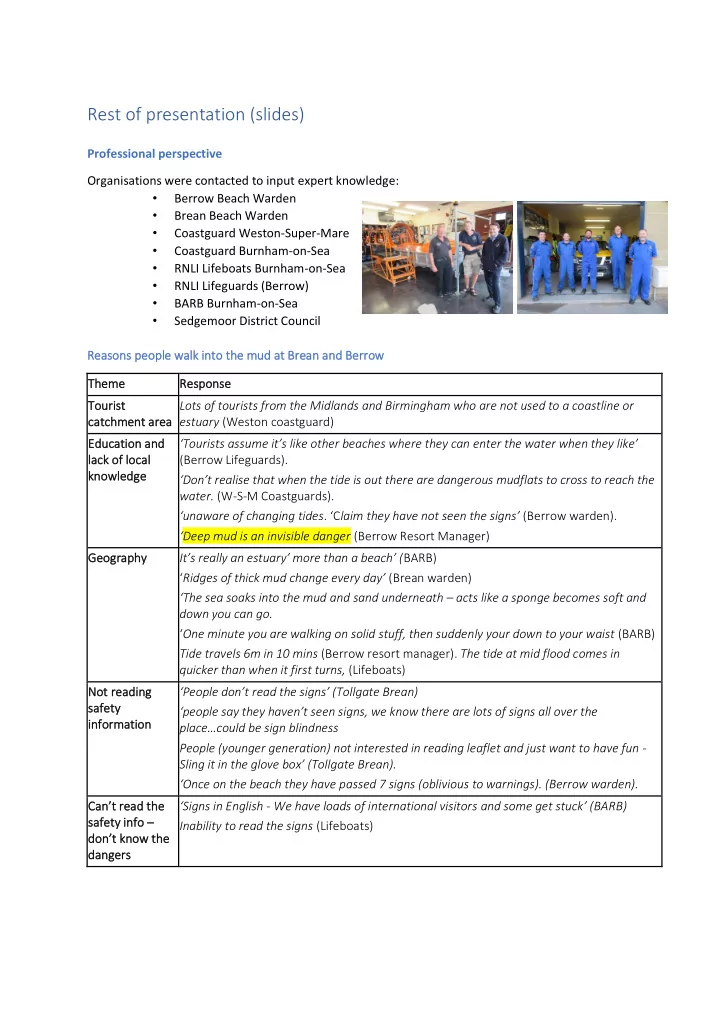
Rest of presentation (slides) Professional perspective Organisations were contacted to input expert knowledge: Berrow Beach Warden Brean Beach Warden Coastguard Weston-Super-Mare Coastguard Burnham-on-Sea RNLI Lifeboats


slide-1
SLIDE 1

Rest of presentation (slides)

Professional perspective Organisations were contacted to input expert knowledge:

  • Berrow Beach Warden
  • Brean Beach Warden
  • Coastguard Weston-Super-Mare
  • Coastguard Burnham-on-Sea
  • RNLI Lifeboats Burnham-on-Sea
  • RNLI Lifeguards (Berrow)
  • BARB Burnham-on-Sea
  • Sedgemoor District Council

Reasons

  • ns pe

peopl

  • ple walk into

nto the the mud ud at t Bre rean n and nd Berr rrow The heme Respo pons nse Tour

  • urist

t catc tchm hment nt are rea Lots of tourists from the Midlands and Birmingham who are not used to a coastline or estuary (Weston coastguard) Edu ducati tion

  • n and

nd lack of

  • f loc
  • cal

knowl nowledg dge ‘Tourists assume it’s like other beaches where they can enter the water when they like’ (Berrow Lifeguards). ‘Don’t realise that when the tide is out there are dangerous mudflats to cross to reach the

  • water. (W-S-M Coastguards).

‘unaware of changing tides. ‘Claim they have not seen the signs’ (Berrow warden). ‘Deep mud is an invisible danger (Berrow Resort Manager) Geog

  • graph

phy It’s really an estuary’ more than a beach’ (BARB) ‘Ridges of thick mud change every day’ (Brean warden) ‘The sea soaks into the mud and sand underneath – acts like a sponge becomes soft and down you can go. ‘One minute you are walking on solid stuff, then suddenly your down to your waist (BARB) Tide travels 6m in 10 mins (Berrow resort manager). The tide at mid flood comes in quicker than when it first turns, (Lifeboats) Not

  • t re

readin ding safety ty inf nfor

  • rmati

tion

  • n

‘People don’t read the signs’ (Tollgate Brean) ‘people say they haven’t seen signs, we know there are lots of signs all over the place…could be sign blindness People (younger generation) not interested in reading leaflet and just want to have fun - Sling it in the glove box’ (Tollgate Brean). ‘Once on the beach they have passed 7 signs (oblivious to warnings). (Berrow warden). Can’t read the safety ty inf nfo

don’t know the da dang ngers rs ‘Signs in English - We have loads of international visitors and some get stuck’ (BARB) Inability to read the signs (Lifeboats)

slide-2
SLIDE 2

Foll

  • llowi
  • wing

ng ti tide de line ne Chasing the tide line’ (Lifeboats) ‘90% of people who venture into the mud do so because they want to get to the sea.’ (Brean warden) ‘Inflatables - end up on the wrong side of the mud flats, (Burnham-on-Sea Coastguard) Ignor noring ng or

  • r

cha hallenging ng verb rbal safety ty adv dvice Disbelieve or challenge safety advice. (Both wardens) ‘When I call people back telling people there is soft mud, they jump up and down to see if it is’ (Brean Warden) Techniques - Threatening to call the coastguard focuses them’ (Berrow warden). ‘People pretend they can’t hear you or don’t understand English, I threaten them with a fine. Opt Optimism bia bias ‘that sign doesn’t apply to me’ (Lifeboats) ‘We all think it isn’t going to happen to us, an awful thing that happens to other people. Holi

  • lida

day mode

  • de/distra

distracte ted Adults switch off’ (Lifeboats) A lack of parental control…parents relying on Sedgemoor to look after kids. - One parent asleep and one on an iPad. The parents attitude when their drowning kid was pulled from the water was it’s your f**king job!’ (Berrow warden) Conf

  • nfus

usion We are reliant on RNLI red flag systems, which is water safety – people assume it means don’t go in the water, here it means don’t pass this point. We write the meaning on our board’. (Berrow Lifeguards) Ot Othe her r Reduced funding (Brean Warden), Alcohol (Lifeboats), ‘No staff during the evening’ (Berrow warden) Risk Contro

  • ntrols
  • Everyone thought risk controls at both beaches were adequate. - I don’t think there’s a lot

more we could actually do (Barb)

  • Signs as you go on the beach and people are given a leaflet’ (Burnham-on-Sea Coastguard)
  • ‘The wardens do a fantastic job - Up and down the beach in a vehicle all day and can see

anybody walking down and chase them straight away.

  • There can always be more I suppose’ (BARB)
  • ‘Warning signs high on the posts - stops people walking/ running into them’.
  • No signs on beach by Brean Down as the sea keeps washing them away’ (Brean Warden).
  • ‘Systems to limit danger and create a safe environment (Sedgemoor Beach Manager)

Sug uggeste ted d impr prov

  • vement

nts Flag syste tem ‘Have flags and signage for mud rather than relying on water safety’.(RNLI lifeguards) Techn hnolo

  • logy

‘New technology could be used…an app constantly updated that tells you specifically where the tide is coming up to on the beach that day. (BARB) Lang ngua uage Information in other languages’ (Berrow Warden) Edu ducati tion

  • n

‘More education, We try to educate people on Facebook’ (B-o-S Coastguard) ‘Public information film’ (Berrow Warden) Tide de ti times ‘More info about tide times - explain where it comes up the beach, not just the height. What does 11.6m mean. Graphics- pictures of stranded cars or people being stuck’ (BARB) Holi

  • lida

day pa park rks ‘Warnings at holiday parks’ (BARB) Less generic ric ‘Warning signs that say today…. (BARB)

slide-3
SLIDE 3

Whe hen n is the the mud ud expos posed? d?

  • Mudflats are exposed at low tide and

nd between high and low tide. Berr rrow

  • w
  • Rule of thumb Safe to enter sea 2 hours either side of high tide.
  • Tide heights differ between 12m and 8m (Depth means how fast the mud gets covered and

the speed the sea comes in and where it will stay).

  • A large tide (12m) - mud gets covered faster as the tide comes in faster (30 mins extra to

access water safely)

  • A small tide (8m) - stays further down the beach, slows down, then goes back out (less time to

access water safely)

  • Tide depths and times are important. Most people won’t know this’ (Berrow lifeguards)

Bre rean

  • Different timings - mud line is diagonal and Berrow gets covered by the sea first’
  • ‘If high tide is 11m then it is safe 3 hours before and 3 hours after high tide. If the high tide is

10m it is safe 2 hours before and after high tide (Brean Beach Warden) De Depth pth of

  • f mud

ud pe people

  • ple get

t stu tuck and nd age

  • ‘Midcalf – depending on age and strength…struggling’ (BARB)
  • ‘People get exhausted rather than stuck. It doesn’t take a lot of mud once your foot is sealed,

the suction starts

  • ‘It’s all ages. 6 year old – pensioners’ (BARB)

Safety ty pr precauti ution

  • n impa

pacts ts

  • Beach wardens and RNLI staff are preventing callouts.
  • Leaflets help educate people, but ensuring all visitors had one was difficult (may not get read)
  • It all helps to push out the message, but when you’ve got 300,000+ people visiting Brean in a

season…then how many leaflets do you push out? …

  • Signage was least likely to prevent callouts.
  • Call-out rates have not decreased since signage at Sedgemoor was changed to comply with

RNLI signage Conclusion

  • Fatality in the past
  • Continuing and increasing rescues (any incident is foreseeable)
  • Mud is a hidden danger (not obvious)
  • Effectiveness of risk controls - . (Clustered, weak or lack of controls)
  • Beach users’ perceptions and experiences on the beach (intended to spend ~4 hours
  • r less on the beach but also wanting to access the sea).
  • Language barriers, understanding terminology, and confusions of the meaning of the red flag
  • Lack of knowledge about environmental conditions (access, changes and exploration)
  • Beach staff are effective but are heavily relied upon.

Recommendations

  • Identify best methods to inform beach users of the hazards and controls.
  • Use technology (app) to warn and inform
  • Install double sided signage at all entrances and make safety leaflets available to all beach

users.

  • Define RNLI red flag or create new mud warning flags and reassess the definition on the

signage

  • Better use of colour on maps
  • Create user friendly entrances (car and pedestrian).
slide-4
SLIDE 4

Questions

  • 1. Have you made a comparison with data prior to 2000 as Mobile phone usage makes it

easier to make contact and therefore take more risks/ignore the risks?

The study focused on why people were walking into the mud at Brean and Berrow in the summer of

  • 2019. Call-out figures for local rescue services were analysed to justify the need for research - part
  • f the dissertation criteria.

It could be possible to look at long term call-outs (this would have to be done by a subject access request) from the Coast Guard Agency. My concern at doing this is that there are other variables that could have changed since 2000, such as signage and availability and design of safety leaflets. I think it is a positive step to put information on websites (there is little warning on websites promoting the area as a tourist destination). This information should both be embedded in general information and also as a warning that stands alone. For example, the average beach user may not be following coastguard agency’s that provide useful safety information on social media. Also with social media algorithms, some users may not ever be exposed to safety information. The other problem with technology (although this is something that needs further research) is beaches – especially at Brean and Berrow sometimes have poor signal. 2.

It just struck me that this is quite relevant to a lot of outdoor activities these days.

  • Yes. I agree. Especially at places with hidden hazards. Especially with hazards that are complex

the safety message should be communicated quickly and effectively. Easier said than done.

  • 3. Have there been more incidents of individuals getting stuck in the mud since

Covid? My own personal recollection of the issues of people and cars in the last few months is that incidents have increased. Some quite dramatic clips on youtube, twitter and in the newspapers.

My research ended at the end of October 2019. I cannot confirm that there have been an increase in incidents therefore official call-out figures would have to be analysed. This summer (2020) the UK coastguard had its highest number of call-outs in a single day for more than four

  • years. Therefore it is likely that this is true to Brean and Berrow as well. The beaches have only

recently opened to cars and there is currently no lifeguard service at Berrow. The lack of preventive actions would suggest the reason for increased call-outs. Interestingly there have been a couple of cars getting stuck. Although I did not look at this in my study (as it would have made the study unmanageable in size) I think the cluster of signage would be one of the reasons for this. Cars can drive anywhere on the beach – if you don’t give people clear boundaries of where is safest then these incidents are very likely to happen. I can

  • nly liken it to a supermarket carpark where there are no spaces drawn out. I can imagine that

there would be some people that would try and park right next to the doors or even in the shop. In the case at Brean some people drive down to the sea without realising the dangers.

slide-5
SLIDE 5

The dramatic incident of the person getting stuck in the mud and the tide almost washing over them highlights how the language used on the signs is misleading.

  • 29/07/2020 Call Out: 11:43 (Job No.47) - Tasked to a woman stuck in the mud with the

tide starting to cover her.(Burnham-on-Sea Coastguard, 2020)

  • Low tide that day at Burnham-on-sea (just along the coast) was 08:38

This shows that it was three hours after low tide and the person was still able to access the mud. The sign below was recently put up in Brean (summer 2020). ‘May’ is a very poor use of wording. I have now contacted the council to share my research.

  • 4. An individual who really enjoyed your presentation and had some suggestions to make

such as providing a notice or an insert in local newspapers making individuals aware of the problem. Volunteers patrolling the beach.

Thank you for making suggestions. This research identified why people go into the mud rather than the most effective way to prevent incidents. I think having information in local newspapers is a positive step, but this probably will not get seem by the majority of tourists (the at risk group). There is also a constant influx of holiday makers. I think the best way to make people aware of the hazard is to have consistent well-placed signage that is attention grabbing and quickly explains the hazards and risks. It should also explain when the sea is generally safe to enter ‘ General rule of thumb is 2 hours either side of high tide’. Volunteers are a good idea but Brean beach is massive and puts a lot of pressure on volunteers to ensure they don’t miss anything. Volunteers also need correct training, checks and transport.

slide-6
SLIDE 6

There were multiple occasions where I had to run to people and tell them not to take their small children in the mud. This was very exhausting and stressful. Interestingly, the majority of emergency responders are volunteers. Barbs (Burnham Area Rescue Boat), Lifeboats AND the Coastguard are volunteers. I was very shocked to find out the majority of people who work for the coastguard (who are part

  • f the emergency services) are volunteers and get paid expenses. This is due to work hours.

Therefore, there are already a huge amount of people already volunteering. These volunteers do emergency service days, open days and go into local schools to educate people. I would like to say thank you to Sharon Humphries who was an excellent dissertation supervisor. I am now actively looking for work in the area of environmental health in the Bristol area I hope I have answered questions effectively, if you would like further information or want to ask a question I can be contacted via the details below.

Contact details

debbielsmith@btinternet.com https://www.linkedin.com/in/deborah-smith-998b84a5/