Respondents by Carnegie Cat. & Med School High & Very High - - PowerPoint PPT Presentation

respondents by carnegie cat med school
SMART_READER_LITE
LIVE PREVIEW

Respondents by Carnegie Cat. & Med School High & Very High - - PowerPoint PPT Presentation

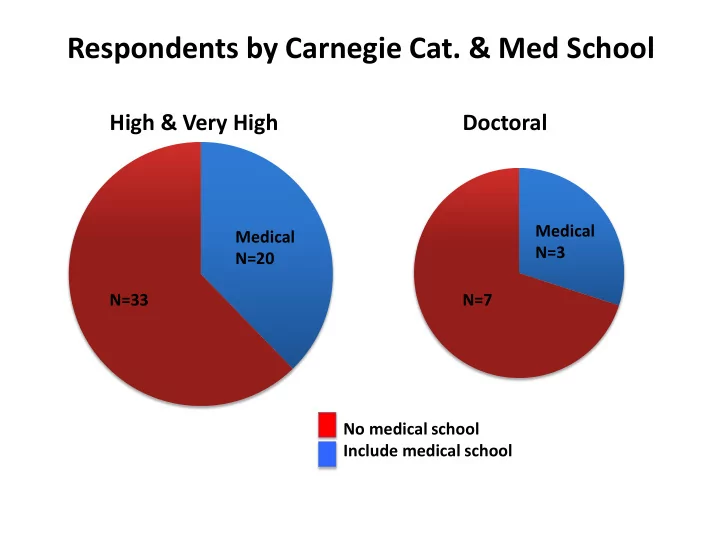
Respondents by Carnegie Cat. & Med School High & Very High Doctoral Medical Medical N=3 N=20 N=33 N=7 No medical school Include medical school Top 10 survey hot topics by school type Top 10 survey hot topics by school type


slide-1
SLIDE 1

Respondents by Carnegie Cat. & Med School

High & Very High Doctoral

N=33 N=7 No medical school Include medical school Medical N=20 Medical N=3
slide-2
SLIDE 2

Top 10 survey hot topics by school type…

slide-3
SLIDE 3

Top 10 survey hot topics by school type…

      

slide-4
SLIDE 4

Fee structures in university core laboratories – Club membership anyone?

Core Laboratory Fee Structures

Subsidized Central Support (F&A) User Fees General Things to consider: [1] Personnel Costs [2] Cost Recovery Approach [3] Operational Model Utah State University Approach [1] Reject the full cost recovery model [2] Personnel support is essential:

  • A. Embrace a faculty director & faculty advisory board
  • B. Commit to a PHD Operator

Role of the RGS Office:

  • Equipment Maintenance
  • Space
  • Director's Salary Stipend (1 month)

Role of Colleges:

  • Personnel Cost Recovery (Operator Salary)

Role of the Faculty User Base

  • New & Additional Equipment (Essential role)
  • Grants to acquire equipment

Role of the User Fee

  • Day to day expenses only (Push to keep low)

USU Goal with Core Laboratory Implementation Microscopy Core (created 2014) [1] Maximize Research Use [2] Motivate faculty to seek more & better equipment [3] Drive fee costs down [4] Encourage expanded grad student access The Club Membership Approach: Each person or laboratory group pays a set annual fee to use the facility. This fee is set at a level expected to recover day to day supply and operations expense beyond central subsidized support.

slide-5
SLIDE 5

F&A Distribution Models

F&A Distribution @ USU

Follow% the% money% …% The$ State$ The$ System$ Campus$ President/Chancellor$ Provost$ Vice$ President$ for$ Research$ 70%$ College$ 30%$ Center$ Department$ Faculty$ $

Use of F&A central funds at USU: 32% - Support for Commercialization facilities (Building Bond Payment and Building O&M) 15% - New faculty startup 14% - Research Support Services 12% - Central Administrative Fees 10% - Core Laboratory Support 08% - Faculty Seed Grants 06% - Graduate & Undergraduate Training 05% - Deans' Program Funds 03% - In-college program support USU F&A Programs Support + E&G (state funds): [1] Sponsored Programs (Personnel) [2] IRB (Software & Personnel) [3] Laboratory Animal Research Centers (Operations) [4] IACUC - Veterinarians (Personnel) [5] Integrity & Compliance (Staff support) [6] EH&S - (Operations support) [7] Research Computing (HPC - now joint with UofU) [8] Undergraduate & Graduate Research - operations [9] Research Development -- OPD, Seed funds, workshops, soft skills training, etc. VPR New Faculty Startup Support — Based upon faculty percent Research appointment: 0-45% R -- yields a variable % match w the college/dept matching the appointment. 45-100% R -- yields a 50% VPR match w the college/dept

slide-6
SLIDE 6

Mandatory Data Curation: USU Approach & Questions

VPR (RGS) Library IT 5%+ of Faculty Google Digital Commons 95%+ of faculty AGENCY RULES USU FACULTY SHARE Nature of the Data: ▪ Grant Project ▪ Legacy Databases What Data? ▪ replicates? ▪ publication related only? ▪ negative data results? ▪ preliminary data? ▪ metadata vs actual data Costs ▪ cost during the grants ▪ cost after the grant ▪ cost to retrieve Forever ▪ define perpetuity? ▪ cost of non-compliance? ▪ case law? Obligations ▪ faculty ▪ institution ▪ sponsor specific ▪ "Dog ate my data"

slide-7
SLIDE 7
slide-8
SLIDE 8

Grantsmanship: USU Stewardship Approach - Skills Development

Training Research Faculty Series (6)

Faculty Grantsmanship Workshop (8hrs) (mandatory w startup$ & Seed Grant$) Faculty Grant Writing Institute (Competitive) Faculty Seed Grants (Preliminary Data) RGS Grant Writing Specialists (Coordinated team across RGS & Colleges) DMP Tool Funding Finder Washington DC Fellows

Graduate Research Training for Students – GRTS Series (6)

Grantsmanship RCR Etc. Soft skills

slide-9
SLIDE 9

External Contracted: www.grantcentral.com

  • TAMU – Center (faculty interest)
  • UF – College ($50M to $100M) in 6yrs
  • USU – University wide – Record $ in 3yrs

Internal Experts Partial Central F&A funded Specialist are Permanent Employees (1/college + central)

slide-10
SLIDE 10

Dollars from State Legislature (Today’s Message: More jobs!)

Funding

The Core Case Industry Voice Legislative Relationships

FY2015– Graduate Training – Research Universities

$0(1time) $1.6M*(R)

FY2014– Graduate Training – X-STEM

$500K(1time) $500K(R)

FY2013– Graduate Training – High Tech STEM Workfore

$3M (1time) $0 (R) *Funding Plan:

New Faculty Lines More college-based assistantships

Program Approach: USU Target: Art-STEM Fellow = Legislative STEM Break-through!

slide-11
SLIDE 11

USU Electronic Sponsored Programs Software

Open Contracts & Grants = $500+M Total Annual Research Support = $220M Annual Research Expenditures = $165M

Kuali Company (Cloud Implementation) Kuali Coeus

  • Previously using PARC
  • - an old custom built platform
  • Currently in a transition year
  • - moving old data to Kuali (5yrs data minimal)
  • - training SPO to Kuali
  • - training Colleges/Depts/Faculty to Kuali
  • - Go live date: Fall 2015
  • Fall 2016 Expect to complete
  • - Campus full transfer
  • Full Cloud implementation
  • All hosting is 100% off site
slide-12
SLIDE 12

Tech Transfer Issues & Worries…

  • Patent Trolls Legislation & Cost to patent & Cash Flow
  • Implementing a new Research Foundation model
  • Trustees & politicians have unrealistic expectations
  • Expectations of reach-through IP Terms
  • Dealing with pros & cons of corporate partners
  • Corporate Partners: Max revenue vs future R&D Support
  • What IP s worth supporting (ROI)
  • IP Ownership and the issue of indemnification
  • PI Conflict of commitment - Institutional Conflict of interest
  • Royalty distribution models
  • Pressure to view a for the public good vs revenue
  • Limited investment capital available to some.
  • Balancing RISK vs REWARD
  • Figuring our IP ownership in complex senarios
  • How to engage faculty culture to support this
  • Getting faculty to open up and declare financial COI
  • Implications of first to file rules & Univ Publish or Perish model
  • Litigation over IP infringment
  • The cost …
slide-13
SLIDE 13

Need ideas on the following best practices …

  • Who’s doing what about Patent Trolls Legislation
  • Approaches to licensing to Startups
  • Streamlined, fixed fee legal arrangements
  • NERFs and reach through IP terms
  • Streamlining decisions making processes
  • Evaluation/measuring ROI
  • Allowing private sector to own university IP
  • Approaches to Managing FCOI and ICOI
  • Is it research OR tech transfer?
  • Who has a good system for building positive faculty involvement
  • Does anyone do Master IP agreements with outside entities?
  • Giving IP away as a university policy – any good ways to do this?
  • Cradle to grave partnerships with industry?
  • Effective communication between Tech Trans & Compliance
  • Staffing levels per research expenditure – college vs central staffing
slide-14
SLIDE 14

Big need facing my university ….

  • none
  • Funds to cover patent costs
  • Good model to estimate ROI
  • Managing required resources
  • Need for good legal guidance
  • How to educate my faculty to get engage
  • Need to keep some perspective of the typical 10yr horizon! No GatorAid
  • Better ways to help startups succeed
  • Figuring out space allocation to this effort.
  • Sources of bridge funds, proof of concept funds, angel funds
  • Creative approaches to undergraduate IP creation
  • Cost to implement staffing to get Tech Transfer going.
  • Understanding of long-term need for fundamental and applied research
  • For health care science, support for translational research.
  • Changing inventor share to a proportion of net royalties (after expenses)
  • Getting faculty to open up and declare financial COI
  • Greater access to funding to get technologies off the ground
  • The cost …
slide-15
SLIDE 15

V-8

License Secure resources, talent & funding

2-Stroke

What is it? What is the Opportunity?

4-Cylinder

Technical Validation Product-Market Fit

Invention Disclosure License Achieve Milestones

slide-16
SLIDE 16

Top 10 survey hot topics by school type…