Oddar Meanchey 4 Kampong Thom 2 Svay Rieng 2 Had legal Of - - PowerPoint PPT Presentation

oddar meanchey 4
SMART_READER_LITE
LIVE PREVIEW

Oddar Meanchey 4 Kampong Thom 2 Svay Rieng 2 Had legal Of - - PowerPoint PPT Presentation

60 50 40 Percent 30 54% 44% 20 10 Siem Reap 19 0 Female Male Bantaey Meanchey 17 Gender Prey Veng 14 Oddar Meanchey 4 Kampong Thom 2 Svay Rieng 2 Had legal Of respondents Of respondents documents to returned from Takeo


slide-1
SLIDE 1

Of respondents returned from Thailand Had legal documents to work and live in destination country Of respondents are under the age of 40

54% 44% 10 20 30 40 50 60

Female Male

Percent Gender
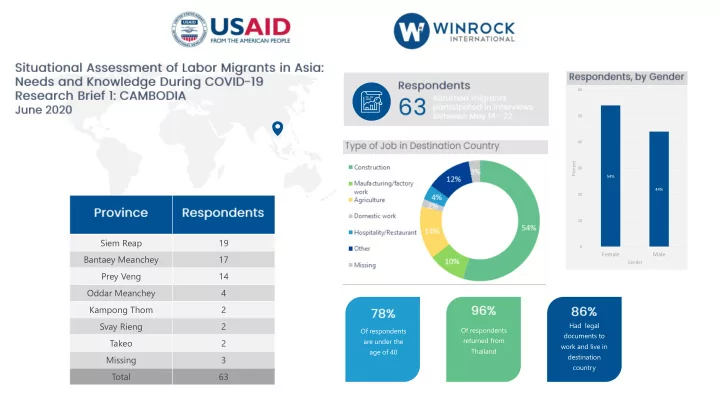
Siem Reap 19 Bantaey Meanchey 17 Prey Veng 14 Oddar Meanchey 4 Kampong Thom 2 Svay Rieng 2 Takeo 2 Missing 3 Total 63

slide-2
SLIDE 2

Of respondents do not have enough food to eat every day Of respondents do not have enough income to support themselves Have not received any support since returning to Cambodia

Of respondents had not been sick since returning to Cambodia

Said returned migrants are being treated worse or much worse since returning. Female respondents said they did not face an increased risk of violence. Respondents who had been sick were able to access medical care.

0% 10% 20% 30% 40% 50% 60% 70%

slide-3
SLIDE 3

Of respondents are currently employed in Cambodia.

Women planning to re-migrate Men planning to re-migrate 23 8

Of respondents are planning to re-migrate for work; half of which plan to return to Thailand.

17 13 6 2

0% 10% 20% 30% 40% 50% 60% 70%

Return to previous job Friends or family Recruitment agency I don't know Broker Online job website Sector Responses Construction 4 Manufacturing (other factory work) 4 Other 4 Agriculture 3

slide-4
SLIDE 4

9.6 40.3 41.9 8.1

5 10 15 20 25 30 35 40 45

I don't know 1-2 ways 3-4 ways 5-6 ways

Percent Number of protection behaviors

49% 63% 20% 20% 6% 1% News/website Government Family/friends Social media NGO/INGO Employer

Multiple responses could be given. Government includes village and district chiefs, and health centers.

0% 20% 40% 60% 80% 100%

Wash hands Wear face mask or cover Social distancing Don't join large groups Stay away from sick people Other I don't know Source (multi-response) Responses

Of respondents received prevention information on Covid-19

slide-5
SLIDE 5

A five-year (2016-2021) program, the USAID Asia Counter Trafficking in Persons (CTIP) project is a regional activity that focuses on transnational and regional challenges to combat human trafficking. The program aims to reduce the trafficking of persons in Asia through a coordinated and consolidated action by governments, civil society and business that will foster cross-border cooperation, develop opportunities for private-sector leadership and improve the quality of data associated with human trafficking. Read the full report here with detailed methodology.

Returned female migrants are finding employment at a much lower rate than men, which may be reflective of the sample including a high number of men with prior construction industry jobs - skills that are in high demand in Cambodia. Therefore, ensuring returned migrant women are included in job placement and skill building activities is highly recommended. The number of women planning to re-migrate is nearly three times more than

  • men. The high rates of

unemployment among female returned migrants is likely a factor in higher rates of women reporting plans to re-

  • migrate. Messages and

information on re-migration should closely consider the needs and risks of women female migrants as this group may be the first – and largest – to migrate for work, when migration is again possible.

The majority of respondents said they were planning to re-migrate to Thailand, and half said they would return to their previous job in the destination country. As long as migrants remain in their home countries, it will be valuable to provide information

  • n employer responsibilities in

destination countries. This information could include: fees employers are legally responsible to pay when they make the journey back, hygienic/health protections that employers must be putting in place, and other worker protection information.

Two-thirds of respondents said they had not received any support since returning despite public government announcements to the

  • contrary. The Royal

Government of Cambodia should continue assisting this vulnerable population through emergency cash and food assistance. International

  • rganizations and NGOs

should consider providing the same type of support with available resources.

Most respondents knew several ways to protect themselves against COVID-19 and have received prevention information, yet a large percentage (over half) said they need additional information. International organizations, NGOs and provincial governments should continue providing protection information in clear, easy to understand graphics or audio

  • messaging. Providing updated

information on travel restrictions (particularly between Cambodia and Thailand) will be extremely valuable as migrants prepare to navigate a return journey. Providing information to migrants who remain in Thailand is an urgent need. Specifically, domestic workers are facing increased vulnerabilities as qualitative interviews found several are working excessive

  • vertime without

compensation, while others are worried about being laid off and unable to return home. Migrants interviewed in Thailand said they often access information through Facebook and YouTube. Particularly, The Cambodia Embassy in Thailand Facebook page is followed by migrants interviewed. These channels should be used by both the Royal Government of Cambodia and Royal Thai Government, as well as migrant assistance organizations, to provide targeted information to this vulnerable group.