Resegregation in the Bay Area @alexschafran alexschafran.com - - PowerPoint PPT Presentation

resegregation in the bay area
SMART_READER_LITE
LIVE PREVIEW

Resegregation in the Bay Area @alexschafran alexschafran.com - - PowerPoint PPT Presentation

Finding Common Purpose: Confronting Regional Alex Schafran Resegregation in the Bay Area @alexschafran alexschafran.com Understanding Resegregation 1. Really segregation 2.0 A new kind of segregation Not your grandparents


slide-1
SLIDE 1

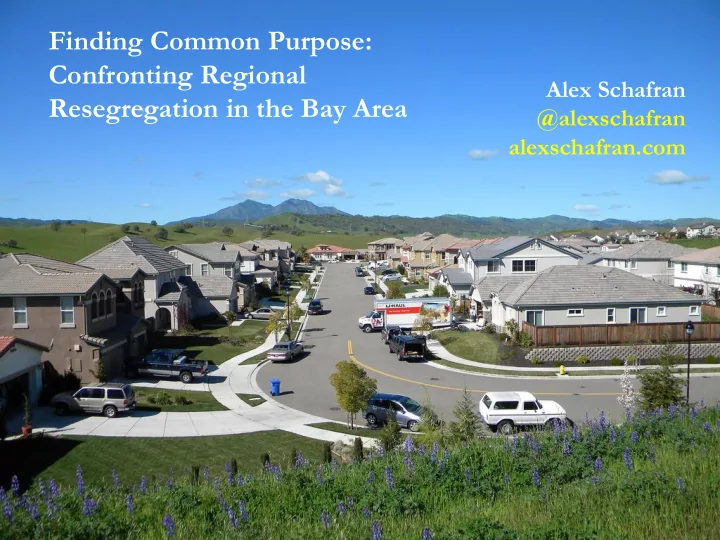
Finding Common Purpose: Confronting Regional Resegregation in the Bay Area

Alex Schafran @alexschafran alexschafran.com

slide-2
SLIDE 2

Understanding Resegregation

1. Really segregation 2.0

  • A new kind of segregation
  • Not your grandparents segregation, but it is still

segregation

  • Being trapped v. moving too often and too far

2. Both kinds of segregation still exist, and operate

  • together. One does not replace the other
  • 3. Does not imply segregation  desegregation 

resegregation

  • 4. Integration and (re)segregation are not opposites.

Antioch is locally integrated, but regionally segregated Why not just talk of inequality, housing crises, etc.? The answer is race.

slide-3
SLIDE 3
  • 1. How we talk about this

matters.

slide-4
SLIDE 4
slide-5
SLIDE 5
  • 2. We need to recognize the new geography
  • f the Northern California, and not plan for

the region that was, or that might have been

slide-6
SLIDE 6

NH Whites NH Blacks Hispanics

Source: NCDB at 2000 tracks via UC Data

Postwar ghettoized segregation: Bay Area 1970

slide-7
SLIDE 7

25,000 50,000 75,000 100,000 125,000 1970 1972 1974 1976 1978 1980 1982 1984 1986 1988 1990 1992 1994 1996 1998 2000 2002 2004 2006 2008

African Americans in San Francisco and San Joaquin Counties, 1970-

  • 2008. Source: Rand CA via US Census

San Francisco County San Joaquin County

Mobile Segregation?

slide-8
SLIDE 8

Source: US Census SF 1, 1990, 2010

Places with:

  • 50% growth
  • 5000 new residents
  • 1990-2010
slide-9
SLIDE 9
slide-10
SLIDE 10
slide-11
SLIDE 11
  • 3. This means transportation matters as

much as housing. So does higher education. Large scale spatial planning with a 21st century progressive ethics?

slide-12
SLIDE 12
slide-13
SLIDE 13
slide-14
SLIDE 14
slide-15
SLIDE 15
  • BART to

Vallejo and Brentwood

  • ACE, really?

Trains?

  • I-80 corridor
  • Ferries
  • New Towns?

Gilroy, Travis, Mountain House/Tracy/ Stockton

  • Tech?
  • Concord NWS

w/CSU, Stockton State

slide-16
SLIDE 16
  • 4. Our number one collective priority

must be making more things possible

slide-17
SLIDE 17

This means prioritizing politics, not policy

slide-18
SLIDE 18

SB50 must be less divisive than SB 827. More CASA-style politics (even that can get better).

slide-19
SLIDE 19

UBI in Stockton. As much about the politics of innovation and reframing the discourse around Stockton than whether the policy works. This makes sense.

slide-20
SLIDE 20
  • 5. Protection  Preservation  Production
slide-21
SLIDE 21
slide-22
SLIDE 22

How to meet the needs of more people in California, while at the same time respecting fundamental limits

  • n our tax dollars and

natural resources is one of the inexorable challenges we face. This Urban Strategy begins to meet that challenge. It gives focus to thousands of individual decisions which will affect California' s cities and suburbs by directing state and local governments toward a common purpose: the revitalization of existing cities and the sound management of new urban development.

  • 6. Sacramento, anyone?
slide-23
SLIDE 23
slide-24
SLIDE 24

A human settlements strategy? A green new fiscal deal?

slide-25
SLIDE 25
  • 7. Restorative Justice and a new

social/spatial contract