
Chapter 16 Linear Programming
CS 573: Algorithms, Fall 2014 October 21, 2014
16.1 Linear Programming 16.2 Introduction and Motivation
16.2.1 Economic planning
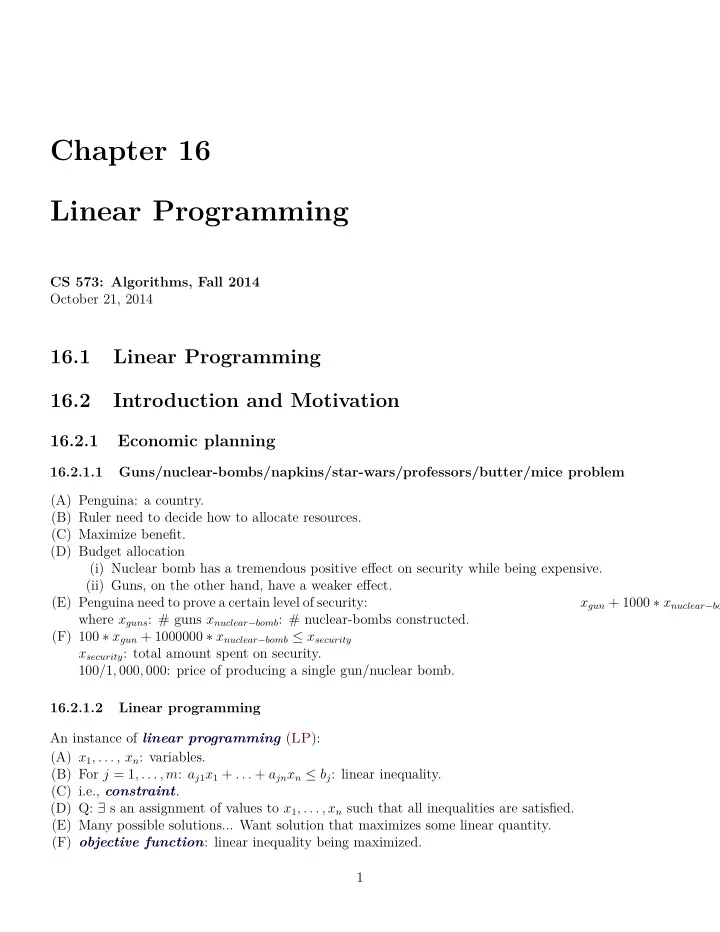
16.2.1.1 Guns/nuclear-bombs/napkins/star-wars/professors/butter/mice problem (A) Penguina: a country. (B) Ruler need to decide how to allocate resources. (C) Maximize benefit. (D) Budget allocation (i) Nuclear bomb has a tremendous positive effect on security while being expensive. (ii) Guns, on the other hand, have a weaker effect. (E) Penguina need to prove a certain level of security: xgun + 1000 ∗ xnuclear−bomb where xguns: # guns xnuclear−bomb: # nuclear-bombs constructed. (F) 100 ∗ xgun + 1000000 ∗ xnuclear−bomb ≤ xsecurity xsecurity: total amount spent on security. 100/1, 000, 000: price of producing a single gun/nuclear bomb. 16.2.1.2 Linear programming An instance of linear programming (LP): (A) x1, . . . , xn: variables. (B) For j = 1, . . . , m: aj1x1 + . . . + ajnxn ≤ bj: linear inequality. (C) i.e., constraint. (D) Q: ∃ s an assignment of values to x1, . . . , xn such that all inequalities are satisfied. (E) Many possible solutions... Want solution that maximizes some linear quantity. (F) objective function: linear inequality being maximized. 1