Research Topic Groundwater flows system at Cu Lao Dung Island, Soc - - PowerPoint PPT Presentation

research topic
SMART_READER_LITE
LIVE PREVIEW

Research Topic Groundwater flows system at Cu Lao Dung Island, Soc - - PowerPoint PPT Presentation

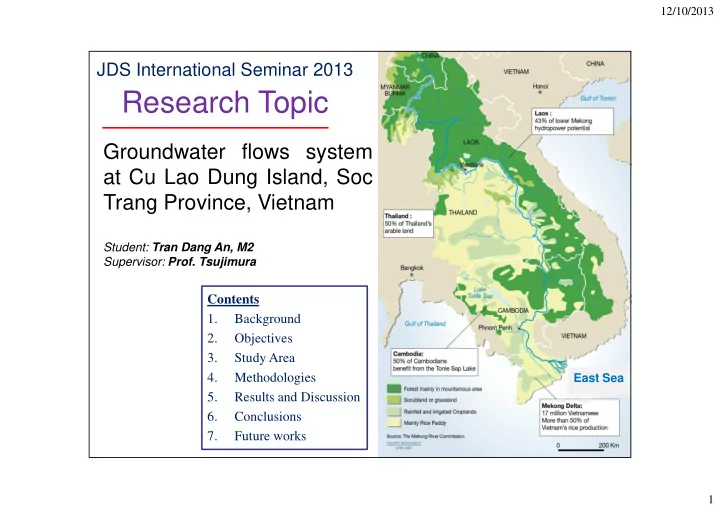
12/10/2013 JDS International Seminar 2013 Research Topic Groundwater flows system at Cu Lao Dung Island, Soc Trang Province, Vietnam Student: Tran Dang An, M2 Supervisor: Prof. Tsujimura Contents 1. Background 2. Objectives 3. Study Area


slide-1
SLIDE 1

12/10/2013 1

Research Topic

Groundwater flows system at Cu Lao Dung Island, Soc Trang Province, Vietnam

Student: Tran Dang An, M2

JDS International Seminar 2013

Supervisor: Prof. Tsujimura

Contents 1. Background 2. Objectives 3. Study Area 4. Methodologies 5. Results and Discussion 6. Conclusions 7. Future works

East Sea

slide-2
SLIDE 2

12/10/2013 2

Introduction: Mekong Delta (MD)

Mekong river Basin: The biggest river and the richest biodiversities in the world (WWF, 2012). Mekong Delta:

  • Very important role for food security,

accounting for over 50% national food production of Vietnam (Anh et al., 2010)

  • Many issues due to hydropower plants
  • Many issues due to hydropower plants

(Tyson R. Roberts, 2000; R. Edward Grumbine et. at, 2011; Jennifer Sills, 2012; Claudia Kuenzer et. Al, 2012). 1.Social issues: Serious impacts on livelihoods (18 mil.) 2.Environmental issues: Lost biodiversities; water contaminations, seawater intrusion => Water scarcity

East Sea

Mekong Delta

Fig.1.1 Mekong Basin Hydropower plant s (R. Edward Grumbine et. al, 2011)

slide-3
SLIDE 3

12/10/2013 3

Introduction: Current problems in MD

  • 1. Surface water and soil pollution:
  • POPs: DDT, PCBs affected seriously on Mekong river

and its aquatic environments (Carvalho et al., 2008; Ikemoto et al., 2008; Minh et al., 2007; Sudaryanto et al., 2011; Toan et al., 2013)

  • Heavy mental and chemical fertilized: Pb, Mo, Rb
  • Heavy mental and chemical fertilized: Pb, Mo, Rb

and As influenced seriously on aquatic environment, particularly fish production (Yamaguchi et al., 2007). Chemical fertilizers also discharged into agricultural soil, river water and sediments (Toan et al., 2013).

slide-4
SLIDE 4

12/10/2013 4

Introduction: Previous researchs

  • 2. Groundwater contamination:
  • Urban areas: Holocene aquifer is heavily polluted with

microbial and inorganic pollutants and considered unfit for drinking water purposes (Tuan, 2004; Danh, 2008).

  • Arsenic pollution causing severe health problems (S.

Fendorf et al.,2010; Erban et.al, 2013). Fendorf et al.,2010; Erban et.al, 2013).

  • 3. Seawater intrusion:
  • Serious issues in Mekong delta (Ho et al., 1991;

Buschmann et al., 2007).

slide-5
SLIDE 5

12/10/2013 5

River water Sea water

Ho et al (1991)

The questions :

Objectives

Severe pollution Serious seawater intrusion

Chemical pollution Arsenic contamination Over groundwater exploitation (Inappropriate management )

Shallow Groundwater

? It is necessary to know Groundwater flow system in coastal aquifers (Hydro-geochemical processes)

Deep Groundwater

?

To answer :

(Inappropriate management ) Seawater intrusion

slide-6
SLIDE 6

12/10/2013 6

Study site: Cu Lao Dung Island

Groundwater 80%

Fig.4. Location of Water Samples in CLD Island

80%

Private Wells (80-140m)

slide-7
SLIDE 7

12/10/2013 7

Study site: Soc Trang province

Groundwater: 54 samples River and canal water : 19 samples

Fig.5.4. Samples locations of water samples at Soc Trang Province, Vietnam

slide-8
SLIDE 8

12/10/2013 8

Methodology

Approaches Field survey Lab Analysis

Na, K, Mg, Ca,SiO2 Cl, HCO3, NO3, SO4 GWL, DO, ORP, T0C EC (Salinity)

I N T

Cl, HCO3, NO3, SO4 Mixing processes Ion exchanges Stable Isotopes: (δO18 and δD) Original water Recharged areas EC (Salinity) Water Flow path Seawater effects Taking water samples

Groundwater flow system, Interaction process

T E R P R E T

54 Groundwater 19 River water

slide-9
SLIDE 9

12/10/2013 9

Results and Discussion

Water types and relationship among water sources

I II IV

Legend I - Calcium Magnesium Sulphate Chloride; II –Sodium Chloride Sulphate III–Sodium Bicarbonate; IV –Calcium Magnesium Bicarbonate A–Mixed Zone; B –Magnesium; C –Sodium Potassium; D –Calcium E–Mixed Zone; F –Sulphate; G –Chloride; H -Bicarbonate

G2: Mixing with saline water T10 MX5 T16 GW1.19 A D B C E H F G III G4: Mixed water? G1: Freshwater Hot water G2: Mixing with saline water G3 Freshening aquifer ?

Fig.5.1. Piper diagram of water samples at Soc Trang Province, August . 2013.

slide-10
SLIDE 10

12/10/2013 10

Result and Discussion

T7-S T8-S T9-S T11-S T12-S

1.0 10.0 100.0

Dissolution of Dolomite

a/Mg(mmol/

Effects of Silicate Mineral (Hot rocks dissolution)

Ca2+/ Mg2+> 2 Ca2+/ Mg2+ =1

MX5

T10, CAI >0 T16

Seawater intrusion?

T0C > 400C, EC > 1500 µS/cm

0.0 0.1 0.01 0.1 1 10 100 1000 GW-CLD S-GW-ST D-GW-ST RW-CLD RW-ST

Cl (mmol/L) Ca/M L)

Precipitation of Ca2+ as CaCO3

Ca2+/ Mg2+< 1 GW1.19, CAI > 0 Most of samples: CAI <0, Mg, Ca of water exchanged with Na, K of Rock S-VC1, S-VC2, CTD1, T10,GW1.19: CAI >0, Na, K of water exchanged with Mg, Ca of Rocks Seawater intrusion ?

Fig.5.2. Ratio of Ca/Mg versus Cl (mmol/L)

slide-11
SLIDE 11

12/10/2013 11

Results and Discussion

T10N T9N T12N T14 T16 RW1.5 CW1.3 S-VC1 S-VC2 1.0 10.0 100.0

Groundwater at qp23 3

  • +CO3

2-(mmol/L)

T8-S T9-S

>6.5: strongly affected slightly and moderately

Whether seawater intrusion occurred or not?

T14 0.0 0.1 0.01 0.1 1 10 100 1000

Groundwater at qp23 auifer in CLD Groundwater at qp23 aquifer in ST Deep groundwater at n13 aquifer in ST Groundwater at qp1 aquifer in ST River water in CLD River water in ST

Cl- (mmol/L) Cl-/HCO3

T9-S

<0.5: Not affected

GW1.19

Fig.5.3. The Cl-/HCO3- +CO32-versus Cl-

slide-12
SLIDE 12

12/10/2013 12

Results and Discussion

Fig.5.4. Groundwater flow paths at Soc Trang Province, August, 2013.

slide-13
SLIDE 13

12/10/2013 13

Result and Discussion

400-500m 80-130m

Seawater intrusion here?

CDT1-T9N

400-500m

Fig.5.5. Spatial distribution of Hexa diagram and δO18 of water samples at Soc Trang Province, August, 2013.

slide-14
SLIDE 14

12/10/2013 14

Results and Discussion

VC1.3 T5 T12N T14 SVC1 SVC2

δD = 8δO18 + 10

  • qp23CLD

r mil.) δO18 (per mil.)

MX2 RW1.5 T9N CW1.3 SMX1 CTD1

δD = 7.35δO18 + 6.11

  • qp23ST

qp1ST n12n13 ST River Water CLD River water ST Linear (qp23CLD) Linear (MWL) Linear (Bangkok MWL) Linear (qp23ST)

δD (per m

Fig.5.6 .Groundwater flow paths at Soc Trang Province, August, 2013.

slide-15
SLIDE 15

12/10/2013 15

Results and Discussion

Fig.5.7. Hydro-geological cross section, Soc Trang Province, Vietnam.

slide-16
SLIDE 16

12/10/2013 16

Results and Discussion

Soc Trang City

Fig.5.8. Profile Hexa diagram and of water samples following depth of wells in Soc Trang, August, 2013 Cross section B-B

slide-17
SLIDE 17

12/10/2013 17

Results and Discussion

Fig.5.9. Profile Hexa diagram and of water samples following depth of wells in Soc Trang, August, 2013 Cross section F-F

slide-18
SLIDE 18

12/10/2013 18

Results and Discussion

GW1.19 T9N T10 T12N T14 T15 T16 SVC1 SVC2 SMX1 CDT1 5.00 4.00 3.00 1.00 10.00 100.00 1000.00 10000.00

Cl (mg/L) SMOW

Seawater intrusion

?

Either seawater intrusion or mineral dissolution or both?

CW1.3 RW1.5 9.00 8.00 7.00 6.00

GWCLD qp1ST qp23ST Deep GW ST RWCLD RWST

δO18 ‰ SM

Seawater intrusion

Rain water dilution

?

? Same recharged sources

Fig.5.10. Chloride concentration versus δO18

slide-19
SLIDE 19

12/10/2013 19

Results and Discussion

T5 T12N T14 S-VC1 S-VC2

  • 4.00
  • 3.00
  • 2.00
  • 1.00

0.00

  • 20.00
  • 15.00
  • 10.00
  • 5.00

0.00 5.00 10.00

Groundwater at qp23 aquifer Cu Lao Dung Island Groundwater at qp23 aquifer , Soc Trang Groundwater at qp1 Aquifer, Soc Trang Deep groundwater at n13 aquifer, Soc Trang River water at Cu Lao Dung Island River water at Soc TrangT

CAI 1 = (Cl- - [Na+ + K+] )/ Cl- SMOW

Seawater intrusion? ? ? ? Mineral dissolution Mineral dissolution T6 T10 T12N T16 T15 RW1.5 CW1.3 S-MX1 CTD1

  • 9.00
  • 8.00
  • 7.00
  • 6.00
  • 5.00
  • 4.00

δO18 ‰ S

Mineral materials dilution Mineral dissolution

Fig.5.11. CAI 1 index versus δO18

slide-20
SLIDE 20

12/10/2013 20

Results and Discussion

T14

  • 3.00
  • 2.00
  • 1.00

0.00

  • 20 -19 -18 -17 -16 -15 -14 -13 -12 -11 -10 -9
  • 8
  • 7
  • 6
  • 5
  • 4
  • 3
  • 2
  • 1

1 2 3 4 5 Groundwater at qp23 aquifer in Cu Lao Dung Island Groundwater qp23 aquỉfer in Soc Trang Groundwater at qp1 Aquifer in Soc Trang Deep Groundwater at n13 aquifer in Soc Trang River water at Cu Lao Dung Island River water at Soc Trang

∆Cl = CCl sample - CCl mix (meq/L) MOW

Seawater intrusion >> Mineral dissolution Mineral dissolution >> Seawater intrusion trend

VC1.3 T5 T6 T9N T10 T12N T16 T15 RW1.5 CW1.3 CTD1

  • 9.00
  • 8.00
  • 7.00
  • 6.00
  • 5.00
  • 4.00

δO18 ‰ SMO

<< Mineral dissolution <<< Mineral materials dilution

Fig.5.12. Chloride concentration versus δO18

slide-21
SLIDE 21

12/10/2013 21

Conclusions

1- Water types: a. Groundwater, 3 group: qp23 Aquifer: Ca-Mg(CO3)2, qp1 and n13 Aquifers: Na-HCO3, most of samples at n13 aquifer is hot water

  • b. River and canal water:
  • Na-Cl, Ca-Mg(CO3)2
  • 2. Interaction between Surface water and Groundwater:

River water (CTD1) and Groundwater (T9N) mixing together Groundwater: some parts of ST may be affected by seawater

slide-22
SLIDE 22

12/10/2013 22

Conclusions

  • 3. Recharged sources:

a. Groundwater at qp1 and n13 aquifers

  • Have same original water sources
  • Mineral

dissolution process is dominantly occurred at deep Groundwater b. Groundwater at qp23 aquifer

  • Have same original water sources
  • Two hydro-geological processes:

(1) Mineral materials dissolution (2) Strongly dissolution saline soils and seawater intrusion maybe starting at groundwater sample T14 => Due to intensive pumping.

slide-23
SLIDE 23

12/10/2013 23

Future work

  • Data processing and interpreting
  • Writing master thesis.
slide-24
SLIDE 24

12/10/2013 24

References

  • Anh, N. N. (2010). Integrated plan for water resources development in Mekong Delta adaptation to climate change an sea level

rising.

  • Brennan, G. a. (2000). "Resource profile subproject: Summary Report.’ An evaluation of the sustainability of the farming systems in

the brackish water region of the Mekong Delta. ACIAR Project, Canberra.".

  • DONRE: Department of Natural Resources and Environment.
  • Eddie.B (2010). Surface water-groundwater interactions in the Rocky River catchment, Kangaroo Island, South Australia.
  • IPCC,2007: The Fourth Assessment Report of the Intergovernmental Panel on Climate Change, 2007.
  • Johanna.B, M. B., Caroline Stengel, Lenny Winkel, Mickey L. Sampsonb, Pham Thi Kim Trang, Pham Hung Viet. (2007).

"Contamination of drinking water resources in the Mekong delta floodplains:Arsenic and other trace metals pose serious health risks to population."

  • Shah, T. (2007). Groundwater: a global assessment of scale and significance.
  • UN-Water (2010). Water in a changing World. Netherland, , UNESCO 349.
  • Vrba, J. (2002). The impact of aquifer intensive use on groundwater quality, . Intensive Use of Groundwater: Challenges and

Opportunities R. L. E. Custodio. LISSE A.A. BALKEMA.

  • World Water Assessment Programme (2009), The United Nations World Water Development Report 3: Water in a Changing
  • World Water Assessment Programme (2009), The United Nations World Water Development Report 3: Water in a Changing
  • World. Paris, UNESCO and London, Earthscan.
  • Kennett, Douglas J.; Winterhalder, Bruce (2006). Behavioral ecology and the transition to agriculture. University of California Press.
  • pp. 121–. ISBN 978-0-520-24647-8. Retrieved 27 December 2010.R.
  • Edward Grumbine ; Jianchu Xu (2011). Mekong Hydropower Development. Policy forum: Environment and Development.
  • Tyson R. Roberts (2000). Downstream ecological implications of China's Lancang Hydropower and Mekong Navigation project .
  • Claudia Kuenzer; Ian Campbell; Marthe Roch; Patrick Leinenkugel; Vo Quoc Tuan; Stefan Dech (2013). Understanding the impact
  • f hydropower developments in the context of upstream–downstream relations in the Mekong river basin. Sustain Sci (2013)

8:565–584, DOI 10.1007/s11625-012-0195-z.

  • IUCN, 2011. Groundwater in the Mekong Delta.
  • Klaus Schmitt , 2010.Effective Mangrove Conservation through Co-management in the Mekong Delta, Viet Nam. Proceedings of

the National Workshop on Co-management Concept and Practice in Viet Nam Soc Trang, 17 – 19 March 2010 .

  • Agusa, T. et al., 2006. Contamination by arsenic and other trace elements in tube-well water and its risk assessment to humans in

Hanoi, Vietnam. Environmental Pollution, 139(1): 95-106.

  • Benner, S.G. et al., 2008. Groundwater flow in an arsenic-contaminated aquifer, Mekong Delta, Cambodia. Applied Geochemistry,

23(11): 3072-3087.

slide-25
SLIDE 25

12/10/2013 25

References

  • Berg, M. et al., 2007. Magnitude of arsenic pollution in the Mekong and Red River Deltas — Cambodia and Vietnam. Science of

The Total Environment, 372(2–3): 413-425.

  • Jennifer Sills (2012). Dam Threatens Mekong Ecology. SCIENCE VOL 338 21 DECEMBER 2012.
  • Mira Ka¨ko¨nen . Mekong Delta at the Crossroads: More Controlor Adaptation?. Ambio Vol. 37, No. 3, May 2008
  • Buschmann, J., Berg, M., 2009. Impact of sulfate reduction on the scale of arsenic contamination in groundwater of the Mekong,

Bengal and Red River deltas. Applied Geochemistry, 24(7): 1278-1286.

  • Buschmann, J. et al., 2008. Contamination of drinking water resources in the Mekong delta floodplains: Arsenic and other trace

metals pose serious health risks to population. Environment International, 34(6): 756-764.

  • Carvalho, F.P. et al., 2008. Agrochemical and polychlorobyphenyl (PCB) residues in the Mekong River delta, Vietnam. Marine

Pollution Bulletin, 56(8): 1476-1485.

  • Eiche, E. et al., 2008. Geochemical processes underlying a sharp contrast in groundwater arsenic concentrations in a village on

the Red River delta, Vietnam. Applied Geochemistry, 23(11): 3143-3154.

  • Frank Wagner , V.B.T., and Fabrice G. Renaud Groundwater Resources in the Mekong Delta: Availability, Utilization and

Risks In: Fabrice G. Renaud, C.K. (Ed.), The Mekong Delta System: Interdisciplinary Analyses of a River Delta. Springer, Risks In: Fabrice G. Renaud, C.K. (Ed.), The Mekong Delta System: Interdisciplinary Analyses of a River Delta. Springer, Dordrecht, Heidelberg, New York, London, pp. 201-220.

  • Hoang, T.H., Bang, S., Kim, K.-W., Nguyen, M.H., Dang, D.M., 2010. Arsenic in groundwater and sediment in the Mekong River

delta, Vietnam. Environmental Pollution, 158(8): 2648-2658.

  • Ikemoto, T. et al., 2008. Analysis of biomagnification of persistent organic pollutants in the aquatic food web of the Mekong Delta,

South Vietnam using stable carbon and nitrogen isotopes. Chemosphere, 72(1): 104-114.

  • Kazama, S., Hagiwara, T., Ranjan, P., Sawamoto, M., 2007. Evaluation of groundwater resources in wide inundation areas of the

Mekong River basin. Journal of Hydrology, 340(3–4): 233-243.

  • Kite, G., 2001. Modelling the Mekong: hydrological simulation for environmental impact studies. Journal of Hydrology, 253(1–4):

1-13.

  • Kocar, B.D. et al., 2008. Integrated biogeochemical and hydrologic processes driving arsenic release from shallow sediments to

groundwaters of the Mekong delta. Applied Geochemistry, 23(11): 3059-3071.

  • Laura E. Erban, S.M.G., Howard A. Zebker, and Scott Fendorf, 2013. Release of arsenic to deep groundwater in the Mekong

Delta, Vietnam, linked to pumping-induced land subsidence. PNAS, 110 ((34)).

  • Le, T.V.H., Nguyen, H.N., Wolanski, E., Tran, T.C., Haruyama, S., 2007. The combined impact on the flooding in Vietnam's

Mekong River delta of local man-made structures, sea level rise, and dams upstream in the river catchment. Estuarine, Coastal and Shelf Science, 71(1–2): 110-116.

  • Lenny H. E. Winkel, P.T.K.T., Vi Mai Lan, Caroline Stengel, Manouchehr Amini, Nguyen Thi Ha, Pham Hung Viet, and Michael

Berg, 2011. Arsenic pollution of groundwater in Vietnam exacerbated by deep aquifer exploitation for more than a century. PNAS, 108(4): 1246–1251.
slide-26
SLIDE 26

12/10/2013 26

References

  • Minh, N.H. et al., 2007. Pollution sources and occurrences of selected persistent organic pollutants (POPs) in sediments of the

Mekong River delta, South Vietnam. Chemosphere, 67(9): 1794-1801.

  • Nguyen, T.T., Tsujimura, M., Naoaki, S., 2013. Groundwater Flow Modeling: Considering Water use in Tay Island, Dong Thap

Province, Southwest Vietnam. Procedia Environmental Sciences, 17(0): 211-220.

  • Sneddon, C., Fox, C., 2007. Power, Development, and Institutional Change: Participatory Governance in the Lower Mekong
  • Basin. World Development, 35(12): 2161-2181.
  • Sudaryanto, A., Isobe, T., Takahashi, S., Tanabe, S., 2011. Assessment of persistent organic pollutants in sediments from Lower

Mekong River Basin. Chemosphere, 82(5): 679-686.

  • Toan, P.V., Sebesvari, Z., Bläsing, M., Rosendahl, I., Renaud, F.G., 2013. Pesticide management and their residues in sediments

and surface and drinking water in the Mekong Delta, Vietnam. Science of The Total Environment, 452–453(0): 28-39.

  • Yamaguchi, S. et al., 2007. Effects of lead, molybdenum, rubidium, arsenic and organochlorines on spermatogenesis in fish:

Monitoring at Mekong Delta area and in vitro experiment. Aquatic Toxicology, 83(1): 43-51.

  • Koussis, A.D., Mazi, K., Destouni, G., 2012. Analytical single-potential, sharp-interface solutions for regional seawater intrusion in

sloping unconfined coastal aquifers, with pumping and recharge. Journal of Hydrology, 416–417(0): 1-11.

  • Masciopinto, C., 2013. Management of aquifer recharge in Lebanon by removing seawater intrusion from coastal aquifers.

Journal of Environmental Management, 130(0): 306-312.

  • Melloul, A.J., Goldenberg, L.C., 1997. Monitoring of Seawater Intrusion in Coastal Aquifers: Basics and Local Concerns. Journal
  • f Environmental Management, 51(1): 73-86.
  • Narayan, K.A., Schleeberger, C., Bristow, K.L., 2007. Modelling seawater intrusion in the Burdekin Delta Irrigation Area, North

Queensland, Australia. Agricultural Water Management, 89(3): 217-228.

slide-27
SLIDE 27

12/10/2013 27