
SLIDE 1
Research design for the study of Passivhaus modernisation processes and technologies: The RENORD project
David Benjamin1,*, Inge Vestergaard2
1University College in Oslo, Norway 2Arkitektskolen i Aarhus, Denmark *David.Benjamin@hio.no
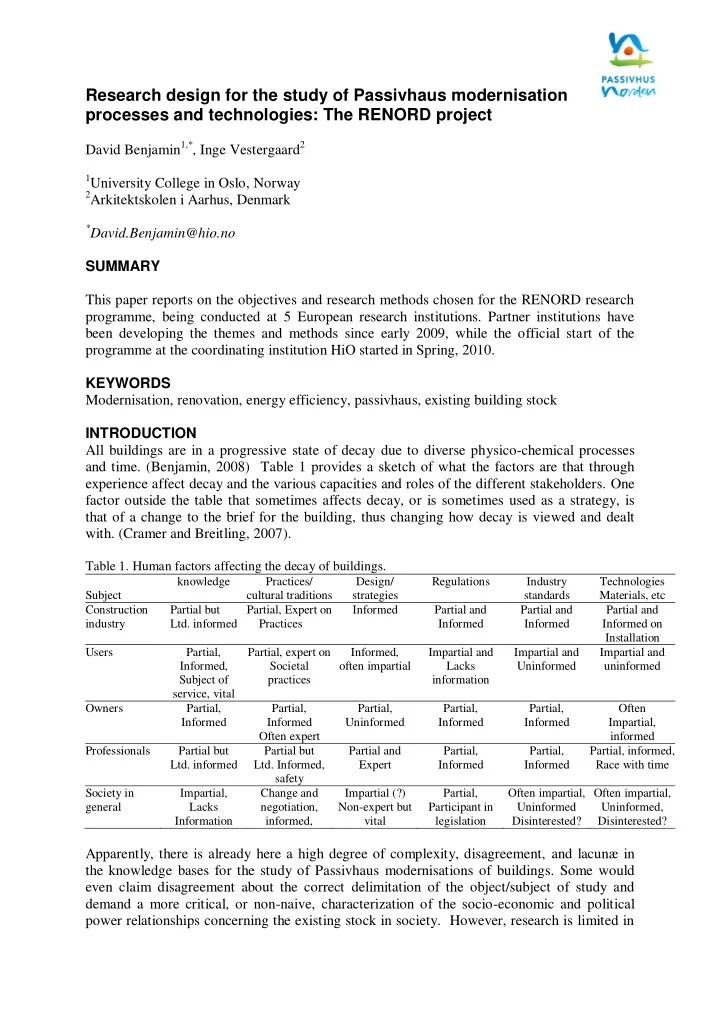
SUMMARY This paper reports on the objectives and research methods chosen for the RENORD research programme, being conducted at 5 European research institutions. Partner institutions have been developing the themes and methods since early 2009, while the official start of the programme at the coordinating institution HiO started in Spring, 2010. KEYWORDS Modernisation, renovation, energy efficiency, passivhaus, existing building stock INTRODUCTION All buildings are in a progressive state of decay due to diverse physico-chemical processes and time. (Benjamin, 2008) Table 1 provides a sketch of what the factors are that through experience affect decay and the various capacities and roles of the different stakeholders. One factor outside the table that sometimes affects decay, or is sometimes used as a strategy, is that of a change to the brief for the building, thus changing how decay is viewed and dealt
- with. (Cramer and Breitling, 2007).
Table 1. Human factors affecting the decay of buildings.
Subject knowledge Practices/ cultural traditions Design/ strategies Regulations Industry standards Technologies Materials, etc Construction industry Partial but
- Ltd. informed
Partial, Expert on Practices Informed Partial and Informed Partial and Informed Partial and Informed on Installation Users Partial, Informed, Subject of service, vital Partial, expert on Societal practices Informed,
- ften impartial
Impartial and Lacks information Impartial and Uninformed Impartial and uninformed Owners Partial, Informed Partial, Informed Often expert Partial, Uninformed Partial, Informed Partial, Informed Often Impartial, informed Professionals Partial but
- Ltd. informed
Partial but
- Ltd. Informed,