reports on community engagement in research in general and - - PDF document

reports on community engagement in research in general
SMART_READER_LITE
LIVE PREVIEW

reports on community engagement in research in general and - - PDF document

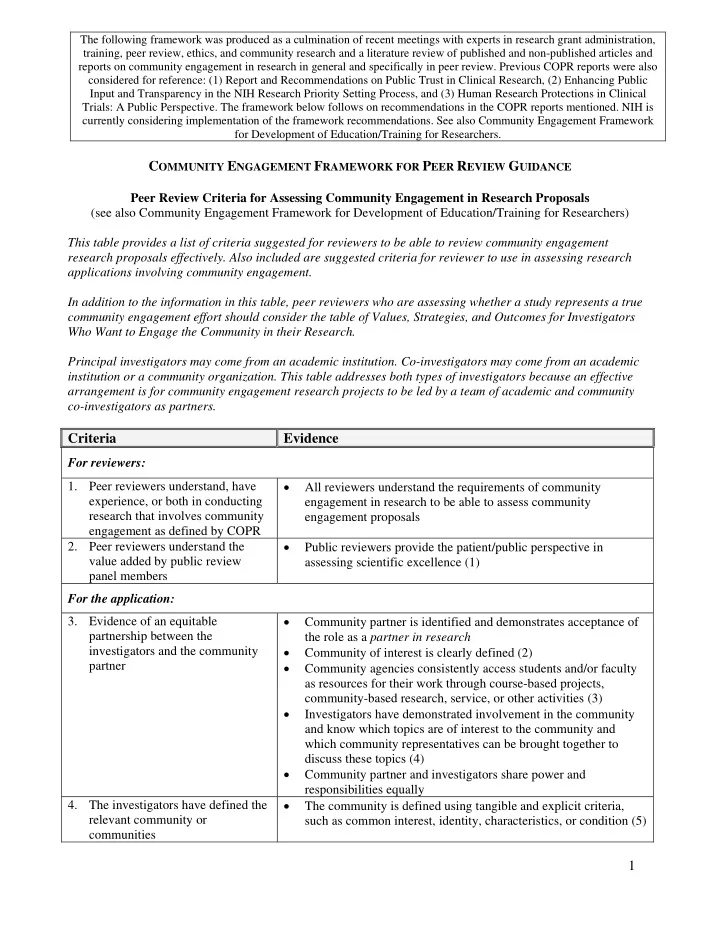
The following framework was produced as a culmination of recent meetings with experts in research grant administration, training, peer review, ethics, and community research and a literature review of published and non-published articles and


slide-1
SLIDE 1

The following framework was produced as a culmination of recent meetings with experts in research grant administration,

training, peer review, ethics, and community research and a literature review of published and non-published articles and reports on community engagement in research in general and specifically in peer review. Previous COPR reports were also considered for reference: (1) Report and Recommendations on Public Trust in Clinical Research, (2) Enhancing Public Input and Transparency in the NIH Research Priority Setting Process, and (3) Human Research Protections in Clinical Trials: A Public Perspective. The framework below follows on recommendations in the COPR reports mentioned. NIH is currently considering implementation of the framework recommendations. See also Community Engagement Framework for Development of Education/Training for Researchers.

1 COMMUNITY ENGAGEMENT FRAMEWORK FOR PEER REVIEW GUIDANCE

Peer Review Criteria for Assessing Community Engagement in Research Proposals (see also Community Engagement Framework for Development of Education/Training for Researchers) This table provides a list of criteria suggested for reviewers to be able to review community engagement research proposals effectively. Also included are suggested criteria for reviewer to use in assessing research applications involving community engagement. In addition to the information in this table, peer reviewers who are assessing whether a study represents a true community engagement effort should consider the table of Values, Strategies, and Outcomes for Investigators Who Want to Engage the Community in their Research. Principal investigators may come from an academic institution. Co-investigators may come from an academic institution or a community organization. This table addresses both types of investigators because an effective arrangement is for community engagement research projects to be led by a team of academic and community co-investigators as partners.

Criteria Evidence

For reviewers:

  • 1. Peer reviewers understand, have

experience, or both in conducting research that involves community engagement as defined by COPR

  • All reviewers understand the requirements of community

engagement in research to be able to assess community engagement proposals

  • 2. Peer reviewers understand the

value added by public review panel members

  • Public reviewers provide the patient/public perspective in

assessing scientific excellence (1) For the application:

  • 3. Evidence of an equitable

partnership between the investigators and the community partner

  • Community partner is identified and demonstrates acceptance of

the role as a partner in research

  • Community of interest is clearly defined (2)
  • Community agencies consistently access students and/or faculty

as resources for their work through course-based projects, community-based research, service, or other activities (3)

  • Investigators have demonstrated involvement in the community

and know which topics are of interest to the community and which community representatives can be brought together to discuss these topics (4)

  • Community partner and investigators share power and

responsibilities equally

  • 4. The investigators have defined the

relevant community or communities

  • The community is defined using tangible and explicit criteria,

such as common interest, identity, characteristics, or condition (5)

slide-2
SLIDE 2

2 Criteria Evidence

  • 5. The investigators have identified

the appropriate community or communities for the project. The community co-investigator has identified the appropriate research partner for the project

  • The investigators have identified the community members who

will participate in the research as partners (5)

  • The community co-investigators have identified the academic co-

investigator who will participate in the research as a partner

  • 6. Community engagement is an

integral part of the research

  • Investigators provide a sound rationale and track record (if

applicable) for community engagement in the study

  • A clear link exists between community-defined priorities and the

proposed research focus and approach (6)

  • The proposal addresses not just research methods, but also

methods of building and sustaining community partnerships and community participation (6)

  • The proposal includes a management plan for maintaining

transparent communications between the community and the academic partners

  • Investigators describe existing or proposed involvement with one
  • r more community-based organizations (5)
  • The investigators involve the community as an equal partner in

the research process, including priority setting, participation, and followup (7)

  • Community partner participation may enhance, but does not focus

solely on, recruitment and retention of research subjects

  • 7. Community played an appropriate

and meaningful role in developing the application

  • Letters of support were clearly written by the community, not the

investigator (8)

  • Proposal offers evidence that the planning, organization,

structure, and design of the research reflect a genuine collaboration between the partners (9)

  • 8. Appropriate division of funding

among partners

  • The amounts going to the academic partner and the community

are transparent, clear, fair, and appropriate (8, 9)

  • 9. Sound science
  • Community engagement projects meet the same rigorous

scientific standards as other projects

  • Project addresses an important scientific health problem (9)
  • If project aims are achieved, this will advance scientific

knowledge, community health, or clinical practice (9)

  • 10. Training opportunities
  • The application includes plans to train investigators, trainees, and

scholars in the methodology of community engagement in research (7)

  • The application includes a plan to train community partners in

research methodology

  • The application includes a plan to train the research team in

translating research findings into policy and practice

  • 11. Appropriate environment
  • The environment in which the research will be done enhances the

likelihood of success (9)

  • The research benefits from unique features of the environment or

study population (9)

  • The community benefits from the presence and implementation
  • f the research
slide-3
SLIDE 3

3 Criteria Evidence

  • 12. Impact
  • The project will lead to improved public understanding of

research (9)

  • The project will produce strategies for promoting collaboration

between academic intuitions and the community to improve the public’s health (9)

  • The research will foster long-term, bidirectional relationships

between the academic institution and the community for the benefit of both (7)

  • The research will support positive social change in the

community’s health

REFERENCES

1. Consumer Advocates in Research and Related Activities. Role and Responsibilities of Consumer Advocates in Peer Review. http://carra.cancer.gov/images/content/Role-of-Consumer-Advocates-in-Peer- Review.pdf. 2. Green L. Guidelines and Categories for Classifying Participatory Research Projects in Health. http://lgreen.net/guidelines.html. 3. Gelmon SB, Seifer SD, Kauper-Brown J and Mikkelsen M. Building Capacity for Community Engagement: Institutional Self-Assessment. Seattle, WA: Community-Campus Partnerships for Health, 2005. 4. Schensul J. The Development and Maintenance of Community Research Partnerships. Occasional Papers in Applied Research Methods, Institute for Community Research, Hartford, CT, 1994. http://www.mapcruzin.com/community-research/schensul1.htm. 5. Eligibility and Review Criteria: PAR-05-026, Community Participation in Research. National Heart, Lung, and Blood Institute, National Institutes of Health. 6. Centers for Disease Control and Prevention. Principles of Community Engagement. 1997. http://www.cdc.gov/phppo/pce/. 7. Clinical and Translational Science Awards Review Shells and Criteria. National Center for Research Resources, National Institutes of Health. 8. Seifer SD. Tips & Strategies for Developing Strong Community-Based Participatory Research Proposals. Community-Campus Partnerships for Health. http://depts.washington.edu/ccph/pdf_files/cbpr-reviewf.pdf. 9. Template for Writing Critiques for the Partners in Research Program, RFA R03, April 2008. Eunice Kennedy Shriver National Institute of Child Health and Human Development, National Institutes of Health.