repetitive parallelism the nature of Mesopotamian poetry is to - - PowerPoint PPT Presentation

repetitive parallelism
SMART_READER_LITE
LIVE PREVIEW

repetitive parallelism the nature of Mesopotamian poetry is to - - PowerPoint PPT Presentation

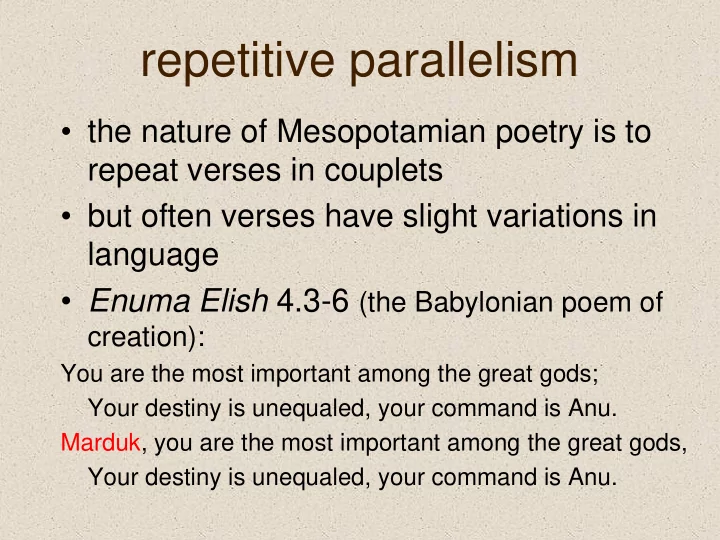
repetitive parallelism the nature of Mesopotamian poetry is to repeat verses in couplets but often verses have slight variations in language Enuma Elish 4.3-6 (the Babylonian poem of creation): You are the most important among the


slide-1
SLIDE 1

repetitive parallelism

  • the nature of Mesopotamian poetry is to

repeat verses in couplets

  • but often verses have slight variations in

language

  • Enuma Elish 4.3-6 (the Babylonian poem of

creation):

You are the most important among the great gods; Your destiny is unequaled, your command is Anu. Marduk, you are the most important among the great gods, Your destiny is unequaled, your command is Anu.

slide-2
SLIDE 2

repetitive parallelism

  • all in all, repetitive parallelism is part

and parcel of the “oral nature” (i.e. story-telling) of Ancient Near Eastern poetry

slide-3
SLIDE 3

progressive specification

  • a more complex form of repetitive

parallelism

  • the second line paraphrases or recasts the

first line

  • Enuma Elish 1.1-2

When above, the heaven had not been named, Below, the earth had not yet been called by name, . . .

slide-4
SLIDE 4

incremental repetition

  • a different form of repetitive parallelism
  • the second line adds an element (or

elements) to the first line

  • Enuma Elish 1.42-3

<Tiamat> was angry and cried out to her husband; She cried out and raged furiously, she alone.

slide-5
SLIDE 5

The Old Testament

  • the scriptures of the ancient Hebrews

arise from the same general culture as Ancient Near Eastern literature

  • the verses of the Bible also use

repetitive parallelism

  • Psalms 111.7-8

The works of His hands are truth and justice; all His commandments are sure. They stand fast for ever and ever, done in truth and uprightness.

slide-6
SLIDE 6

nephilim

  • “sons of God” mentioned in Bible
  • Genesis 6:4

There were giants in the earth in those days; and also after that, when the sons of God came in unto the daughters of men, and they bare children to them, the same became mighty men which were of old, men of renown.

slide-7
SLIDE 7

nephilim

  • but the nephilim misbehave, which induces

God to precipitate the Deluge

  • cf. Gilgamesh I.67-8, 71-72

The young men of Uruk he harries without warrant, Gilgamesh lets no son go free to his father . . . It is he who is shepherd of Uruk-the-Sheepfold, but Gilgamesh let no daughter go free to her mother.

slide-8
SLIDE 8

nephilim

  • the nephilim character/s in both The Epic
  • f Gilgamesh and the Bible are semi-

divine being/s

  • both overstep their bounds and disobey

the commandments of heaven

  • cf. the motif of the “fallen angel,” e.g.

Satan in the Bible and Prometheus (the fire-bringer) in Greek myth

slide-9
SLIDE 9

Cedars of Lebanon

  • an enormous and daunting forest in the

area of modern Lebanon

  • in antiquity, destroyed by deforestation

and ecological mismanagement

  • felling these cedar trees serves as a test
  • f valor for Assyrian and Babylonian

kings, even as late as the first millennium BCE

slide-10
SLIDE 10

Cedars of Lebanon

  • Isaiah 14:8-9, the cedars sing a clever

mocking dirge of a recently deceased Babylonian king:

The whole earth is at rest and is quiet: they break forth into singing. Yea, the fir trees rejoice at thee,and the cedars

  • f Lebanon, saying,

‘Since thou art laid down, no feller is come up against us.’

slide-11
SLIDE 11

Aruru

  • mother-goddess who creates Enkidu

from clay

  • cf. the creation of Adam in Genesis

2:7:

And the Lord God formed man of the dust

  • f the ground
  • also, cf. Job 33:6:

Behold, before God I am as you are; I too was formed from a piece of clay.

slide-12
SLIDE 12

adom

  • the Hebrew word for “clay”
  • thus, Adam’s name is a Hebrew pun on

adom (or adamah, “dirt”)

slide-13
SLIDE 13

adom

  • Biblical theme: humans are as fragile as

clay, but also fired with the spark of divinity

  • likewise in Mesopotamian literature,

Enkidu is “what Anu had thought of” (Gilgamesh I.100)

  • cf. Genesis 1:26-7: “God made man in

his own image”

slide-14
SLIDE 14

Acculturation of Man

  • is the most comprehensive parallel

between Gilgamesh and the Bible

  • the wild man Enkidu is tamed and

becomes human (mortal)

  • cf. Adam who becomes mortal after

eviction from Eden

slide-15
SLIDE 15

Acculturation of Man

  • Shamhat’s food
  • Enkidu’s clothes
  • his rejection by wild

animals

  • Uruk
  • fruit of the tree of

Good and Evil

  • fig leaves
  • eviction from the

Garden of Eden

  • Enoch (Cain’s city)

Genesis 5.17: . . . and (Cain) builded a city, and called the name of the city, after the name of his son, Enoch.

slide-16
SLIDE 16

walls of Uruk

  • Gilgamesh XI.324-7

Go up, Urshanabi, walk on the ramparts of Uruk. Inspect the base terrace, examine its brickwork, If its brickwork is not of burnt brick, And if the Seven Wise Ones laid not its foundation.

  • Psalms 48:12-13

Walk about Zion (Jerusalem), and go round about her: count her towers, Mark well her bulwarks, consider her palaces; that you may tell it to the generation following.

slide-17
SLIDE 17

Dominant Theme of The Epic of Gilgamesh

  • a man’s immortality rests upon his

accomplishments and the monuments he leaves behind

  • e.g. the structures or cities he builds