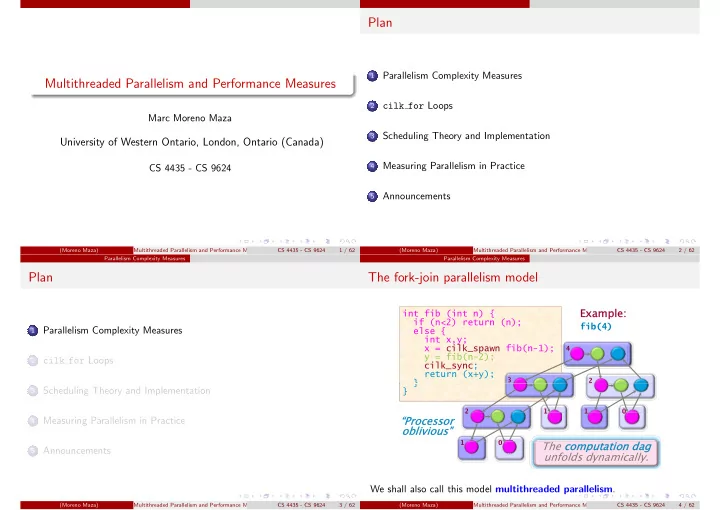
Plan Parallelism Complexity Measures 1 Multithreaded Parallelism - - PowerPoint PPT Presentation

plan
SMART_READER_LITE
LIVE PREVIEW

Plan Parallelism Complexity Measures 1 Multithreaded Parallelism - - PowerPoint PPT Presentation

Plan Parallelism Complexity Measures 1 Multithreaded Parallelism and Performance Measures cilk for Loops 2 Marc Moreno Maza Scheduling Theory and Implementation 3 University of Western Ontario, London, Ontario (Canada) Measuring Parallelism


slide-1
SLIDE 1

Multithreaded Parallelism and Performance Measures

Marc Moreno Maza

University of Western Ontario, London, Ontario (Canada)

CS 4435 - CS 9624

(Moreno Maza) Multithreaded Parallelism and Performance Measures CS 4435 - CS 9624 1 / 62

Plan

1

Parallelism Complexity Measures

2

cilk for Loops

3

Scheduling Theory and Implementation

4

Measuring Parallelism in Practice

5

Announcements

(Moreno Maza) Multithreaded Parallelism and Performance Measures CS 4435 - CS 9624 2 / 62 Parallelism Complexity Measures

Plan

1

Parallelism Complexity Measures

2

cilk for Loops

3

Scheduling Theory and Implementation

4

Measuring Parallelism in Practice

5

Announcements

(Moreno Maza) Multithreaded Parallelism and Performance Measures CS 4435 - CS 9624 3 / 62 Parallelism Complexity Measures

The fork-join parallelism model

int fib (int n) { if (n<2) return (n); int fib (int n) { if (n<2) return (n);

Example: Example:

fib(4) ( ) ( ); else { int x,y; x = cilk_spawn fib(n-1); y fib(n 2); ( ) ( ); else { int x,y; x = cilk_spawn fib(n-1); y fib(n 2); fib(4)

4

y = fib(n-2); cilk_sync; return (x+y); } y = fib(n-2); cilk_sync; return (x+y); }

3 2

} } } }

2 1 1

“Processor “Processor

  • blivious”
  • blivious”

2 1 1 1

The computation dag computation dag unfolds dynamically.

1

We shall also call this model multithreaded parallelism.

(Moreno Maza) Multithreaded Parallelism and Performance Measures CS 4435 - CS 9624 4 / 62

slide-2
SLIDE 2

Parallelism Complexity Measures

Terminology

initial strand initial strand final strand inal strand strand strand spawn spawn edge dge return edge return edge continu continue edg edge strand strand spawn spawn edge edge call edge call edge

a strand is is a maximal sequence of instructions that ends with a spawn, sync, or return (either explicit or implicit) statement. At runtime, the spawn relation causes procedure instances to be structured as a rooted tree, called spawn tree or parallel instruction stream, where dependencies among strands form a dag.

(Moreno Maza) Multithreaded Parallelism and Performance Measures CS 4435 - CS 9624 5 / 62 Parallelism Complexity Measures

Work and span

We define several performance measures. We assume an ideal situation: no cache issues, no interprocessor costs: Tp is the minimum running time on p processors T1 is called the work, that is, the sum of the number of instructions at each node. T∞ is the minimum running time with infinitely many processors, called the span

(Moreno Maza) Multithreaded Parallelism and Performance Measures CS 4435 - CS 9624 6 / 62 Parallelism Complexity Measures

The critical path length

Assuming all strands run in unit time, the longest path in the DAG is equal to T∞. For this reason, T∞ is also referred to as the critical path length.

(Moreno Maza) Multithreaded Parallelism and Performance Measures CS 4435 - CS 9624 7 / 62 Parallelism Complexity Measures

Work law

We have: Tp ≥ T1/p. Indeed, in the best case, p processors can do p works per unit of time.

(Moreno Maza) Multithreaded Parallelism and Performance Measures CS 4435 - CS 9624 8 / 62

slide-3
SLIDE 3

Parallelism Complexity Measures

Span law

We have: Tp ≥ T∞. Indeed, Tp < T∞ contradicts the definitions of Tp and T∞.

(Moreno Maza) Multithreaded Parallelism and Performance Measures CS 4435 - CS 9624 9 / 62 Parallelism Complexity Measures

Speedup on p processors

T1/Tp is called the speedup on p processors A parallel program execution can have:

linear speedup: T1/TP = Θ(p) superlinear speedup: T1/TP = ω(p) (not possible in this model, though it is possible in others) sublinear speedup: T1/TP = o(p)

(Moreno Maza) Multithreaded Parallelism and Performance Measures CS 4435 - CS 9624 10 / 62 Parallelism Complexity Measures

Parallelism

Because the Span Law dictates that T ≥ T the maximum that TP ≥ T∞, the maximum possible speedup given T1 and T∞ is T /T ll ll li li T1/T∞ = para parall lleli lism = the average amount of work amount of work per step along the span.

(Moreno Maza) Multithreaded Parallelism and Performance Measures CS 4435 - CS 9624 11 / 62 Parallelism Complexity Measures

The Fibonacci example (1/2)

1 2 7 8 4 6 2 7 3 5 For Fib(4), we have T1 = 17 and T∞ = 8 and thus T1/T∞ = 2.125. What about T1(Fib(n)) and T∞(Fib(n))?

(Moreno Maza) Multithreaded Parallelism and Performance Measures CS 4435 - CS 9624 12 / 62

slide-4
SLIDE 4

Parallelism Complexity Measures

The Fibonacci example (2/2)

We have T1(n) = T1(n − 1) + T1(n − 2) + Θ(1). Let’s solve it.

One verify by induction that T(n) ≤ aFn − b for b > 0 large enough to dominate Θ(1) and a > 1. We can then choose a large enough to satisfy the initial condition, whatever that is. On the other hand we also have Fn ≤ T(n). Therefore T1(n) = Θ(Fn) = Θ(ψn) with ψ = (1 + √ 5)/2.

We have T∞(n) = max(T∞(n − 1), T∞(n − 2)) + Θ(1).

We easily check T∞(n − 1) ≥ T∞(n − 2). This implies T∞(n) = T∞(n − 1) + Θ(1). Therefore T∞(n) = Θ(n).

Consequently the parallelism is Θ(ψn/n).

(Moreno Maza) Multithreaded Parallelism and Performance Measures CS 4435 - CS 9624 13 / 62 Parallelism Complexity Measures

Series composition A B

Work? Span?

(Moreno Maza) Multithreaded Parallelism and Performance Measures CS 4435 - CS 9624 14 / 62 Parallelism Complexity Measures

Series composition A B

Work: T1(A ∪ B) = T1(A) + T1(B) Span: T∞(A ∪ B) = T∞(A) + T∞(B)

(Moreno Maza) Multithreaded Parallelism and Performance Measures CS 4435 - CS 9624 15 / 62 Parallelism Complexity Measures

Parallel composition A B

Work? Span?

(Moreno Maza) Multithreaded Parallelism and Performance Measures CS 4435 - CS 9624 16 / 62

slide-5
SLIDE 5

Parallelism Complexity Measures

Parallel composition A B

Work: T1(A ∪ B) = T1(A) + T1(B) Span: T∞(A ∪ B) = max(T∞(A), T∞(B))

(Moreno Maza) Multithreaded Parallelism and Performance Measures CS 4435 - CS 9624 17 / 62 Parallelism Complexity Measures

Some results in the fork-join parallelism model Al Algorithm

  • rithm

Work Work Span an g p

Merge sort Θ(n lg n) Θ(lg3n) Matrix multiplication Θ(n3) Θ(lg n) Strassen Θ(nlg7) Θ(lg2n) LU-decomposition Θ(n3) Θ(n lg n) Tableau construction Θ(n2) Ω(nlg3) FFT Θ(n lg n) Θ(lg2n) B d h fi h Θ(E) Θ(d l V) Breadth-first search Θ(E) Θ(d lg V)

We shall prove those results in the next lectures.

(Moreno Maza) Multithreaded Parallelism and Performance Measures CS 4435 - CS 9624 18 / 62 cilk for Loops

Plan

1

Parallelism Complexity Measures

2

cilk for Loops

3

Scheduling Theory and Implementation

4

Measuring Parallelism in Practice

5

Announcements

(Moreno Maza) Multithreaded Parallelism and Performance Measures CS 4435 - CS 9624 19 / 62 cilk for Loops

For loop parallelism in Cilk++

a11 a12 ⋯ a1n a21 a22 ⋯ a2n a11 a21 ⋯ an1 a12 a22 ⋯ an2

21 22 2n

⋮ ⋮ ⋱ ⋮ an1 an2 ⋯ ann

12 22 n2

⋮ ⋮ ⋱ ⋮ a1n a2n ⋯ ann

n1 n2 nn 1n 2n nn

A AT

cilk_for (int i=1; i<n; ++i) { for (int j=0; j<i; ++j) { double temp = A[i][j]; A[i][j] = A[j][i]; A[j][i] = temp; } } The iterations of a cilk for loop execute in parallel.

(Moreno Maza) Multithreaded Parallelism and Performance Measures CS 4435 - CS 9624 20 / 62

slide-6
SLIDE 6

cilk for Loops

Implementation of for loops in Cilk++

Up to details (next week!) the previous loop is compiled as follows, using a divide-and-conquer implementation: void recur(int lo, int hi) { if (hi > lo) { // coarsen int mid = lo + (hi - lo)/2; cilk_spawn recur(lo, mid); recur(mid, hi); cilk_sync; } else for (int j=0; j<i; ++j) { double temp = A[i][j]; A[i][j] = A[j][i]; A[j][i] = temp; } } }

(Moreno Maza) Multithreaded Parallelism and Performance Measures CS 4435 - CS 9624 21 / 62 cilk for Loops

Analysis of parallel for loops

1

2 3 4

1

2 3 4 5 6 7 8

Here we do not assume that each strand runs in unit time. Span of loop control: Θ(log(n)) Max span of an iteration: Θ(n) Span: Θ(n) Work: Θ(n2) Parallelism: Θ(n)

(Moreno Maza) Multithreaded Parallelism and Performance Measures CS 4435 - CS 9624 22 / 62 cilk for Loops

Parallelizing the inner loop

cilk_for (int i=1; i<n; ++i) { cilk_for (int j=0; j<i; ++j) { double temp = A[i][j]; A[i][j] = A[j][i]; A[j][i] = temp; } } Span of outer loop control: Θ(log(n)) Max span of an inner loop control: Θ(log(n)) Span of an iteration: Θ(1) Span: Θ(log(n)) Work: Θ(n2) Parallelism: Θ(n2/log(n)) But! More on this next week . . .

(Moreno Maza) Multithreaded Parallelism and Performance Measures CS 4435 - CS 9624 23 / 62 Scheduling Theory and Implementation

Plan

1

Parallelism Complexity Measures

2

cilk for Loops

3

Scheduling Theory and Implementation

4

Measuring Parallelism in Practice

5

Announcements

(Moreno Maza) Multithreaded Parallelism and Performance Measures CS 4435 - CS 9624 24 / 62

slide-7
SLIDE 7

Scheduling Theory and Implementation

Scheduling

Memory I/O Network P $ $ $

P P P P $ $ $

A scheduler’s job is to map a computation to particular processors. Such a mapping is called a schedule. If decisions are made at runtime, the scheduler is online, otherwise, it is offline Cilk++’s scheduler maps strands onto processors dynamically at runtime.

(Moreno Maza) Multithreaded Parallelism and Performance Measures CS 4435 - CS 9624 25 / 62 Scheduling Theory and Implementation

Greedy scheduling (1/2)

A strand is ready if all its predecessors have executed A scheduler is greedy if it attempts to do as much work as possible at every step.

(Moreno Maza) Multithreaded Parallelism and Performance Measures CS 4435 - CS 9624 26 / 62 Scheduling Theory and Implementation

Greedy scheduling (2/2)

P = 3 In any greedy schedule, there are two types of steps:

complete step: There are at least p strands that are ready to run. The greedy scheduler selects any p of them and runs them. incomplete step: There are strictly less than p threads that are ready to run. The greedy scheduler runs them all.

(Moreno Maza) Multithreaded Parallelism and Performance Measures CS 4435 - CS 9624 27 / 62 Scheduling Theory and Implementation

Theorem of Graham and Brent

P = 3 For any greedy schedule, we have Tp ≤ T1/p + T∞ #complete steps ≤ T1/p, by definition of T1. #incomplete steps ≤ T∞. Indeed, let G ′ be the subgraph of G that remains to be executed immediately prior to a incomplete step.

(i) During this incomplete step, all strands that can be run are actually run (ii) Hence removing this incomplete step from G ′ reduces T∞ by one.

(Moreno Maza) Multithreaded Parallelism and Performance Measures CS 4435 - CS 9624 28 / 62

slide-8
SLIDE 8

Scheduling Theory and Implementation

Corollary 1

A greedy scheduler is always within a factor of 2 of optimal. From the work and span laws, we have: TP ≥ max(T1/p, T∞) (1) In addition, we can trivially express: T1/p ≤ max(T1/p, T∞) (2) T∞ ≤ max(T1/p, T∞) (3) From Graham - Brent Theorem, we deduce: TP ≤ T1/p + T∞ (4) ≤ max(T1/p, T∞) + max(T1/p, T∞) (5) ≤ 2 max(T1/p, T∞) (6) which concludes the proof.

(Moreno Maza) Multithreaded Parallelism and Performance Measures CS 4435 - CS 9624 29 / 62 Scheduling Theory and Implementation

Corollary 2

The greedy scheduler achieves linear speedup whenever T∞ = O(T1/p). From Graham - Brent Theorem, we deduce: Tp ≤ T1/p + T∞ (7) = T1/p + O(T1/p) (8) = Θ(T1/p) (9) The idea is to operate in the range where T1/p dominates T∞. As long as T1/p dominates T∞, all processors can be used efficiently. The quantity T1/pT∞ is called the parallel slackness.

(Moreno Maza) Multithreaded Parallelism and Performance Measures CS 4435 - CS 9624 30 / 62 Scheduling Theory and Implementation

The work-stealing scheduler (1/11)

spawn call spawn call call call spawn spawn call spawn call spawn call call

P P P P

call

Call! Call!

P P P P

(Moreno Maza) Multithreaded Parallelism and Performance Measures CS 4435 - CS 9624 31 / 62 Scheduling Theory and Implementation

The work-stealing scheduler (2/11)

spawn call spawn call call call spawn spawn spawn call spawn call spawn call call

P

spawn

P P P

call

Spawn! Spawn!

P P P P

(Moreno Maza) Multithreaded Parallelism and Performance Measures CS 4435 - CS 9624 32 / 62

slide-9
SLIDE 9

Scheduling Theory and Implementation

The work-stealing scheduler (3/11)

spawn call spawn call call call spawn spawn spawn call spawn call spawn call spawn call

P

spawn spawn

P P P

call call spawn

Spawn! Spawn! Spawn! Spawn! Call! Call!

P P P P

(Moreno Maza) Multithreaded Parallelism and Performance Measures CS 4435 - CS 9624 33 / 62 Scheduling Theory and Implementation

The work-stealing scheduler (4/11)

spawn call spawn spawn call call call call spawn spawn call spawn call spawn call spawn

P

spawn

P P P

call call spawn spawn

Return! Return!

P P P P

(Moreno Maza) Multithreaded Parallelism and Performance Measures CS 4435 - CS 9624 34 / 62 Scheduling Theory and Implementation

The work-stealing scheduler (5/11)

spawn call spawn spawn call call call spawn spawn call spawn call spawn call spawn

P

spawn

P P P

call call spawn spawn

Return! Return!

P P P P

(Moreno Maza) Multithreaded Parallelism and Performance Measures CS 4435 - CS 9624 35 / 62 Scheduling Theory and Implementation

The work-stealing scheduler (6/11)

spawn call spawn call call call spawn spawn call spawn call spawn call spawn

P

spawn

P P P

call call spawn spawn

Steal! Steal!

P P P P

(Moreno Maza) Multithreaded Parallelism and Performance Measures CS 4435 - CS 9624 36 / 62

slide-10
SLIDE 10

Scheduling Theory and Implementation

The work-stealing scheduler (7/11)

spawn call spawn call call call spawn spawn call spawn call spawn call spawn

P

spawn

P P P

call call spawn spawn

Steal! Steal!

P P P P

(Moreno Maza) Multithreaded Parallelism and Performance Measures CS 4435 - CS 9624 37 / 62 Scheduling Theory and Implementation

The work-stealing scheduler (8/11)

spawn call spawn call call call spawn spawn call spawn call spawn call spawn

P

spawn

P P P

call call spawn spawn

P P P P

(Moreno Maza) Multithreaded Parallelism and Performance Measures CS 4435 - CS 9624 38 / 62 Scheduling Theory and Implementation

The work-stealing scheduler (9/11)

spawn call spawn call call call spawn spawn call spawn call spawn call spawn spawn

P

spawn

P P P

call call spawn spawn

Spawn! Spawn!

P P P P

(Moreno Maza) Multithreaded Parallelism and Performance Measures CS 4435 - CS 9624 39 / 62 Scheduling Theory and Implementation

The work-stealing scheduler (10/11)

spawn call spawn call call call spawn spawn call spawn call spawn call spawn spawn

P

spawn

P P P

call call spawn spawn

P P P P

(Moreno Maza) Multithreaded Parallelism and Performance Measures CS 4435 - CS 9624 40 / 62

slide-11
SLIDE 11

Scheduling Theory and Implementation

The work-stealing scheduler (11/11)

spawn call spawn call call call spawn spawn call spawn call spawn call spawn spawn

P

spawn

P P P

call call spawn spawn

P P P P

(Moreno Maza) Multithreaded Parallelism and Performance Measures CS 4435 - CS 9624 41 / 62 Scheduling Theory and Implementation

Performances of the work-stealing scheduler

Assume that each strand executes in unit time, for almost all “parallel steps” there are at least p strands to run, each processor is either working or stealing. Then, the randomized work-stealing scheduler is expected to run in TP = T1/p + O(T∞) During a steal-free parallel steps (steps at which all processors have work on their deque) each of the p processors consumes 1 work unit. Thus, there is at most T1/p steal-free parallel steps. During a parallel step with steals each thief may reduce by 1 the running time with a probability of 1/p Thus, the expected number of steals is O(p T∞). Therefore, the expected running time TP = (T1 + O(p T∞))/p = T1/p + O(T∞). (10)

(Moreno Maza) Multithreaded Parallelism and Performance Measures CS 4435 - CS 9624 42 / 62 Scheduling Theory and Implementation

Overheads and burden

Obviously T1/p + T∞ will over-estimate Tp in practice. Many factors (simplification assumptions of the fork-join parallelism model, architecture limitation, costs of executing the parallel constructs, overheads of scheduling) will make Tp smaller in practice. One may want to estimate the impact of those factors:

1

by improving the estimate of the randomized work-stealing complexity result

2

by comparing a Cilk++ program with its C++ elision

3

by estimating the costs of spawning and synchronizing

(Moreno Maza) Multithreaded Parallelism and Performance Measures CS 4435 - CS 9624 43 / 62 Scheduling Theory and Implementation

Span overhead

Let T1, T∞, Tp be given. We want to refine the randomized work-stealing complexity result. The span overhead is the smallest constant c∞ such that Tp ≤ T1/p + c∞T∞. Recall that T1/T∞ is the maximum possible speed-up that the application can obtain. We call parallel slackness assumption the following property T1/T∞ >> c∞p (11) that is, c∞ p is much smaller than the average parallelism . Under this assumption it follows that T1/p >> c∞T∞ holds, thus c∞ has little effect on performance when sufficiently slackness exists.

(Moreno Maza) Multithreaded Parallelism and Performance Measures CS 4435 - CS 9624 44 / 62

slide-12
SLIDE 12

Scheduling Theory and Implementation

Work overhead

Let Ts be the running time of the C++ elision of a Cilk++ program. We denote by c1 the work overhead c1 = T1/Ts Recall the expected running time: TP ≤ T1/P + c∞T∞. Thus with the parallel slackness assumption we get TP ≤ c1Ts/p + c∞T∞ ≃ c1Ts/p. (12) We can now state the work first principle precisely Minimize c1 , even at the expense of a larger c∞. This is a key feature since it is conceptually easier to minimize c1 rather than minimizing c∞. Cilk++ estimates Tp as Tp = T1/p + 1.7 burden span, where burden span is 15000 instructions times the number of continuation edges along the critical path.

(Moreno Maza) Multithreaded Parallelism and Performance Measures CS 4435 - CS 9624 45 / 62 Scheduling Theory and Implementation

The cactus stack

A A A A A A C B A D E B A C A A A C A C A C B C E D B D E Views of stack Views of stack

A cactus stack is used to implement C’s rule for sharing of function-local variables. A stack frame can only see data stored in the current and in the previous stack frames.

(Moreno Maza) Multithreaded Parallelism and Performance Measures CS 4435 - CS 9624 46 / 62 Scheduling Theory and Implementation

Space bounds

P

P = 3

P P

S1

P

1

The space Sp of a parallel execution on p processors required by Cilk++’s work-stealing satisfies: Sp ≤ p · S1 (13) where S1 is the minimal serial space requirement.

(Moreno Maza) Multithreaded Parallelism and Performance Measures CS 4435 - CS 9624 47 / 62 Measuring Parallelism in Practice

Plan

1

Parallelism Complexity Measures

2

cilk for Loops

3

Scheduling Theory and Implementation

4

Measuring Parallelism in Practice

5

Announcements

(Moreno Maza) Multithreaded Parallelism and Performance Measures CS 4435 - CS 9624 48 / 62

slide-13
SLIDE 13

Measuring Parallelism in Practice

Cilkview

Work Law (linear Span Law (linear speedup) Measured Burdened Measured speedup Burdened parallelism — estimates Parallelism estimates scheduling

  • verheads

Cilkview computes work and span to derive upper bounds on parallel performance Cilkview also estimates scheduling overhead to compute a burdened span for lower bounds.

(Moreno Maza) Multithreaded Parallelism and Performance Measures CS 4435 - CS 9624 49 / 62 Measuring Parallelism in Practice

The Fibonacci Cilk++ example

Code fragment long fib(int n) { if (n < 2) return n; long x, y; x = cilk_spawn fib(n-1); y = fib(n-2); cilk_sync; return x + y; }

(Moreno Maza) Multithreaded Parallelism and Performance Measures CS 4435 - CS 9624 50 / 62 Measuring Parallelism in Practice

Fibonacci program timing

The environment for benchmarking: – model name : Intel(R) Core(TM)2 Quad CPU Q6600 @ 2.40GHz – L2 cache size : 4096 KB – memory size : 3 GB #cores = 1 #cores = 2 #cores = 4 n timing(s) timing(s) speedup timing(s) speedup 30 0.086 0.046 1.870 0.025 3.440 35 0.776 0.436 1.780 0.206 3.767 40 8.931 4.842 1.844 2.399 3.723 45 105.263 54.017 1.949 27.200 3.870 50 1165.000 665.115 1.752 340.638 3.420

(Moreno Maza) Multithreaded Parallelism and Performance Measures CS 4435 - CS 9624 51 / 62 Measuring Parallelism in Practice

Quicksort

code in cilk/examples/qsort void sample_qsort(int * begin, int * end) { if (begin != end) {

  • -end;

int * middle = std::partition(begin, end, std::bind2nd(std::less<int>(), *end)); using std::swap; swap(*end, *middle); cilk_spawn sample_qsort(begin, middle); sample_qsort(++middle, ++end); cilk_sync; } }

(Moreno Maza) Multithreaded Parallelism and Performance Measures CS 4435 - CS 9624 52 / 62

slide-14
SLIDE 14

Measuring Parallelism in Practice

Quicksort timing

Timing for sorting an array of integers: #cores = 1 #cores = 2 #cores = 4 # of int timing(s) timing(s) speedup timing(s) speedup 10 × 106 1.958 1.016 1.927 0.541 3.619 50 × 106 10.518 5.469 1.923 2.847 3.694 100 × 106 21.481 11.096 1.936 5.954 3.608 500 × 106 114.300 57.996 1.971 31.086 3.677

(Moreno Maza) Multithreaded Parallelism and Performance Measures CS 4435 - CS 9624 53 / 62 Measuring Parallelism in Practice

Matrix multiplication

Code in cilk/examples/matrix Timing of multiplying a 687 × 837 matrix by a 837 × 1107 matrix iterative recursive threshold st(s) pt(s) su st(s) pt (s) su 10 1.273 1.165 0.721 1.674 0.399 4.195 16 1.270 1.787 0.711 1.408 0.349 4.034 32 1.280 1.757 0.729 1.223 0.308 3.971 48 1.258 1.760 0.715 1.164 0.293 3.973 64 1.258 1.798 0.700 1.159 0.291 3.983 80 1.252 1.773 0.706 1.267 0.320 3.959

st = sequential time; pt = parallel time with 4 cores; su = speedup

(Moreno Maza) Multithreaded Parallelism and Performance Measures CS 4435 - CS 9624 54 / 62 Measuring Parallelism in Practice

The cilkview example from the documentation

Using cilk for to perform operations over an array in parallel: static const int COUNT = 4; static const int ITERATION = 1000000; long arr[COUNT]; long do_work(long k){ long x = 15; static const int nn = 87; for (long i = 1; i < nn; ++i) x = x / i + k % i; return x; } int cilk_main(){ for (int j = 0; j < ITERATION; j++) cilk_for (int i = 0; i < COUNT; i++) arr[i] += do_work( j * i + i + j); }

(Moreno Maza) Multithreaded Parallelism and Performance Measures CS 4435 - CS 9624 55 / 62 Measuring Parallelism in Practice

1) Parallelism Profile Work : 6,480,801,250 ins Span : 2,116,801,250 ins Burdened span : 31,920,801,250 ins Parallelism : 3.06 Burdened parallelism : 0.20 Number of spawns/syncs: 3,000,000 Average instructions / strand : 720 Strands along span : 4,000,001 Average instructions / strand on span : 529 2) Speedup Estimate 2 processors: 0.21 - 2.00 4 processors: 0.15 - 3.06 8 processors: 0.13 - 3.06 16 processors: 0.13 - 3.06 32 processors: 0.12 - 3.06

(Moreno Maza) Multithreaded Parallelism and Performance Measures CS 4435 - CS 9624 56 / 62

slide-15
SLIDE 15

Measuring Parallelism in Practice

A simple fix

Inverting the two for loops int cilk_main() { cilk_for (int i = 0; i < COUNT; i++) for (int j = 0; j < ITERATION; j++) arr[i] += do_work( j * i + i + j); }

(Moreno Maza) Multithreaded Parallelism and Performance Measures CS 4435 - CS 9624 57 / 62 Measuring Parallelism in Practice

1) Parallelism Profile Work : 5,295,801,529 ins Span : 1,326,801,107 ins Burdened span : 1,326,830,911 ins Parallelism : 3.99 Burdened parallelism : 3.99 Number of spawns/syncs: 3 Average instructions / strand : 529,580,152 Strands along span : 5 Average instructions / strand on span: 265,360,221 2) Speedup Estimate 2 processors: 1.40 - 2.00 4 processors: 1.76 - 3.99 8 processors: 2.01 - 3.99 16 processors: 2.17 - 3.99 32 processors: 2.25 - 3.99

(Moreno Maza) Multithreaded Parallelism and Performance Measures CS 4435 - CS 9624 58 / 62 Measuring Parallelism in Practice

Timing

#cores = 1 #cores = 2 #cores = 4 version timing(s) timing(s) speedup timing(s) speedup

  • riginal

7.719 9.611 0.803 10.758 0.718 improved 7.471 3.724 2.006 1.888 3.957

(Moreno Maza) Multithreaded Parallelism and Performance Measures CS 4435 - CS 9624 59 / 62 Announcements

Plan

1

Parallelism Complexity Measures

2

cilk for Loops

3

Scheduling Theory and Implementation

4

Measuring Parallelism in Practice

5

Announcements

(Moreno Maza) Multithreaded Parallelism and Performance Measures CS 4435 - CS 9624 60 / 62

slide-16
SLIDE 16

Announcements

Acknowledgements

Charles E. Leiserson (MIT) for providing me with the sources of its lecture notes. Matteo Frigo (Intel) for supporting the work of my team with Cilk++. Yuzhen Xie (UWO) for helping me with the images used in these slides. Liyun Li (UWO) for generating the experimental data.

(Moreno Maza) Multithreaded Parallelism and Performance Measures CS 4435 - CS 9624 61 / 62 Announcements

References

Matteo Frigo, Charles E. Leiserson, and Keith H. Randall. The Implementation of the Cilk-5 Multithreaded Language. Proceedings

  • f the ACM SIGPLAN ’98 Conference on Programming Language

Design and Implementation, Pages: 212-223. June, 1998. Robert D. Blumofe, Christopher F. Joerg, Bradley C. Kuszmaul, Charles E. Leiserson, Keith H. Randall, and Yuli Zhou. Cilk: An Efficient Multithreaded Runtime System. Journal of Parallel and Distributed Computing, 55-69, August 25, 1996. Robert D. Blumofe and Charles E. Leiserson. Scheduling Multithreaded Computations by Work Stealing. Journal of the ACM,

  • Vol. 46, No. 5, pp. 720-748. September 1999.

(Moreno Maza) Multithreaded Parallelism and Performance Measures CS 4435 - CS 9624 62 / 62