Parallelism ! Multiple processes concurrently Parallelism CPU1 - - PDF document

parallelism
SMART_READER_LITE
LIVE PREVIEW

Parallelism ! Multiple processes concurrently Parallelism CPU1 - - PDF document

Parallelism ! Multiple processes concurrently Parallelism CPU1 CPU1 CPU1 Pseudo- Process 1 CPU1 CPU1 CPU1 Operating Systems Process 2 Parallelism CPU1 Parallel Systems Process 1 True (Soon to be basic OS knowledge) CPU2 Process 2


slide-1
SLIDE 1

1

Operating Systems

Parallel Systems (Soon to be basic OS knowledge)

Parallelism

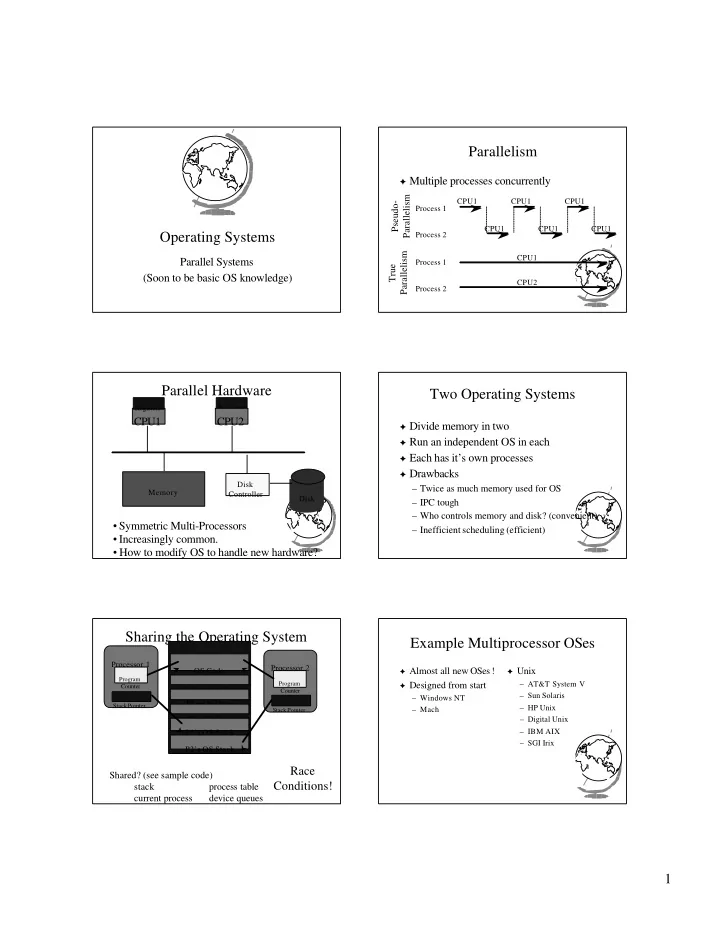
! Multiple processes concurrently Process 1 Process 2 CPU1 CPU1 CPU1 CPU1 CPU1 CPU1 Process 1 Process 2 CPU1 CPU2

Pseudo- Parallelism True Parallelism

Parallel Hardware

CPU1

Registers Registers

CPU2

Memory Disk Controller Disk

  • Symmetric Multi-Processors
  • Increasingly common.
  • How to modify OS to handle new hardware?

Two Operating Systems

! Divide memory in two ! Run an independent OS in each ! Each has it’s own processes ! Drawbacks

– Twice as much memory used for OS – IPC tough – Who controls memory and disk? (convenient) – Inefficient scheduling (efficient)

Sharing the Operating System

Processor 1

Program Counter Stack Pointer

Processor 2

Program Counter Stack Pointer

Main Memory OS Code OS Common Data P1’s OS Data P2’s OS Data P1’s OS Stack P2’s OS Stack

Shared? (see sample code) stack process table current process device queues

Race Conditions!

Example Multiprocessor OSes

! Almost all new OSes ! ! Designed from start

– Windows NT – Mach

! Unix

– AT&T System V – Sun Solaris – HP Unix – Digital Unix – IBM AIX – SGI Irix

slide-2
SLIDE 2

2

Threads

Software Multi-Processors

Threads (Lightweight Processes)

! Basic unit of CPU utilization

– (“What?!” you say)

! Own

– program counter – register set – stack space

! Shares

– code section – data section – OS resources

text segment data segment Program Counter (Threads) C stack B stack A stack

A B C A B C

“Multithreaded Program” Process

Stack

A(int tmp) { B(); printf(tmp) ; } B() { C(); } C() { A(2); } A: tmp = 2 C B A: tmp = 1

Example: A Threaded Spreadsheet

Command Thread Spreadsheet Data Other Data Display Thread Recalculate Thread

What Kinds of Programs to Thread?

! Independent tasks

– ex: debugger needs gui, program, perf monitor… – especially when blocking for I/O!

! Single program, concurrent operation

– Servers

N ex: file server, web server

– OS kernels

N concurrent requests by multiple users -- no protection

needed in kernel

Thread Benefits

! “What about just using processes with

shared memory?”

– fine – debugging tougher (more thread tools) – processes slower

N 30 times slower to create on Solaris N slower to destroy N slower to context switch

among

– processes eat up memory

N few thousand processes not ok N few thousand threads ok

slide-3
SLIDE 3

3

Threads Standards

! POSIX (Pthreads

)

– Common API – Almost all Unix’s have thread library

! Win32 and OS/2

– very different from POSIX, tough to port – commercial POSIX libraries for Win32 – OS/2 has POSIX option

! Solaris

– started before POSIX standard – likely to be like POSIX

Do they Work?

! Operating systems

– Mach, Windows NT, Windows 95, Solaris, IRIX, AIX, OS/2, OSF/1 – Millions of (unforgiving) users

! NFS, SPECfp, SPECint 1 4 8 12 16 20 24 CPUs

Levels of Threads

User Level Thread Thread Kernel Thread Process A Process B