Repeated On-Chip Interconnect Analysis and Evaluation of Delay, - - PDF document

repeated on chip interconnect analysis and evaluation of
SMART_READER_LITE
LIVE PREVIEW

Repeated On-Chip Interconnect Analysis and Evaluation of Delay, - - PDF document

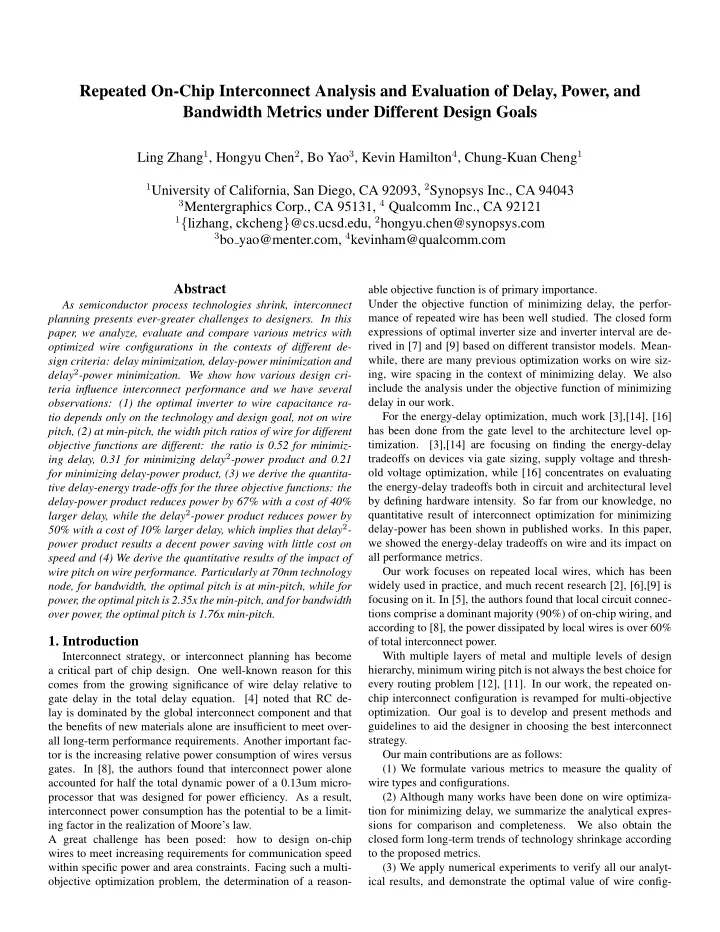
Repeated On-Chip Interconnect Analysis and Evaluation of Delay, Power, and Bandwidth Metrics under Different Design Goals Ling Zhang 1 , Hongyu Chen 2 , Bo Yao 3 , Kevin Hamilton 4 , Chung-Kuan Cheng 1 1 University of California, San Diego, CA


slide-1
SLIDE 1

Repeated On-Chip Interconnect Analysis and Evaluation of Delay, Power, and Bandwidth Metrics under Different Design Goals

Ling Zhang1, Hongyu Chen2, Bo Yao3, Kevin Hamilton4, Chung-Kuan Cheng1

1University of California, San Diego, CA 92093, 2Synopsys Inc., CA 94043 3Mentergraphics Corp., CA 95131, 4 Qualcomm Inc., CA 92121 1{lizhang, ckcheng}@cs.ucsd.edu, 2hongyu.chen@synopsys.com 3bo yao@menter.com, 4kevinham@qualcomm.com

Abstract

As semiconductor process technologies shrink, interconnect planning presents ever-greater challenges to designers. In this paper, we analyze, evaluate and compare various metrics with

  • ptimized wire configurations in the contexts of different de-

sign criteria: delay minimization, delay-power minimization and delay2-power minimization. We show how various design cri- teria influence interconnect performance and we have several

  • bservations: (1) the optimal inverter to wire capacitance ra-

tio depends only on the technology and design goal, not on wire pitch, (2) at min-pitch, the width pitch ratios of wire for different

  • bjective functions are different: the ratio is 0.52 for minimiz-

ing delay, 0.31 for minimizing delay2-power product and 0.21 for minimizing delay-power product, (3) we derive the quantita- tive delay-energy trade-offs for the three objective functions: the delay-power product reduces power by 67% with a cost of 40% larger delay, while the delay2-power product reduces power by 50% with a cost of 10% larger delay, which implies that delay2- power product results a decent power saving with little cost on speed and (4) We derive the quantitative results of the impact of wire pitch on wire performance. Particularly at 70nm technology node, for bandwidth, the optimal pitch is at min-pitch, while for power, the optimal pitch is 2.35x the min-pitch, and for bandwidth

  • ver power, the optimal pitch is 1.76x min-pitch.
  • 1. Introduction

Interconnect strategy, or interconnect planning has become a critical part of chip design. One well-known reason for this comes from the growing significance of wire delay relative to gate delay in the total delay equation. [4] noted that RC de- lay is dominated by the global interconnect component and that the benefits of new materials alone are insufficient to meet over- all long-term performance requirements. Another important fac- tor is the increasing relative power consumption of wires versus

  • gates. In [8], the authors found that interconnect power alone

accounted for half the total dynamic power of a 0.13um micro- processor that was designed for power efficiency. As a result, interconnect power consumption has the potential to be a limit- ing factor in the realization of Moore’s law. A great challenge has been posed: how to design on-chip wires to meet increasing requirements for communication speed within specific power and area constraints. Facing such a multi-

  • bjective optimization problem, the determination of a reason-

able objective function is of primary importance. Under the objective function of minimizing delay, the perfor- mance of repeated wire has been well studied. The closed form expressions of optimal inverter size and inverter interval are de- rived in [7] and [9] based on different transistor models. Mean- while, there are many previous optimization works on wire siz- ing, wire spacing in the context of minimizing delay. We also include the analysis under the objective function of minimizing delay in our work. For the energy-delay optimization, much work [3],[14], [16] has been done from the gate level to the architecture level op- timization. [3],[14] are focusing on finding the energy-delay tradeoffs on devices via gate sizing, supply voltage and thresh-

  • ld voltage optimization, while [16] concentrates on evaluating

the energy-delay tradeoffs both in circuit and architectural level by defining hardware intensity. So far from our knowledge, no quantitative result of interconnect optimization for minimizing delay-power has been shown in published works. In this paper, we showed the energy-delay tradeoffs on wire and its impact on all performance metrics. Our work focuses on repeated local wires, which has been widely used in practice, and much recent research [2], [6],[9] is focusing on it. In [5], the authors found that local circuit connec- tions comprise a dominant majority (90%) of on-chip wiring, and according to [8], the power dissipated by local wires is over 60%

  • f total interconnect power.

With multiple layers of metal and multiple levels of design hierarchy, minimum wiring pitch is not always the best choice for every routing problem [12], [11]. In our work, the repeated on- chip interconnect configuration is revamped for multi-objective

  • ptimization. Our goal is to develop and present methods and

guidelines to aid the designer in choosing the best interconnect strategy. Our main contributions are as follows: (1) We formulate various metrics to measure the quality of wire types and configurations. (2) Although many works have been done on wire optimiza- tion for minimizing delay, we summarize the analytical expres- sions for comparison and completeness. We also obtain the closed form long-term trends of technology shrinkage according to the proposed metrics. (3) We apply numerical experiments to verify all our analyt- ical results, and demonstrate the optimal value of wire config-

slide-2
SLIDE 2

urations, performance metrics and their relations for minimizing delay-power and delay2-power product. We consider short circuit current and leakage current in our buffer model, and adopt an ac- curate wire capacitance model, Elmore delay model and ITRS technology parameters. We have several observations: (1) The optimal inverter to wire capacitance ratio depends only

  • n the design goal and technology, and remains constant with

changing wire pitch. In [7], the author has pointed out that opti- mal wire configuration for minimizing delay requires a constant capacitance ratio of wire to the inverter. We expand this conclu- sion to minimizing delay-power and delay2-power product. (2) Some previous works has found that to save power, thinner wire is preferred. In our work, we derived the closed form opti- mal width pitch ratio for minimizing delay, and found the optimal width pitch ratio for the other two design goals by numerical ex-

  • periments. At min-pitch, the ratio is 0.52 for minimizing delay,

0.31 for minimizing delay2-power product and 0.21 for minimiz- ing delay-power product. (3) We derive the quantitative delay-energy trade-offs for the three objective functions: the delay-power product reduces power by 67% with a cost of 40% larger delay, while the delay2-power product reduces power by 50% with a cost of 10% larger delay, which implies that delay2-power product results a decent power saving with little cost on speed. (4) We derive the quantitative results of the impact of wire pitch on wire performance. Particularly at 70nm technology node, for bandwidth, the optimal pitch is at min-pitch, while for power, the optimal pitch is 2.35x the min-pitch, and for band- width over power, the optimal pitch is 1.76x min-pitch.

  • 2. Glossary

To clarify further expression, we define symbols and expres- sions used in this paper. Most of notations follow [7].

2.1. Variables

These variables can be controlled in physical layout and we want to understand their effect on wire performance.

  • w is the width of a wire used for interconnect.
  • pitch is the wire pitch.
  • sinv is the scaled size of an inverter.
  • linv is the distance between placed inverter instances.
  • l is the total length of a wire.

2.2. Parameters

These two interconnect parameters play critical role in wire performance.

  • rw is the wire resistance per unit length.
  • cw is the wire capacitance per unit length.

2.3. Functions

These functions produce the values with which we gauge per- formance.

  • dtotal is the delay of a repeated wire.
  • dstage is the delay of a wire segment between two adjacent

inverters.

  • pstage = pwire + pinv which shows the sum of a wire seg-

ment power and the power of its driver is the power of a single stage.

  • delayn is the wire-length-normalized delay.
  • powern is the wire-length-normalized power.
  • bandwidth = 1/(delayn×pitch) is the amount of data that

can be transferred per unit area per unit time.

  • bandwidth/power = 1/(delayn × pitch × powern) is the

bandwidth for a given power budget. Table 1. Technology data from ITRS[4]

year 1999 2001 2003 2006 Technology node(nm) 180 130 100 70 Metal 1 pitch(nm) 450 350 240 170 Metal 1 aspect ratio 1.8 1.6 1.7 1.7 Conductor effective resistivity (Ω-cm) 2.2 2.2 2.2 2.2 Voltage supply(volt) 1.8 1.5 1.2 1.1 Interlevel metal insulator dielectric constant 3.1 3.1 3.1 3.1 Leakage current(25◦C)(uA/um) 0.001 0.01 0.03 0.05

Table 2. Hspice simulation result of output resis- tance of min sized CMOS inverter

Technode(nm) 180 130 100 70 r0(kΩ) 7.07 8.32 8.38 9.43

2.4. Technology data

We list technology related data besides those already listed in Table [4]. We performed Hspice simulation to obtain the output resistance of inverters, and leakage currents. (More details are in Section 3.2.1.)

  • w0 = 2technode is the min-sized NMOS gate width.
  • g = 1.34 is the P/N ratio of transistor width.
  • f = 1 is the ratio of diffusion capacitance to gate capaci-

tance of a transistor.

  • cg = 1.75fF/um is the value of NMOS gate capacitance

per micron [7].

  • cmos = cgw0 is the min-sized NMOS gate capacitance.
  • r0 is the output resistance of a min-sized inverter.
  • ρ is the resistivity of copper.
  • ϵ is the interlevel metal insulator dielectric constant.
  • t is the wire thickness.
  • h is the interlevel metal insulator thickness. We assume h =

t.

  • s is wiring spacing, which satisfies s = pitch − w.
  • vdd is the supply voltage.
  • a and b are are constants related to the transistor switch-

ing model. When switching occurs at half the voltage swing,a = 0.4 and b = 0.7, and those are the values we use.

  • Ileak is the leakage current, which relies on technology, gate

size and working temperature.

  • ηleak is the ratio of leakage power and dynamic power. It is

technology depended. (Details are in Section 3.2.1.)

  • sw is the switching factor of signal wires, we assume sw =

0.15[15].

  • 3. Evaluation procedure and models

3.1. Evaluation procedure

Our evaluation process is as follows. For a given objective function and process technology, a rea- sonable range of wire pitch is selected. We sweep the pitch in very small step (10nm) from the lower to upper bound. At each step, we find the optimal w, sinv and linv by numerical search so that the given objective function is minimized. With this optimal wire configuration, metrics (defined below) at that pitch value are evaluated. There are four design metrics that are our primary concerns: delayn, powern , bandwidth , bandwidth/power The meanings of delayn and powern are straightforward, and the bandwidth measures the speed and capacity of wire communication while bandwidth/power shows the communi- cation efficiency in terms of power. Note that for a given pitch,

slide-3
SLIDE 3

Table 3. The value of ηleak Technode(nm) 180 130 100 70 ηleak 1.4% 12% 35% 45% with the definition of bandwidth = 1/(delayn × pitch), the maximization of bandwidth and bandwidth/power is equiva- lent to the minimization of the objective functions delayn and delayn × powern. We define three objective functions as follows: delayn, delayn × powern , delay2

n × powern

We explore performance in the context of each objective func- tion for a range of wire configurations, and note how the design goal influences the perception of the ”best” configuration. We define procedures of minimizing delayn, delayn × powern and delay2

n × powern as min-d, min-dp and min-ddp.

For min-d, we summarize the closed form of optimal sinv and linv (shown in section 4).

3.2. Assumptions and models

To simplify our study, we make several assumptions:

  • Driver and receiver inverters are of the same size. Inverters

are inserted at equal intervals into wires.

  • There is no scattering effect for wiring resistivity.
  • There is no minimal wiring width constraint when searching

for optimal w, sinv and linv. 3.2.1 Elmore delay and power model We use the Elmore model from [1] to derive the wire delay and power per bit, which are also derived by [7]. The wire delay can be written as: dtotal = l linv dstage = l(b(1 + g)(1 + f)r0cnmos linv +arwcwlinv + br0cw sinv + b(1 + g)rwcnmossinv) (1) The power for every wire segment and its driver can be written as pstage = pwire+pinv, in which the power consumed by wire is pwire = cwlinvv2

dd, and the power consumed by driver includes

dynamic power, short circuit power and leakage power. Dynamic power can be estimated by pdyn = (1 + f)(1 + g)cnmossinvv2

dd.

The work in [10] shows that the short circuit power is roughly 10% of the dynamic power regardless of technology scaling. Considering the exponential relations between the leakage cur- rent and temperature, we choose the temperature of 100◦C to ex- plore the importance of leakage effect. To estimate the leakage power, we performed Hspice simulations under 180nm technol-

  • gy to obtain the leakage current of a NMOS transistor with zero

gate voltage, and supply voltage at drain. We find that at 100◦C, leakage current becomes 30 times of the value at 25◦C [4], and we assume this relation holds for all technologies we concern. By having that relation and clock rate from [1], we can define: ηleak = pleak/(swpdyn) = Ileak/[sw(1 + f)(1 + g)cgvddfclock] and the computation results are listed in Table 3. In summary, the total power for a single stage is expressed as

pstage = (cwlinv + (1.1 + ηleak)(1 + f)(1 + g)cnmossinv)v2

dd (2)

3.2.2 Models of wire capacitance To determine the wire capacitance, cw, we assume that there are power and ground planes above and below RC wires. We use the equations (12-15) from [13] for the numerical experiments, which have less than 5% error compared with results of RC ex-

  • traction. For analytical derivation we apply a much simpler form:

cs = ϵw/h, cc = ϵt/(p − w) (3) In (3), cs is ground capacitance, and cc is coupling capaci-

  • tance. Our experiments show that around min-pitch, 3 gives a

result of around 30% less than that in [13], and cc is around 3 times of cs. The simpler form enables us to derive analytical es- timations on wire performance at min-pitch area with tolerable error, as shown in Sections 4 and 5. We consider the average coupling effect of a wire sandwiched by other two, which means adjacent wires don’t switch to worsen

  • r improve coupling. Then summing up the capacitance on both

sides, we have the wiring capacitance: cw = 2cc + 2cs (4) Equation 5 determines the wire resistance rw. rw = ρ/(wt) (5) 3.2.3 Wire length normalized delay and power model Instead of being interested in total delay in equation 1, we are interested in normalized delay, defined as delayn in equation (7), since it is independent from the wire length. delayn = dstage/linv = b(1 + g)(1 + f)r0cnmos/linv arwcwlinv + br0cw/sinv + b(1 + g)rwcnmossinv (6) Also, we normalize power of each stage by the inverter inter- val:

powern = pstage linv = (cw + (1.1 + ηleak)(1 + f)(1 + g)cnmossinv linv )v2

dd (7)

It can be seen that now both the delay and power metrics are independent of wire length. They only rely on physical parame- ters linv, sinv, rw, and cw.

  • 4. Analysis of min-d procedure

In this section, the well known expressions ([1][8]) of optimal wire configuration for min-d are given, and the trends of metrics

  • ver technology are summarized in Table 4. for later comparison.

To perform minimization, we take the derivative of delayn with respect to sinv and linv, and let them equals to zero. We have the following results, which are first derived by [1]:

linv mind =

b(1 + g)(1 + f)r0cnmos/(arwcw) (8) sinv mind =

r0cw/[(1 + g)rwcnmos] (9)

Hence the minimal delay and power are derived by plugging in (8,9) back to definitions (6,7):

delayn mind = 2(

a(1 + f) + √ b)

(1 + g)br0cnmosrwcw (10) powern mind = (1 + (1.1 + ηleak

(1 + f)a/b))cwv2

dd

(11)

To obtain optimal w, we employ (10,11,3), and take the derivative of delayn mind with respect to w, and let it equal to

  • zero. We then have

wmind = 0.5pitch (12) As technology scales down, if assumed that r0 is roughly constant and apply (8-11), we can summarize the trends for variables and metrics over feature size for min-d in Table 4. Substituting linv mind and sinv mind with formula (8,9), we also derive the ratio of inverter capacitance to wire capacitance for min-d: cgate mind/cwire mind = (1 + f)(1 + g)cnmossinv mind cwlinv mind = √ a(1 + f)/b (13) Which means cgate mind/cwire mind is independent of tech- nology and wire configuration. For min-dp and min-ddp, power is related with technology via ηleak, hence, this ratio varies with technology scaling. These trends are verified in Section 5.

slide-4
SLIDE 4

Table 4. Relations of variables and metrics with technode around min-pitch for min-d

variables trend variables trend w/pitch 0.5 cw constant cnmos w0 linv mind

w3 rw 1/w2 sinv mind √w0 metrics trend metrics trend powern ηleakv2

dd

delayn 1/√w0 bandwidth 1/√w0 bandwidth/power 1/(ηleakv2

dd

√w0)

0.2 0.4 0.6 0.8 1 1.2 x 10

  • 6

0.2 0.4 0.6 0.8 1x 10

  • 6

pitch(m) wire width(m) min-d min-ddp min-dp 180nm 130nm 100nm 70nm

Figure 1. Optimal widths

  • 5. Experimental Results

All experiments were performed using Matlab 7.0. We use Matlab function fminsearch to find the minimum value of given

  • function. Technology nodes include 70nm, 100nm, 130nm, and
  • 180nm. The pitch ranged from the minimum Metal 1 pitch of

each technology to 1.2um. This range exceeds the practical range used for local wires in each technology. Optimal wire configurations are discussed in Subsection 5.1, and metrics are evaluated in Subsection 5.2. We discuss the re- sults roughly from three perspectives: (1) spreading from 180nm to 70nm technology nodes, values at minimum pitches are com- pared, (2) values at the same technology node with a range of pitches are compared (In both (1) and (2), we compare the ana- lytical derivation for min-d procedure to the numerical results.) (3) values at 70nm technology are shown. Some related results have been derived and scattered in many previous works, our contributions are summarizing and compar- ing them in a systematic way so that the relations between tech- nology, design goals, wire configurations and performance can be explored thoroughly.

5.1. Optimized wire configuration

The optimal wire widths, inverter sizes and inverter distances under different objective functions and technology nodes are shown in Fig.1 to Fig.3. We have several observations regarding the optimized wire configurations: Wire width: At minimum pitch, the w/pitch ratio is 0.52 for min-d, which matches our prediction in section 4, and 0.31 for min-ddp and 0.21 for min-dp (Fig.1). It is reasonable that power consideration favors narrower wire. Inverter size: (1) Spreading through four different technology nodes for min-d at min-pitch, the trend of inverter size can be observed (Fig.2).

0.2 0.4 0.6 0.8 1 1.2 x 10

  • 6

50 100 150 200 pitch(m) inverter size(times of min size) min-d min-ddp min-dp 180nm 130nm 100nm 70nm

Figure 2. Optimal inverter sizes

0.2 0.4 0.6 0.8 1 1.2 x 10

  • 6

0.2 0.4 0.6 0.8 1 1.2 1.4 1.6 1.8 2x 10

  • 3

pitch(m) inverter distance (m) min-d(180nm) min-d(130nm) min-d(100nm) min-d(70nm) min-dp(180nm) min-dp(130nm) min-dp(100nm) min-dp(70nm) min-ddp(180nm) min-ddp(130nm) min-ddp(100nm) min-ddp(70nm)

Figure 3. Optimal inverter distances (2) For the same technology node with a range of pitches, we can derive analytical expression for min-d procedure by us- ing (3,5,9,12) and the assumption h = t. Noting that r0 and cnmos are constant under the same technology, the result is sinv mind ∝ √ r0cw/(rwcnmos) √ t2 + 0.25p2. This explains why the inverter size increases linearly near the min-pitch range in Fig.2 (The same approach is used in other variables and met- rics evaluations.) (3) For min-ddp and min-dp procedures, comparing values for different technology nodes at minimum pitch vs. values at the same technology node with a range of pitches, we can also ob- serve similar trends but they are much less drastic. (4) For 70nm technology node and at min-pitch, the inverter size of min-ddp is 41% of that of min-d, and the inverter size of min-dp is 25% of that of min-d. Inverter distance: (1) Spreading through four different technology nodes for min-d at min-pitch range, the trend of w3/2 can been seen (Fig.3). (2) For the same technology node with a range of pitches, in- verter distance increases (Fig.3). The analytical expression can be derived from (3,5,8,12): linv mind ∝ √ cnmosr0/(rwcw) ∝ √ 1/(4/p2 + 1/t2) (14) (3) For min-ddp and min-dp procedures, comparing values for different technology nodes at minimum pitch vs. values at the same technology node with a range of pitches, we can also ob- serve similar trends. (4) On average, the inverter distance of min-dp is 140% of that

  • f min-d, and min-ddp is 130% of that of min-d.

Capacitance ratio cgate/cwire: In our experiments, we found that for min-d, cgate/cwire is a constant: cgate mind/cwire mind = 1.07, which matches the

slide-5
SLIDE 5

50 100 150 200 0.5 1 1.5 x 10

  • 6

0.5 1 1.5 2 2.5 x 10

  • 7

technology(nm) pitch(micron) delay

n

(s/m) min-d min-dp min-ddp

Figure 4. overview of delayn result in [7]. This means the optimum wire configuration re- sults in a particular cgate/cwire value, regardless of the wire pitch and technology. In other words, the proper cgate/cwire value is essential to optimize min-d wire configuration of repeated RC

  • wire. For min-dp and min-ddp, the cgate/cwire value depends
  • n technology, but not on wire pitch. cgate mindp/cwire mindp is

0.45∼0.50, and cgate mindp/cwire mindp is 0.27∼0.33. In summary, around min-pitch, if we formulate the cost of in- verter as sinv/linv, then according to the above comparison, the cost of min-dp is 15%∼18% of min-d, and the cost of min-ddp is 29%∼33% of min-d. Increasing pitch induces a linear increase in wire width, inverter size and inverter distance in min-d, but has much less effect on min-dp and min-ddp.

5.2. Metric evaluation

In this section, 4 3-D figures show the trends of delay, power, bandwidth, and bandwidth over power with respect to wire pitch and technology under different design goals. Normalized delay evaluation: (1) Spreading through 180nm to 70nm technology nodes at min-pitch, delay increases proportional to 1/w0.5 (Table 4 , Fig.4). The min-d delay increases by around 100% from 180nm to 70nm technology node. (2) For the same technology node with a range of pitches, the trend can be derived by adopting (3,5,10,12): delayn mind ∝ √cnmosrwcw ∝ √ 1/(4p2) + 1/t2 which makes delayn de- crease (Fig.4). As pitch further increases, delay becomes insen- sitive to pitch. Such a change of trend leads to the definition

  • f a saturating pitch: the pitch at which the decrease rate of de-

lay becomes smaller than a threshold rate. Increasing pitch can not effectively reduce delayn when the pitch is larger than the saturating pitch. Here, we pick the threshold rate as 0.03s/m2 which means delayn decreases 30ps/mm when pitch increases 1 micron. (3) At saturating pitch, the delay of min-dp is about 140% of that of min-d, and the delay of min-ddp is about 115% of that of min-d. (4) Saturating pitch scales with technology. (5) In the 70nm technology node, saturating pitch is 0.6∼0.7um, and the delay of min-d is about 68ps/mm, which is about 1/20 the speed of light. Normalized power evaluation: (1) Spreading through 180nm to 70nm technology nodes at min-pitch, power decreases (Fig.5) due to lower supply voltage. Smaller technology can bring more than 60% power reduction

50 100 150 200 0.5 1 1.5 x 10

  • 6

0.5 1 1.5 2 2.5 x 10

  • 9

technology(nm) pitch(micron) power

n

(J/m) min-d min-dp min-ddp

Figure 5. overview of powern

60 80 100 120 140 160 180 0.5 1 1.5 x 10

  • 6

0.5 1 1.5 2 2.5 3 3.5 4 x 10

13

technology(nm) pitch(micron) bandwidth(bits/s) min-d min-dp min-ddp

Figure 6. overview of bandwidth at min-pitch (Fig.5), since v2

dd trend (Table 1) gives power the

reduction of 63% for min-d. (2) For the same technology node with a range of pitches, op- timal pitch for min-d can be derived analytically using (3,5,7,12): powern mind ∝ ηleakcwv2

dd ∝ (2t/p + 0.5p/t)ηleakv2

  • dd. Power

decreases since coupling capacitance cc dominates ground capac- itance cs near min-pitch. At larger pitch area, with wire width in- creasing relatively faster, larger cw enables wire to consume more power. (3) For min-ddp and min-dp in the higher pitch range, the trend is almost constant (Fig.5). The reason is that neither wire capac- itance nor inverter capacitance change much for these objective functions (Fig.1-3), which implies wire spacing is not quite ef- fective for power saving. (4) At optimal pitch, compared with min-d, min-ddp reduces power by 47%∼60%, and min-dp by 67%. Further, optimal pitch scales with technology. The power at minimum pitch is around 1.3x∼1.5x of that at optimal pitch. (5) At the 70nm technology node, the optimal pitch is around 0.4um, and the power is about 0.75pJ/mm for min-d, 0.23pJ/mm for min-dp, and 0.33pJ/mm for min-ddp at optimal pitch. At min- pitch, the power is about 1.3pJ/mm for min-d, 0.33pJ/mm for min-d, and 0.45pJ/mm for min-ddp. Bandwidth evaluation: (1) Spreading through 180nm to 70nm technology nodes at min-pitch, the trend of bandwidth follows 1/w0.5 (Table 4) which is verified in Fig.6. (2) For the same technology node with a range of pitches, the trend is clear: bandwidth almost inversely proportional to pitch because of the definition of bandwidth is proportional to

slide-6
SLIDE 6

50 100 150 200 0.5 1 1.5 x 10

  • 6

2 4 6 8 10 x 10

22

technology(nm) pitch(micron) bandwidth/power(bits/Js)

min-d min-dp min-ddp

Figure 7. overview of bandwidth/power 1/pitch. (3) The min-d procedure results in the best bandwidth (Fig.6). The reduction of bandwidth for min-ddp is 15%, and for min-dp is 33%. (4) Min-d enjoys the highest bandwidth of 37.5bits/ps at the minimum pitch for the 70nm technology. Bandwidth over power evaluation: (1) Spreading through 180nm to 70nm technology nodes at min-pitch, Fig.7 verifies the 1/(v2

ddw0.5 0 ) trend of

bandwidth/power. Since both vdd and w0 shrink, smaller technologies show increasing sensitivity of bandwidth/power to pitch, and the largest values for this metric. (2) For the same technology node with a range of pitches, the trend can be inferred easily from the optimal pitch of powern and the decrease of bandwidth. (3) Optimal pitch scales with technology, and min-dp has the greatest value for this metric (Fig.7). (4) At the optimal pitch of 0.3um for 70nm technology, min-dp’s bandwidth/power is 0.088bits*m/(pspJ), which is 113% larger than min-d, and is around 9.4% larger than min-ddp. At min-pitch, the min-dp’s bandwidth/power is 0.075bits*m/(pspJ), which is 108% larger than min-d and 8.7% larger than min-ddp. On average, bandwidth/power at optimal pitch is around 1.4x∼1.7x of that at min-pitch.

  • 6. Conclusions

In this paper, we studied the optimized wiring strategies for three objective functions, and evaluated their effects on four de- sign metrics. In addition to numerical experiments, we summa- rized the analytical explanations for the min-d procedure, and the analytical results match well with the numerical experiments. Our observations are as follows: (1) The inverter to wire capacitance ratio depends only on the

  • bjective function and technology, and remains constant when

wire pitch changes. (2) At min-pitch, the width pitch ratios of wire for different

  • bjective functions are different: the ratio is 0.52 for minimizing

delay, 0.31 for minimizing delay2-power product and 0.21 for minimizing delay-power product. (3) Among the commonly used objective functions studied, Min-ddp shows a better trade-off between delay and power compared with min-d. It reduces powern by 50%, increases bandwidth/power by 60∼100%, while the cost is 10% increase in delnayn and 15% reduction in bandwidth. In contrast, min- dp reduces powern by 67% and increases bandwidth/power by more than 100%, but the costs on delayn and bandwidth are

  • ver 40%.

(4) Each metric has its own optimal pitch region, and the re- gion scales down with technology. At 70nm technology node, for bandwidth, the optimal pitch is at min-pitch, while for powern, it is 2.35x min-pitch (0.4um), for bandwidth/power, it is 1.76x min-pitch (0.3um), and for delayn, it is larger than 0.6um. Repeated RC wire is still used most widely in current chip design as local interconnect. Analysis and numerical evaluation in this work give favorable pitch values for different metrics and depict how different design goals choose different trade-offs be- tween delay vs. power: to choose different cgate/cwire. The delay2-power product acquires much power saving with relative low cost in wire speed.

References

[1] V. Agarwal, M. S.Hrishikesh, S. W. Keckler, and D. Burger. Clock rate versus ipc: The end of the road for conventional microarchitectures. 2000. [2] K. Banerjee and A. Mehrotra. Accurate analysis of on-chip inductance effects and implications for optimal repeater insertion and technology scaling. 2001. [3] R. Brodersen, M. A. Horowitz, D. Markovic, B. Nikolic, and V. Stojanovic. Methods for true power minimization. In Int. Conf. Computer-Aided Design Dig. Tech. Papers, 2002. [4] I. R. Committee. International Technology Roadmap for Semiconductors. [5] A. Deutsch, P. Coteus, G. Kopcsay, H. Smith, C. Surovic, B. Krauter, D. Edelstein, and

  • P. Restle. On-chip wiring design challenges for gigahertz operation. IEEE Proceedings,

pages 529–555, April 2001. [6] Y. Ismail, E.Friedman, and J. Neves. Effects of inductance on the propagation delay and repeater insertion in vlsi circuits. IEEE Trans on VLSI System, 8:195–206, 2000. [7] P. Kapur, G. Chandra, and K. C. Saraswat. Power estimation in global interconnects and its reduction using a novel repeater optimization methodology. In DAC, 2002. [8] N. Magen, A. Kolodny, U. Weiser, and N. Shamir. Interconnect power dissipation in a

  • microprocessor. In SLIP, 2004.

[9] A. Nalamalpu and W. Burleson. Repeater insertion in deep sub-micron cmos: ramp- based analytical model and placement sensitivity analysis. IEEE International Sympo- sium on Circuits and Systems, pages 766–769, 2000. [10] K. Nose and T. Sakurai. Analysis of future trend of short-circuit power. IEEE Trans. Computer-Aided Design, 19:1023–1030, 2000. [11] N. Rohrer, C. Lichtenau, P. Sandon, P. Kartschoke, E. Cohen, M. Canada, T. Pfluger,

  • M. Ringler, R. Hilgendorf, S. Geissler, and J. Zimmerman. A 64-bit microprocessor

in 130nm and 90nm technologies with power management features. IEEE J. of Solid State Circuits, 2005. [12] G. Sai-Halasz. Performance trends in high-end processors. IEEE Proceedings, 1995. [13] S. Sim, S.Krishnan, D. Petranovic, and N. Arora. A unified rlc model for high-speed

  • n-chip interconnects. IEEE Trans. Electron Devices, 2003.

[14] V. Stojanovic, D. Markovic, B. Nikolic, M. Horowitz, and R. Brodersen. Energy-delay tradeoffs in combinational logic using gate sizing and supply voltage optimization. In

  • Proc. ESSCIRC, 2002.

[15] D. Sylvester and K. Keutzer. Getting to the bottom of deep submicron. In Proc. ICCAD, 1998. [16] V. Zyuban and P. N. Strenski. Balancing hardware intensity in microprocessor

  • pipelines. IBM J. Res. and Dev., 2003.