
SLIDE 1
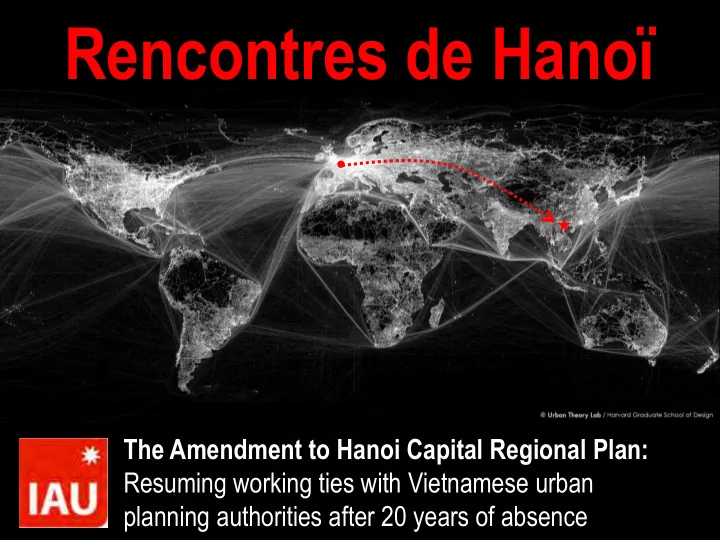
Rencontres de Hanoï
The Amendment to Hanoi Capital Regional Plan: Resuming working ties with Vietnamese urban planning authorities after 20 years of absence
Rencontres de Hano The Amendment to Hanoi Capital Regional Plan: - - PowerPoint PPT Presentation
Rencontres de Hano The Amendment to Hanoi Capital Regional Plan: Resuming working ties with Vietnamese urban planning authorities after 20 years of absence The Institut dAmnagement et dUrbanisme dIle -de-France (IAU-IdF) at a glance
The Amendment to Hanoi Capital Regional Plan: Resuming working ties with Vietnamese urban planning authorities after 20 years of absence
Rencontres de Hanoï – 27 & 28 Mai 2014
The Institut d’Aménagement et d’Urbanisme d’Ile-de-France (IAU-IdF) is the Planning and Development Institute for the French capital region of Paris "Ile-de-France". Originally set up in 1960 to draft the first master plan for the Paris region by the State government, it was transferred to the Ile-de-France Region in 1982 and is thus now chaired by the President of the Regional Council. Its board of directors includes 25 members such as the Regional Prefect, the Chairman of the Regional Economic & Social Council, regional councilors and representatives of the Government and
institutions.
Rencontres de Hanoï – 27 & 28 Mai 2014
1965 1976 1994 2012
Connecting - Structuring Preserving - Enhancing Focusing - Balancing
Today, IAU-IdF's primary mission is to propose planning and development policies for the Ile-de- France region and to implement them. It takes into account their spatial aspects (from local to regional scales, and with respect to French and European policy), and sectorial aspects (planning, transport, and environment projects, housing and urban regeneration policies, etc.) It is in particular responsible for drafting the Ile-de- France Regional Master Plan – SDRIF (or “Ile-de- France 2030”).
Rencontres de Hanoï – 27 & 28 Mai 2014
A regional agency for metropolitan planning taking part in the development of the Grand Paris Project
The Grand Paris transportation project (Grand Paris Express) is the centerpiece of Ile-de-France 2030’s transport policies and urban development orientations. When completed, this new metro network will offer in particular excellent connections with the high speed railway network.
Rencontres de Hanoï – 27 & 28 Mai 2014
IAU-IdF’s workforce is split among:
planning & Design, Transportation, Environment, Economy, Housing & Sociology),
GIS, information, media library and publishing studio),
resources and finance) and
security and sport. In addition to this, IAU-IdF is an active member of the French Federation of Urban Planning Agencies (FNAU )
Rencontres de Hanoï – 27 & 28 Mai 2014
Beyond its standing role as provider of expertise and proposals to the Regional Council, and the departments thereof, for all planning policies in the French capital region, IAU-IdF is a multi-disciplinary metropolitan planning and urban design consultancy. In this context, it works on master plans at various scales for many local authorities in Ile-de-France, in other regions, as well as abroad,. More than 190 people are enrolled at IAU-IdF, including some 140 top professionals from the various fields
development: physical planning, economic planning, environment, demography, housing, transport, GIS and other information technologies.
Rencontres de Hanoï – 27 & 28 Mai 2014
From Shanghai to Hanoi, from Casablanca to Beyrouth, and from Phnom Penh to Mumbai, more than 60 countries
metropolises have already called on the services of IAU- IdF to advise them as regards their development strategies, urban design projects & guidelines, sector-based surveys, or managing and programming their growth.
Rencontres de Hanoï – 27 & 28 Mai 2014
In this framework, a broad range of consultancies may be performed, from master planning studies at metropolitan & city levels to consultations
specific policies & development projects, and training actions. Funding either comes from the French technical cooperation, or from international bodies, through direct allocations (UNDP, World Bank), or local consultancy contracts.
Rencontres de Hanoï – 27 & 28 Mai 2014
Another important role of IAU-IdF is to be a center for regional development analysis and futures studies by means of a range of indicators on population, housing, employment, natural resources, transportation, pollution, noise etc., which are feeding our Regional Geographical Information System (SIGR). IAU-IdF’s IT and geomatics experts are constantly developing new 2D & 3D cartographic and web applications to enhance
Rencontres de Hanoï – 27 & 28 Mai 2014
Rencontres de Hanoï – 27 & 28 Mai 2014
IAU-IdF publishes a quarterly journal (“Les Cahiers) and digest notes (“Notes Rapides”) on various issues of interest for the planning community and its web site enjoys a large audience. It organizes or attend to numerous training sessions, conferences and exhibitions worldwide.
www.iau-idf.fr/...
The Amendment to Hanoi Capital Regional Plan
Resuming working ties with Vietnamese urban planning authorities after 20 years
Rencontres de Hanoï – 27 & 28 Mai 2014
HCR’s Planning & Management Framework
Rencontres de Hanoï – 27 & 28 Mai 2014 (source VIUP)
Each province is quite autonomous in terms of planning
Rencontres de Hanoï – 27 & 28 Mai 2014 (source VIUP)
Many construction master plans seem quite ambitious in terms of urban development and infrastructure provisions: political will or wishful thinking ?
PHÚ THỌ VĨNH PHÚC THÁI NGUYÊN BẮC GIANG HÀ NỘI BẮC NINH HÒA BÌNH HƯNG YÊN HẢI DƯƠNG HÀ NAM
Rencontres de Hanoï – 27 & 28 Mai 2014 (source VIUP)
Quite a tight schedule right from the start!
Rencontres de Hanoï – 27 & 28 Mai 2014
TASK 1: DEVELOPMENT FORECASTING
T.1.1.SWOT Analysis T.1.2.Economic Growth Forecasting T.1.3.Population & Labor Growth Forecasting T.1.4.Land Consumption Forecasting T.1.5.Urbanization Capacity and Environmental Impact Assessment T.1.6.Regional/Provincial Socio-Economic Development Models Assessment T.1.7.International Benchmarking of Regional Development Models T.1.8. Regional Development Visions and Objectives T.1.9.Socio-economic & Spatial Development Scenarios T.1.10.Master Plan Implementation Strategy
TASK 2: TRANSPORTATION PLANNING
T.2.1.Transportation System & Traffic Assessment for Goods T.2.2.Transportation System & Traffic Assessment for Passengers T.2.3.International Benchmarking of Transportation Strategies T.2.4.Traffic Development Forecasting for Goods T.2.5.Traffic Development Forecasting for Passengers T.2.6.Orientations for Freight Transport Networks and Logistics Hubs T.2.7.Orientations for Passengers Transport Networks and Intermodal Hubs T.2.8.Orientations for the Regional Airport System
Rencontres de Hanoï – 27 & 28 Mai 2014
Rencontres de Hanoï – 27 & 28 Mai 2014 (source NIURP/Hansen Partnership)
It set key development orientations, in particular 2 east-west mixed transportation corridors and the promotion of Hai Duong to the status of « regional » city by 2030
A “planning region” of:
Rencontres de Hanoï – 27 & 28 Mai 2014 (source VIUP)
A bigger region in terms of population and space, but not necessarily in terms of wealth per capita because the 3 new provinces are mainly rural…
The scope of the revision includes Ha Noi capital and 9 provinces: Vinh Phuc, Bac Ninh, Hai Duong, Hung Yen, Ha Nam, Hoa Binh, Phu Tho, Thai Nguyen and Bac Giang. HCR reaches today a total area of 24,314 km2 and a population of approximately 17.5 M people (i.e. 19.1% of VN’s population).
Regional urban system: 136 cities/towns Regional percentage of urban population: 30% (same as VN as whole) Average population size: 35,000 people per city/town
Rencontres de Hanoï – 27 & 28 Mai 2014 (source VIUP)
One of the most intensely populated regions in the world, with rural densities reaching up to 1,500 people/sq.km and urban ones up to 40,000 people/sq.km (i.e a “desakota”)
Farmland & forests: 1,702,233 Ha Residential lands: 147,775 Ha Other developed lands: 222,100 Ha Unused & vacant lands: 165,028 Ha > 454,000 Ha requested by 2020 for HCR’s food security
Rencontres de Hanoï – 27 & 28 Mai 2014
Significant and hard to manage changes, yet not as radical as in China !
Rencontres de Hanoï – 27 & 28 Mai 2014 (source VIUP)
A need to catch up with many big infrastructure projects, particularly in Hanoi Capital
SWOT Analysis
Rencontres de Hanoï – 27 & 28 Mai 2014
Quite useful to launch the debate on key development issues !
Rencontres de Hanoï – 27 & 28 Mai 2014
Often requested yet seldom used: an exercise in style in some ways !
Rencontres de Hanoï – 27 & 28 Mai 2014
Socioeconomic databases in Vietnam must make some progresses…
Rencontres de Hanoï – 27 & 28 Mai 2014
in « strategic » metropolitan planning and benchmarking
vietnamese planning procedures and technical skills
growth scenarios
(statistically and GIS-driven) with more pragmatic expertises
Rencontres de Hanoï – 27 & 28 Mai 2014
Rencontres de Hanoï – 27 & 28 Mai 2014
Thank you ! Xin trân trọng cảm ơn!