Renal Failure and the diabetic Foot Andrew J M Boulton, MD, DSc, - - PowerPoint PPT Presentation

renal failure and the diabetic foot
SMART_READER_LITE
LIVE PREVIEW

Renal Failure and the diabetic Foot Andrew J M Boulton, MD, DSc, - - PowerPoint PPT Presentation

Renal Failure and the diabetic Foot Andrew J M Boulton, MD, DSc, FACP, FICP,FRCP Universities of Manchester, UK and Miami, FL, USA President, Worldwide Diabetes Educational Initiative The art of medicine consists of Complications of


slide-1
SLIDE 1

Renal Failure and the diabetic Foot

Andrew J M Boulton, MD, DSc, FACP, FICP,FRCP Universities of Manchester, UK and Miami, FL, USA

President, Worldwide Diabetes Educational Initiative

Harris MI. Clin Invest Med. 1995;18:231-239. Nelson RG, et al. Adv Nephrol Necker Hosp. 1995;24:145-156. World Health Organization. Diabetes Mellitus Fact Sheet 138.2002.

Diabetic Retinopathy

Microvascular Complications Macrovascular Complications

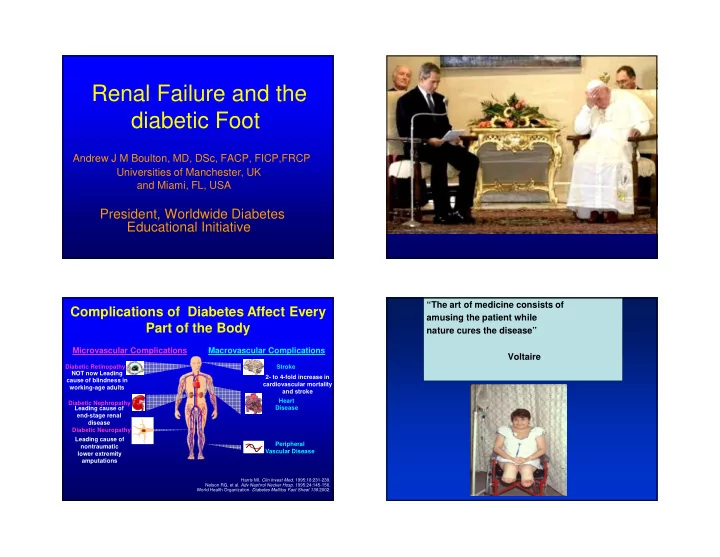
Complications of Diabetes Affect Every Part of the Body

Diabetic Nephropathy Diabetic Neuropathy Stroke Peripheral Vascular Disease Heart Disease NOT now Leading cause of blindness in working-age adults Leading cause of end-stage renal disease Leading cause of nontraumatic lower extremity amputations 2- to 4-fold increase in cardiovascular mortality and stroke

“The art of medicine consists of amusing the patient while nature cures the disease” Voltaire

slide-2
SLIDE 2

an affliction that is not very frequent…being a melting down of the flesh and limbs into the urine…life is short, disgusting and painful…thirst unquenchable…the kidneys and bladder never stop making water…it may be something pernicious, derived from other diseases, which attack the bladder and kidneys

Areteus of Cappadocia (early 2nd century ad)

Diabetes...

The Harsh Reality of Diabetes

  • Most common cause of ESRD in Europe/USA

140 per million in diabetes 15-42 per million in non-diabetes

  • Once on dialysis poor survival if diabetic

5 year survival 30.2% if diabetic 5 year survival 62.2% if non-diabetic

diabetes hypertension glomerulonephritis cystic kidney disease

Incidence of End Stage Renal Disease

Rossing P Diabetologia 2005;48:1439-1444

ACEi

Proteinuria Is an Independent Risk Factor for Mortality in Type 2 Diabetes

*P < 0.001 normoalbuminuria vs macroalbuminuria. Gall MA et al. Diabetes. 1995;44:1303-1309.

1.0 0.9 0.8 0.7 0.6 0.5 1 2 3 4 5 6 Years Survival (all-cause mortality) Normoalbuminuria (n = 191) Microalbuminuria (n = 86) Macroalbuminuria* (n = 51)

P <.01 P <.05

slide-3
SLIDE 3

DN = diabetic nephropathy. Adler et al. Kidney Int. 2003;63:225-232.

Annual Transition Rates Through Stages of DN

No nephropathy Microalbuminuria Macroalbuminuria

Elevated plasma creatinine or Renal replacement therapy

2.0% (1.9% to 2.2%) 2.8% (2.5% to 3.2%) 2.3% (1.5% to 3.0%) 1.4% (1.3% to 1.5%) 3.0% (2.6% to 3.4%) 4.6% (3.6% to 5.7%) 19.2% (14.0% to 24.4%)

Causal Pathways for Foot Ulceration

  • Neuropathy most important component

cause (78%)

  • Critical triad: neuropathy, deformity,

and trauma present in 63%

  • Ischemia component cause in 35%
  • >80% of ulcers potentially preventable

Reiber, Vileikyte et al, 1999.

Risk Factors for foot ulceration in Diabetic Nephropathy

84 patients studied

  • 4 groups: Microalbuminuria (MA),

Albuminuria (A); Chronic Renal Failure(CRF) and non-nephropathic diabetes (N)

  • VPT, NCVs and dynamic foot pressures

assessed

Fernando DJ et al, Diabetic Med 1991;8:223.

Risk Factors for foot ulceration in Diabetic Nephropathy:

Results

  • VPT, NCV and foot pressures

significantly reduced in all 3 groups – eg., VPT: MA=21, A=28, CRF=39V.

  • Past history of ulcers in 5% NN, 10%

MA and A, and 40% CRF.

  • Patients at all stages of nephropathy

have increased DFU risk.

Fernando DJ et al, Diabetic Med 1991;8:223.

slide-4
SLIDE 4

Other Associations with Foot Ulceration End-stage Renal Disease

  • Association between start of dialysis

and incidence of foot ulceration

  • Up to 40% of dialysis patients have past
  • r current ulceration
  • ? Related to lack of diabetes follow-up
  • ? Ethnic protection lost

Game et al 2006, 2010; Ndip et al 2010

Incidence of Foot Ulcers & Amputation in ESRD

Game FL, Jeffcoate WH et al. Nephrol Dial Transplant 2006

CKD associated risk independent of PAD

1 2 3 4 5 6 7 8 9 No PAD PAD Total population No PAD PAD Total population Foot Ulcer Amputation ≥ 60 ml/min ≥ 30 to < 60 ml/min < 30 ml/min

Margolis DJ, Hofstad O, Feldman HI. Diabetes Care 2008

Life on Dialysis

Nicholas Evans, BMJ 2012;345:e5262:

“Being on dialysis isn’t really a life: it’s not even half a life.”

Renata Carey, BMJ 2012:345:e4492:

”Dialysis is brilliant, of course, but deeply horrendous.”

Renata Carey, BMJ 2012:345:e4492

“On the dialysis unit, patients suddenly appear with amputations: and often before that with heavily bandaged feet, rapidly followed by crutches and then wheelchairs.”

slide-5
SLIDE 5

Dialysis and Foot Ulceration

  • Dialysis is an independent risk factor

for foot ulceration

  • When compared to ESRD patients not
  • n dialysis, 4.2x increased risk of foot

ulceration

  • Mortality after amputation - 290%

increase in hazard for those on dialysis

  • Need for foot care on dialysis units

Ndip A et al, Diabetes Care 2010;33: 878-880 and 33;1811-1816 Lavery et al, Diabetes Care 2010;33:epub August 25th.

Dialysis vs No-dialysis

Factor No-dialysis (n=187)α Dialysis (n=139)α OR (95% CI) P-value Prevalent foot ulcer (%) 4.8 21 5.1 (2.3 to 11) <0.0001 Prior amputation (%) 6.4 15 2.6 (1.2 to 5.6) 0.008 PAD (%) 43 64 2.4 (1.5 to 3.8) <0.0001 Neuropathy (%) 65 79 2.0 (1.2 to 3.3) 0.006 Prior foot ulcer (%) 20 32 1.9 (1.1 to 3.1) 0.011 Deformity (%) 33 22 0.6 (0.4 to 1.0) 0.019 IWGDF risk categories (%) Low vs High risk category 16 vs 85 7 vs 94 2.7 (1.2 to 5.8) 0.015 Patient care Use of bespoke footwear (%) 8 16 2.6 (1.2 to 4.3) 0.026 Walking barefoot at home (%) 28 43 2.0 (1.2 to 3.1) 0.004 Routine podiatry attendance (%) 70 44 0.3 (0.2 to 0.5) <0.0001 Daily inspection of foot (%) 70 29 0.2 (0.1 to 0.3) <0.0001

Ndip A et al. Diabetes Care 2010

ADA T A S K F O R C E R E P O R T

Risk factors for foot ulcers

  • Previous amputation
  • Past foot ulcer history
  • Peripheral neuropathy
  • Foot deformity
  • Peripheral vascular disease
  • Visual impairment
  • Diabetic nephropathy (especially those on dialysis)
  • Poor glycemic control
  • Cigarette smoking

Boulton AJM et al, Diabetes Care 2008;31:1679.

Mortality after amputation in CKD & Haemodialysis

CKD and dialysis treatment are independent risk factors for mortality after lower extremity amputation. 10-year mortality among patients on dialysis who have an amputation X 3 greater than patients that require amputation without CKD. Mortality in this population is higher than many

  • ther disease processes such as coronary artery

disease and cancer

Lavery LA, Hunt NA, Ndip A et al. Diabetes care 2010

slide-6
SLIDE 6

Cumulative survival post-amputation

Lavery LA, Hunt NA, Ndip A et al. Diabetes care 2010

Mortality,Dialysis and Foot Ulceration

  • 192 diabetic dialysis patients followed

for 2 years

  • Overall 2 yr mortality 53%: 59% if foot

ulcer at baseline; 74% if amputation: p<0.001.

  • Mortality after amputation - 290%

increase in hazard for those on dialysis

  • Need for foot care on dialysis units

Ndip A et al, 2012 .

Recommendations

  • 3. Vascular Assessment
  • Foot pulse assessment – dichotomous

IF ANY PULSE ABSENT or Hx of PVD, then

  • Ankle Brachial Index if possible.

Recommendations What about the ABI?

  • ADA/ACC recommend that all those

patients >50 years old should have an annual ABI

  • Is this practical
  • Could this give rise to a false sense of

security?

slide-7
SLIDE 7

Recommendations What about the ABI?

  • ADA/ACC recommend that all those

patients >50 years old should have an annual ABI

  • Is this practical
  • Could this give rise to a false sense of

security?

Charcot

Vascular calcification Osteolysis/osteopenia

RANKL/OPG ? Diabetes ESRD Foot ulceration Amputation Charcot neuroarthropathy (CNA):

The osteolysis/ vascular calcification paradox

slide-8
SLIDE 8

Contrasting fortunes: Chalk or Cheese

RANKL/OPG and Vascular Calcification

  • RANKL/OPG signaling pathway plays a

role in vascular calcification

  • Human VSMCs cultured in serum from

CN patients show accelerated

  • steoblastic differentiation
  • This pathway is a potential target for

intervention

Ndip A et al, Diabetes 2011;60:2187

Multidisciplinary team

  • Diabetologists
  • Interventional Radiologists
  • Nurses
  • Orthotist
  • Patient
  • Podiatrist
  • Surgeons

No conflicting advice

For one mistake made for not knowing, ten mistakes are made for not looking.

J A Lindsay