Reminder of Asymptotic Notation Let f , g : N ! R be functions. We - - PowerPoint PPT Presentation

reminder of asymptotic notation
SMART_READER_LITE
LIVE PREVIEW

Reminder of Asymptotic Notation Let f , g : N ! R be functions. We - - PowerPoint PPT Presentation

1 / 18 2 / 18 Reminder of Asymptotic Notation Let f , g : N ! R be functions. We say that: I f is O ( g ) if there is some n 0 2 N and some c > 0 2 R such that for all n n 0 we have Inf 2B: Asymptotic notation and Algorithms Lecture 2B of


slide-1
SLIDE 1

1 / 18

Inf 2B: Asymptotic notation and Algorithms

Lecture 2B of ADS thread Kyriakos Kalorkoti

School of Informatics University of Edinburgh

2 / 18

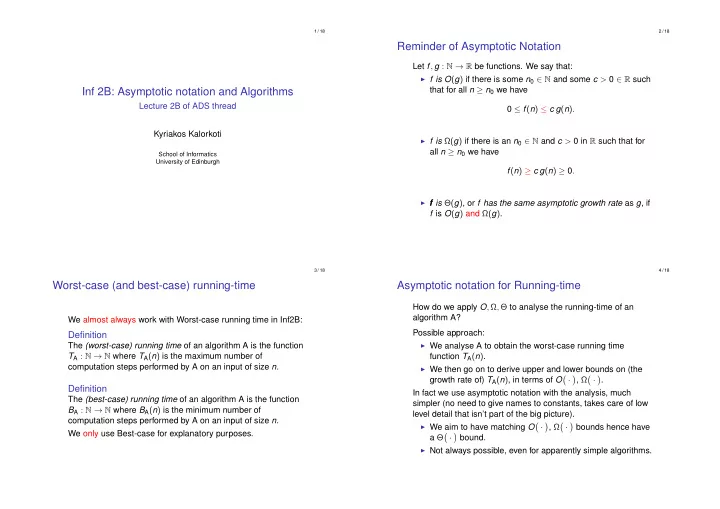
Reminder of Asymptotic Notation

Let f, g : N ! R be functions. We say that:

I f is O(g) if there is some n0 2 N and some c > 0 2 R such

that for all n n0 we have 0  f(n)  c g(n).

I f is Ω(g) if there is an n0 2 N and c > 0 in R such that for

all n n0 we have f(n) c g(n) 0.

I f

f f is Θ(g), or f has the same asymptotic growth rate as g, if f is O(g) and Ω(g).

3 / 18

Worst-case (and best-case) running-time

We almost always work with Worst-case running time in Inf2B:

Definition

The (worst-case) running time of an algorithm A is the function TA : N ! N where TA(n) is the maximum number of computation steps performed by A on an input of size n.

Definition

The (best-case) running time of an algorithm A is the function BA : N ! N where BA(n) is the minimum number of computation steps performed by A on an input of size n. We only use Best-case for explanatory purposes.

4 / 18

Asymptotic notation for Running-time

How do we apply O, Ω, Θ to analyse the running-time of an algorithm A? Possible approach:

I We analyse A to obtain the worst-case running time

function TA(n).

I We then go on to derive upper and lower bounds on (the

growth rate of) TA(n), in terms of O

  • ·
  • , Ω
  • ·
  • .

In fact we use asymptotic notation with the analysis, much simpler (no need to give names to constants, takes care of low level detail that isn’t part of the big picture).

I We aim to have matching O

  • ·
  • , Ω
  • ·
  • bounds hence have

a Θ

  • ·
  • bound.

I Not always possible, even for apparently simple algorithms.

slide-2
SLIDE 2

5 / 18

Example

algA(A,r,s) algB(A,r,s)

  • 1. if r < s then
  • 1. if A[r] < A[s] then

2. for i r to s do 2. swap A[r] with A[s] 3. for j i to s do

  • 3. if r < s r then

4. m b i+j

2 c

4. algA(A, r, s r) 5. algB(A, i, m 1) 6. algB(A, m, j) 7. m b r+s

2 c

8. algA(A, r, m 1) 9. algA(A, m, s)

6 / 18

linSearch

Input: Integer array A, integer k being searched. Output: The least index i such that A[i] = k. Algorithm linSearch(A, k)

  • 1. for i 0 to A.length 1 do

2. if A[i] = k then 3. return i

  • 4. return 1

(Lecture Note 1) Worst-case running time TlinSearch(n) satisfies (c1 + c2)n + min{c3, c1 + c4}  TlinSearch(n)  (c1 + c2)n + max{c3, c1 + c4}. Best-case running time satisfies BlinSearch(n) = c1 + c2 + c3.

7 / 18

Picture of TlinSearch(n), BlinSearch(n)

1

B(n)=c +c +c

2 1

T(n)=(c +c )n + ...

2 45 40 35 30 25 20 15 10 5 10 5 15 25 20 30 35 40 45 50 55 60 70 65 3

8 / 18

TlinSearch(n) = O(n)

Proof.

From Lecture Note 1 we have TlinSearch(n)  (c1 + c2) · n + max

  • c3, (c1 + c4)

. Take n0 = max{c3, (c1 + c4)}, c = c1 + c2 + 1. Then for every n n0, we have TlinSearch(n)  (c1 + c2)n + n0  (c1 + c2 + 1)n = cn. Hence TlinSearch(n) = O(n).

slide-3
SLIDE 3

9 / 18

TlinSearch(n) = Ω(n)

We know TlinSearch(n) = O(n). Also true: TlinSearch(n) = O(n lg(n)), TlinSearch(n) = O(n2). Is TlinSearch(n) = O(n) the best we can do? YES, because . . . TlinSearch(n) = Ω(n).

Proof.

TlinSearch(n) (c1 + c2)n, because all ci are positive. Take n0 = 1 and c = c1 + c2 in defn of Ω. TlinSearch(n) = Θ(n).

10 / 18

Misconceptions/Myths about O and Ω

MISCONCEPTION 1 If we can show TA(n) = O(f(n)) for some function f : N ! R, then the running time of A on inputs of size n is bounded by f(n) for sufficiently large n. FALSE: Only guaranteed an upper bound of cf(n), for some constant c > 0. Example: Consider linSearch. We could have shown TlinSearch = O( 1

2(c1 + c2)n) (or O(αn), for any constant α > 0)

exactly as we showed TlinSearch(n) = O(n) but . . . the worst-case for linSearch is greater than 1

2(c1 + c2)n.

11 / 18

Misconceptions/Myths about O and Ω

MISCONCEPTION 2 Because TA(n) = O(f(n)) implies a c f(n) upper bound on the running-time of A for all inputs of size n, then TA(n) = Ω(g(n)) implies a similar lower bound on the running-time of A for all inputs of size n. FALSE: If TA(n) = Ω(g(n)) for some g : N ! R, then there is some constant c0 > 0 such that TA(n) c0 g(n) for all sufficiently large n. But A can be much faster than TA(n) on other inputs of length n that are not worst-case! No lower bound on general inputs of size n. linSearch graph is an example.

12 / 18

Insertion Sort

Input: An integer array A Output: Array A sorted in non-decreasing order Algorithm insertionSort(A)

  • 1. for j 1 to A.length 1 do

2. a A[j] 3. i j 1 4. while i 0 and A[i] > a do 5. A[i + 1] A[i] 6. i i 1 7. A[i + 1] a

slide-4
SLIDE 4

13 / 18

Example: Insertion Sort

3 6 5 1 4 Input: 3 6 5 1 4 j=1 3 1 4 j=2 5 6 6 5 1 4 j=3 6 5 3 6 5 1 3 5 6 4 5 6 4 j=4 1 3

14 / 18

Big-O for TinsertionSort(n)

Algorithm insertionSort(A)

  • 1. for j 1 to A.length 1 do

2. a A[j] 3. i j 1 4. while i 0 and A[i] > a do 5. A[i + 1] A[i] 6. i i 1 7. A[i + 1] a Line 1 O(1) time, executed A.length 1 = n 1 times. Lines 2,3,7 O(1) time each, executed n 1 times. Lines 4,5,6 O(1)-time, executed together as for-loop. No. of executions depends on for-test, j. For fixed j, for-loop at 4. takes at most j iterations.

15 / 18

Algorithm insertionSort(A)

  • 1. for j 1 to A.length 1 do

2. a A[j] 3. i j 1 4. while i 0 and A[i] > a do 5. A[i + 1] A[i] 6. i i 1 7. A[i + 1] a For a fixed j, lines 2-7 take at most O(1)+O(1) + O(1) + O(j) + O(j) + O(j) + O(1) = O(1) + O(j) = O(1) + O(n) = O(n). There are n 1 different j-values. Hence TinsertionSort(n) = (n 1)O(n) = O(n)O(n) = O(n2).

16 / 18

TinsertionSort(n) = Ω(n2)

Harder than O(n2) bound. Focus on a BAD instance of size n: Take input instance hn, n 1, n 2, . . . , 2, 1i.

I For every j = 1 . . . , n 1, insertionSort uses j executions

  • f line 5 to insert A[j].

Then TinsertionSort(n)

  • n1

X

j=1

c j = c

n1

X

j=1

j = c n(n 1) 2 . So TinsertionSort(n) = Ω(n2) and TinsertionSort(n) = Θ(n2).

slide-5
SLIDE 5

17 / 18

“Typical” asymptotic running times

I Θ(lg n) (logarithmic), I Θ(n) (linear), I Θ

  • n lg n
  • (n-log-n),

I Θ(n2) (quadratic), I Θ(n3) (cubic), I Θ(2n) (exponential).

18 / 18

Further Reading

I Lecture notes 2 from last week. I If you have Goodrich & Tamassia [GT]:

All of the chapter on “Analysis Tools” (especially the “Seven functions” and “Analysis of Algorithms” sections).

I If you have [CLRS]:

Read chapter 3 on “Growth of Functions.”