Remember These? Carbon monoxide rigid rotator Zeeman effect in the - - PowerPoint PPT Presentation

remember these
SMART_READER_LITE
LIVE PREVIEW

Remember These? Carbon monoxide rigid rotator Zeeman effect in the - - PowerPoint PPT Presentation

Remember These? Carbon monoxide rigid rotator Zeeman effect in the Sun Jerry Gilfoyle Radiation 1 / 13 Remember These? Carbon monoxide rigid rotator Zeeman effect in the Sun To explain these we invoked selection rules: l = 1, m =

slide-1
SLIDE 1

Remember These?

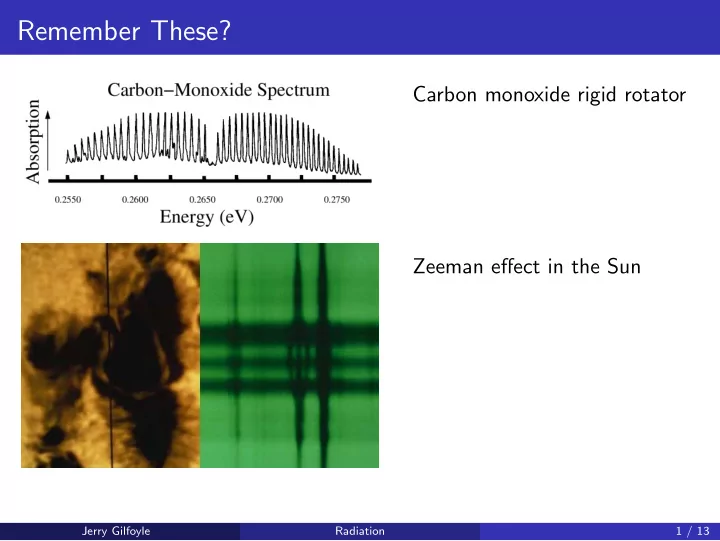
Carbon monoxide rigid rotator Zeeman effect in the Sun

Jerry Gilfoyle Radiation 1 / 13

slide-2
SLIDE 2

Remember These?

Carbon monoxide rigid rotator Zeeman effect in the Sun To explain these we invoked selection rules: ∆l = ±1, ∆m = 0, ±1.

Jerry Gilfoyle Radiation 1 / 13

slide-3
SLIDE 3

Remember These?

Carbon monoxide rigid rotator Zeeman effect in the Sun To explain these we invoked selection rules: ∆l = ±1, ∆m = 0, ±1.

WHY? WHY? WHY?

Jerry Gilfoyle Radiation 1 / 13

slide-4
SLIDE 4

The Question

To explain the carbon monox- ide spectrum and the Zeeman effect we invoked angular mo- mentum selection rules: ∆l = ±1, ∆m = 0, ±1 to under- stand light emission from the transitions between atomic en- ergy states. Where do these selections rules come from?

Jerry Gilfoyle Radiation 2 / 13

slide-5
SLIDE 5

What Is an Electromagnetic Wave?

Jerry Gilfoyle Radiation 3 / 13

slide-6
SLIDE 6

What Is an Electromagnetic Wave?

1 Consider a charge at a point in space. It creates an

E field at all points in space.

Jerry Gilfoyle Radiation 3 / 13

slide-7
SLIDE 7

What Is an Electromagnetic Wave?

1 Consider a charge at a point in space. It creates an

E field at all points in space.

2 Let the charge move and the

E field changes.

Jerry Gilfoyle Radiation 3 / 13

slide-8
SLIDE 8

What Is an Electromagnetic Wave?

1 Consider a charge at a point in space. It creates an

E field at all points in space.

2 Let the charge move and the

E field changes.

3 This disturbance of the

E propagates through space via electromagnetic induction - a changing electric field induces a changing magnetic field B which induces an electric field...

Jerry Gilfoyle Radiation 3 / 13

slide-9
SLIDE 9

What Is an Electromagnetic Wave?

1 Consider a charge at a point in space. It creates an

E field at all points in space.

2 Let the charge move and the

E field changes.

3 This disturbance of the

E propagates through space via electromagnetic induction - a changing electric field induces a changing magnetic field B which induces an electric field...

4 If the charge oscillates sinusoidally, then you get ‘typical’

electromagnetic (EM) waves.

Jerry Gilfoyle Radiation 3 / 13

slide-10
SLIDE 10

More on Oscillating Charges

1 How is the amplitude of the wave related to the oscillator? Jerry Gilfoyle Radiation 4 / 13

slide-11
SLIDE 11

More on Oscillating Charges

1 How is the amplitude of the wave related to the oscillator?

Amplitudeoscillator ∝ Amplitudewave

Jerry Gilfoyle Radiation 4 / 13

slide-12
SLIDE 12

More on Oscillating Charges

1 How is the amplitude of the wave related to the oscillator?

Amplitudeoscillator ∝ Amplitudewave

2 What phenomenon connects points in space so the wave propagates? Jerry Gilfoyle Radiation 4 / 13

slide-13
SLIDE 13

More on Oscillating Charges

1 How is the amplitude of the wave related to the oscillator?

Amplitudeoscillator ∝ Amplitudewave

2 What phenomenon connects points in space so the wave propagates?

Electromagnetic induction

Jerry Gilfoyle Radiation 4 / 13

slide-14
SLIDE 14

More on Oscillating Charges

1 How is the amplitude of the wave related to the oscillator?

Amplitudeoscillator ∝ Amplitudewave

2 What phenomenon connects points in space so the wave propagates?

Electromagnetic induction

3 Consider two charges ±e a distance r0

apart and located along the z axis with dipole moment d = e r0.

Field Lines Electric

d = er

Jerry Gilfoyle Radiation 4 / 13

slide-15
SLIDE 15

More on Oscillating Charges

1 How is the amplitude of the wave related to the oscillator?

Amplitudeoscillator ∝ Amplitudewave

2 What phenomenon connects points in space so the wave propagates?

Electromagnetic induction

3 Consider two charges ±e a distance r0

apart and located along the z axis with dipole moment d = e r0.

Field Lines Electric

d = er

4 How is the electric field related to

r0 and the dipole moment?

Jerry Gilfoyle Radiation 4 / 13

slide-16
SLIDE 16

More on Oscillating Charges

1 How is the amplitude of the wave related to the oscillator?

Amplitudeoscillator ∝ Amplitudewave

2 What phenomenon connects points in space so the wave propagates?

Electromagnetic induction

3 Consider two charges ±e a distance r0

apart and located along the z axis with dipole moment d = e r0.

Field Lines Electric

d = er

4 How is the electric field related to

r0 and the dipole moment?

  • E ∝

r0 cos ωt → e r0 cos ωt = d cos ωt

Jerry Gilfoyle Radiation 4 / 13

slide-17
SLIDE 17

Energy Transfer in an Electromagnetic Wave

  • S = 1

µ0

  • E ×

B

Jerry Gilfoyle Radiation 5 / 13

slide-18
SLIDE 18

Rapidly Oscillating Energy Transfer

5 10 15 20

  • 1.0
  • 0.5

0.0 0.5 1.0 t (10-9 s) Ey(N/C) 〈 〉 〈 〉

Jerry Gilfoyle Radiation 6 / 13

slide-19
SLIDE 19

Rapidly Oscillating Energy Transfer

5 10 15 20

  • 1.0
  • 0.5

0.0 0.5 1.0 t (10-9 s) Ey(N/C) 5 10 15 20

  • 1.0
  • 0.5

0.0 0.5 1.0 t (10-9 s) Sx(J/s-m 2) 〈 〉 〈 〉

Jerry Gilfoyle Radiation 6 / 13

slide-20
SLIDE 20

Rapidly Oscillating Energy Transfer

5 10 15 20

  • 1.0
  • 0.5

0.0 0.5 1.0 t (10-9 s) Ey(N/C) 5 10 15 20

  • 1.0
  • 0.5

0.0 0.5 1.0 t (10-9 s) Sx(J/s-m 2) 〈Sx〉= 1/2 5 10 15 20

  • 1.0
  • 0.5

0.0 0.5 1.0 t (10-9 s) Sx(J/s-m 2) 〈 〉

Jerry Gilfoyle Radiation 6 / 13

slide-21
SLIDE 21

Rapidly Oscillating Energy Transfer

5 10 15 20

  • 1.0
  • 0.5

0.0 0.5 1.0 t (10-9 s) Ey(N/C) 5 10 15 20

  • 1.0
  • 0.5

0.0 0.5 1.0 t (10-9 s) Sx(J/s-m 2) 〈Sx〉= 1/2 5 10 15 20

  • 1.0
  • 0.5

0.0 0.5 1.0 t (10-9 s) Sx(J/s-m 2) 〈Sx〉= 1/2 5 10 15 20

  • 1.0
  • 0.5

0.0 0.5 1.0 t (10-9 s) Sx(J/s-m 2)

Jerry Gilfoyle Radiation 6 / 13

slide-22
SLIDE 22

Time Dependence of Coefficients

|a

2

|b

2

tmax ∼10-8s 0.5 1 t P(t)

P(t) = |Ψ( r, t)|2 = | aeiEnt/|nlm + beiEn′t/|n′l′m′ |2

Jerry Gilfoyle Radiation 7 / 13

slide-23
SLIDE 23

Some Necessary Math Results

Jerry Gilfoyle Radiation 8 / 13

slide-24
SLIDE 24

Some Necessary Math Results

Jerry Gilfoyle Radiation 9 / 13

slide-25
SLIDE 25

Some Necessary Math Results

Jerry Gilfoyle Radiation 10 / 13

slide-26
SLIDE 26

Some Necessary Math Results

Jerry Gilfoyle Radiation 11 / 13

slide-27
SLIDE 27

Some More Necessary Math Results

Jerry Gilfoyle Radiation 12 / 13

slide-28
SLIDE 28

Some More Necessary Math Results

Jerry Gilfoyle Radiation 13 / 13