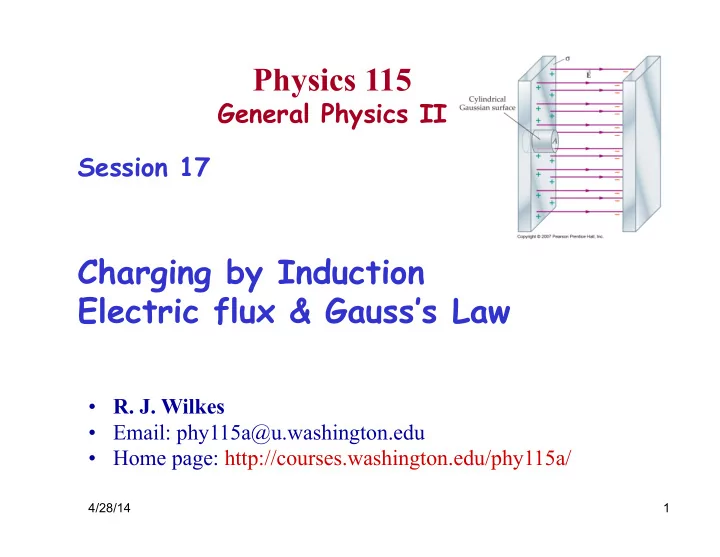
Physics 115
General Physics II Session 17
Charging by Induction Electric flux & Gauss’s Law
4/28/14 1
- R. J. Wilkes
- Email: phy115a@u.washington.edu
- Home page: http://courses.washington.edu/phy115a/
Physics 115 General Physics II Session 17 Charging by Induction - - PowerPoint PPT Presentation
Physics 115 General Physics II Session 17 Charging by Induction Electric flux & Gausss Law R. J. Wilkes Email: phy115a@u.washington.edu Home page: http://courses.washington.edu/phy115a/ 4/28/14 1 Lecture Schedule (up to
4/28/14 1
4/28/14 Physics 115
Today
2
– Except near edges: symmetry ends there! – “infinite sheet” approximation... – NOTICE: E does not diminish with distance!
– For a sheet in the y-z plane, consider E field at a point on the x axis: For contributions to E from Δq’s symmetrically located at + y
4/28/14 3 Physics 115
– Capacitors have many useful properties
– We’ll come back to study them later
4/28/14 4 Physics 115
4/28/14 5 Physics 115
Charge separation by induction:
– (not in contact – no direct transfer of q)
within conductor
and left behind
zero but E field of rod has caused charge separation
inside conductor cancels external field from rod
4/28/14 6
7
never touching) one sphere
charge.
The near one has negative and the far one has positive charge.
4/28/14 7
8
a) A single neutral conducting sphere is polarized by the positively charged rod, which attracts negative charges b) The conductor is grounded by connecting a wire to the Earth, which acts like a gigantic conductor c) Electrons from the ground neutralize the positive charge on the far
(somewhere within the Earth there is a bit of extra negative charge) d) The negative charge remains if the connection to the ground is broken before the rod is removed. e) After the rod is removed, the sphere has a uniform negative charge.
4/28/14 8
In insulators, external charge’s E field can distort the distribution of electrons, producing an asymmetry in the atoms that makes one end +, the other – . On average, there will be a net force on the object. (Notice the electrons do not separate from the nuclei, as in a conductor) Some materials have polar molecules:
water molecule 4/28/14 9
– Superseded by modern E field concept, but useful; flux can be connected to real physical quantities: we define – A means area of a surface, taking into account its angle relative to the E field direction
– then ΦE = E ⋅ A
Deep thought: how do we choose which direction perpendicular to surface ? (we could reverse n) Here, we choose direction where E has a parallel component This will come up again...
4/28/14 10
ΦE = E ⋅ A = E Acosθ
4/28/14 11
– Maximum flow if loop is perpendicular to airflow – Zero if loop is parallel – At other angles, airflow is given by dot product of v and A
“(component of v perpendicular to A) times (A)”, OR “(v) times (component of A perpendicular to v)”
ΦAIR = v ⋅ A = vAcosθ
4/28/14 12