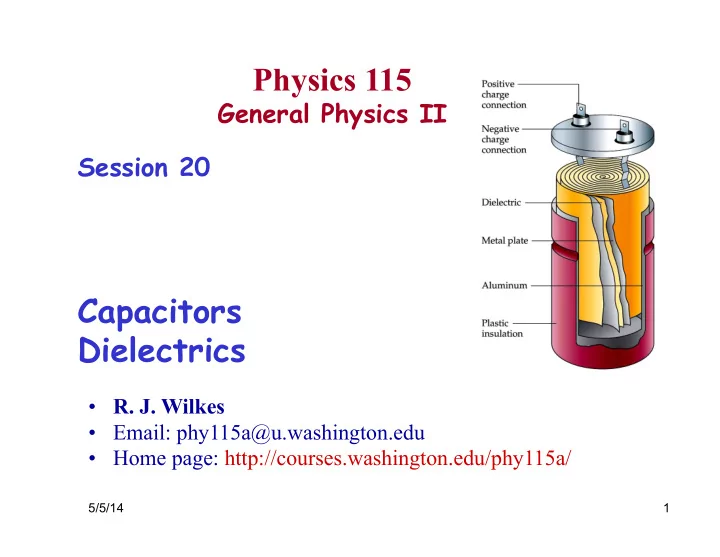
Physics 115 General Physics II Session 20 Capacitors Dielectrics - - PowerPoint PPT Presentation

physics 115
SMART_READER_LITE
LIVE PREVIEW

Physics 115 General Physics II Session 20 Capacitors Dielectrics - - PowerPoint PPT Presentation

Physics 115 General Physics II Session 20 Capacitors Dielectrics R. J. Wilkes Email: phy115a@u.washington.edu Home page: http://courses.washington.edu/phy115a/ 5/5/14 1 Lecture Schedule (up to exam 2) Today 5/5/14 Physics 115


slide-1
SLIDE 1

Physics 115

General Physics II Session 20

Capacitors Dielectrics

5/5/14 1

  • R. J. Wilkes
  • Email: phy115a@u.washington.edu
  • Home page: http://courses.washington.edu/phy115a/
slide-2
SLIDE 2

5/5/14 Physics 115

Today

Lecture Schedule

(up to exam 2)

2

slide-3
SLIDE 3

Announcements

  • Exam 2 is this Friday 5/9
  • Covers material discussed in class from Chs 18, 19, 20
  • NOT Ch. 21
  • Same format and procedures as last exam
  • If you arranged to take exam 1 with section B, please do

same for all remaining exams, OR email us to say you want to change

  • Practice questions will posted Tuesday, and we will review

them in class Thursday

5/5/14 3

slide-4
SLIDE 4

Field Lines and Equipotentials

5/5/14 4

Field maps can have equipotentials drawn, simultaneously showing the E field and the electric potential V. Here: map for equal and oppositely charged plates. Remember: equipotentials will always be perpendicular to field lines: that’s how we define potentials! (no work done moving along one) Remember: both field lines and V contours are “just pictures”, not real

  • bjects.

Spacing of lines, etc, is just a matter of choice. Notice: V increases in opposite direction to motion of a “falling” +q

slide-5
SLIDE 5

Equipotentials around sets of charges

  • For 2 point charges (both +, or a dipole)

5/5/14 5

slide-6
SLIDE 6

Conductors and Equipotentials

5/5/14 6

Recall: All points on or inside a conductor in electrostatic equilibrium must be at the same potential. (Otherwise, mobile charges will move around until the potential IS constant.) Therefore, the surface of a conductor is an equipotential.

slide-7
SLIDE 7

Why is charge concentrated near sharp spots?

  • Conducting sphere creates external E

field as if it were a point charge at its center (same as gravity of Earth)

  • If we want 2 conducting spheres of

different radii to have the same potential at their surfaces, we have to give the smaller one larger charge density (not more Q):

5/5/14 7

Surface area A = 4πR2, charge density σ = Q / A V(R) = kQ R = 4πkσ R →V ∝ R

Surface area A = 4πr2, charge density σ1 = Q1 / A V = 4πkσ1R ⇒ R / 2 needs 2σ1 to have same V But notice: Q2 =σ 2A = 2σ14π R / 2

( )

2 = Q1 / 2

( )

ESURFACE = kQ r2 = k 4πr2σ

( )

r2 = 4πkσ

So higher σ à higher E

slide-8
SLIDE 8

Charge density and E are larger where radius of curvature is smaller, to keep V=constant

5/5/14 8

SO: On the surface of a non-spherical conductor, regions with a small radius of curvature must have high surface E field and charge density (~1/R).

2

1 1 4 4 4 q R R V R R π σ σ πε πε ε = = = V R ε σ =

surface

V E R σ ε = =

In terms of permittivity instead of k, same equations are

slide-9
SLIDE 9
  • For parallel plates, Q on plates is proportional to ΔV between them

– For 2Q, you get 2E, and 2ΔV, for the same Δs – Proportionality means... – Named after Michael Faraday We can also give k and ε0 in units of farads -- sometimes handier: V= J/C = N-m/C, so k (units: NŸm2/C2)à VŸm/C = m/F, and ε ~ (1/k)

Q = CV Define capacitance: C ≡ Q V

Units of capacitance: 1 farad 1 F 1 C/V = =

6 9 12

1 µF 10 F; 1 nF 10 F; 1 pF 10 F

− − −

= = = ε0 = 8.85×10⁻¹² F/m = 8.85 pF/m; k = 8.99×10⁹ m/F

Capacitance, charge and potential

slide-10
SLIDE 10

Quiz 13

  • “Equipotentials can never intersect” -- Why?
  • A. If they intersected, that point in space would have 2

values of V at the same time!

  • B. Field lines never intersect, and equipotentials are

always perpendicular to field lines

  • C. Neither A nor B are true
  • D. Both A and B are true

5/5/14 10

slide-11
SLIDE 11

Quiz 13

  • “Equipotentials can never intersect”

Why?

  • A. If they intersected, that point in space would have 2

values of V at the same time!

  • B. Field lines never intersect, and equipotentials are

always perpendicular to field lines

  • C. Neither A nor B are true
  • D. Both A and B are true

5/5/14 11

slide-12
SLIDE 12

ANY two conducting electrodes holding equal and opposite Q will form a capacitor, regardless of their shape or arrangement.

C = Q ΔV

Notice: Capacitance depends only on the geometry of the electrodes, not on their Q or potential difference at any time. The same arrangement of electrodes located in a different place in space may have different V and Q, but has the same C.

Not just for parallel plates

slide-13
SLIDE 13

A d A

ΔV = −EΔs going in the direction of  E Then ΔV is negative as you go from + to −electrode If we take +V = potential of the + electrode then Δs = −d →V = σ ε0 $ % & & ' ( ) )d = Q A $ % & ' ( ) d ε0

/ ( ) Q Q A C V Qd A d ε ε = = =

Common example of capacitors: Parallel plate capacitor has equal and opposite charges on two plates of area A separated by a gap of width d. Notice: E field is uniform, as long as you stay away from the edges Assume we can “neglect edge effects” and take E to be uniform, Then:

C for Parallel Plate Capacitors

Capacitance ~ Area/spacing

slide-14
SLIDE 14

A d A A parallel-plate capacitor has square metallic plates

  • f edge length of 10.0 cm separated by 1.0 mm.

(a) Calculate the capacitance of the device. (b) If the capacitor is “charged up” to ΔV = 12 V, how much charge must be transferred* from one plate to the other? For capacitance problems, it is handy to express ε0 in terms of farads:

ε0 = 8.85 x 10⁻¹² C2/ N⋅ m2

( ) = 8.85 x 10⁻¹² F/m = 8.85 pF/m

C = ε0A d = (8.85 pF/m)(0.10 m)2 (0.001 m) = 88.5 pF

(88.5 pF)(12 V) 1062 pC 1.06 nC Q CV = = = =

* How’s it done? Work must be done on the charge to move it – provided by some source of energy (e.g, a battery)

Example: Capacitance of a Parallel Plate Capacitor

slide-15
SLIDE 15

The spacing between the plates of a 1.0 µF capacitor is 0.05 mm. (a) What must the surface area A of the plates be? (b) How much charge is on the plates if this capacitor is attached to a 1.5 V battery?

.05 mm 1.0 µF 1.5 V

5

  • 6

12 2

(5.0 10 m)(1.0 10 F)/(8.85 10 F/m) 5.65 m dC A ε

− −

= = × × × =

6 6 C

(1.0 10 F)(1.5 V) 1.5 10 C 1.5 C Q C V µ

− −

= Δ = × = × = Example: Charging a Capacitor

(Large surface area – how’s it done in a small package?)

slide-16
SLIDE 16

Examples of Capacitors in electronic circuits

slide-17
SLIDE 17

Large-C capacitor Cross section Coax cable is a capacitor Variable capacitor Disk capacitors

Real Capacitors

slide-18
SLIDE 18

Dielectrics in capacitors

  • For ideal capacitors we assumed vacuum between plates –
  • r air, which makes very little difference
  • However if the insulator between plates is polarizable, there

is a big difference

– E field of separated charges on plates orients the polar molecules – Oriented atoms have their – end toward + charged capacitor plate – Atoms’ internal fields oppose E – Effective E between plates is reduced

5/5/14 18

If E between plates is reduced, V = -E Δs à V between plates is also smaller: Then C=Q/V à larger C for same Q on plates Oriented atoms are attracted by electrodes: E force pulls slab in

slide-19
SLIDE 19

Dielectric constant

  • Notice:

– For an isolated capacitor (fixed charge already in place), V drops – If capacitor is connected to a battery (maintains constant V) the charge will increase to match the increased C

5/5/14 19

C0 = Q V0 , V0 = E0d, for vacuum between plates with dielectric, E0 → E = E0 κ , κ = dielectric constant V = Ed = E0 κ d = V0 κ ⇒ C = Q V →C =κ Q V0 =κC0

  • Polarizable materials (“dielectrics”) increase C compared

to vacuum, for given geometry of capacitor:

slide-20
SLIDE 20

Dielectric strength: breakdown

5/5/14 20

  • We can’t just keep stuffing charge into a capacitor:

– At some V, the insulator breaks down – Breakdown is usually at some very high E field intensity – Air can handle ~3 million volts per meter (3000 volts/mm) – When you touch a light switch and feel a 1 mm spark:

  • Your body + light switch = capacitor
  • You have accumulated enough Q to make your half of the

capacitor ~ 3000V higher potential than ground

slide-21
SLIDE 21

WTOTAL =UC = 1

2 QΔVC

C = Q ΔVC →UC = 1

2CΔVC 2 = Q2

2C

* What’s this “charge escalator”? A source of energy (e.g, a battery) that “lifts” charge through the potential difference (against E force)

Energy Storage in a Capacitor

In capacitors, charge is stored on electrodes with potential difference ΔV. It takes work to move charge against the E field represented by ΔV ! The first bit of charge is easy to move: for an uncharged capacitor, V=0 Thereafter each bit of charge takes more work: V grows linearly with total Q

  • n the capacitor, since V=Q/C.

The stored charge represents the work done, in potential energy: U = Q ΔV Using calculus we find the total work done is

*

Or, without calculus: since V grows linearly with total Q, average V =½ Q/C, so total W = QVAVG = ½ Q2 /C