Physics 115 General Physics II Session 32 Induced currents Work - - PowerPoint PPT Presentation

physics 115
SMART_READER_LITE
LIVE PREVIEW

Physics 115 General Physics II Session 32 Induced currents Work - - PowerPoint PPT Presentation

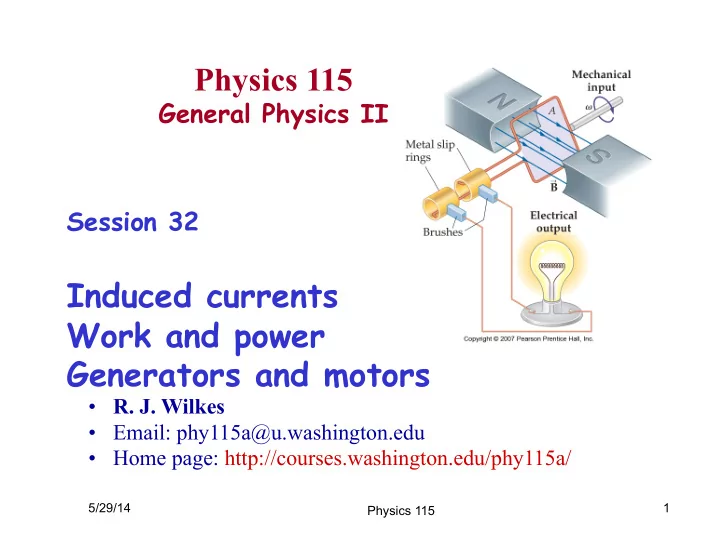
Physics 115 General Physics II Session 32 Induced currents Work and power Generators and motors R. J. Wilkes Email: phy115a@u.washington.edu Home page: http://courses.washington.edu/phy115a/ 5/29/14 1 Physics 115 Lecture Schedule


slide-1
SLIDE 1

Physics 115

General Physics II Session 32

Induced currents Work and power Generators and motors

5/29/14 1 Physics 115

  • R. J. Wilkes
  • Email: phy115a@u.washington.edu
  • Home page: http://courses.washington.edu/phy115a/
slide-2
SLIDE 2

Today

Lecture Schedule

5/29/14 2 Physics 115

slide-3
SLIDE 3

Announcements

  • Exam 3 tomorrow, Friday 5/30
  • Same format and procedures as previous exams
  • YOU must bring bubble sheet, pencil, calculator
  • Covers material discussed in class from Chs. 21, 22, 23
  • Practice questions will be reviewed in class today.
  • Homework set 9 is due Friday 6/6, 11:59pm
  • Not due Weds night as usual

5/29/14 3 Physics 115

slide-4
SLIDE 4

4 Formula sheet (final) 5/29/14

slide-5
SLIDE 5

5/29/14 5 Physics 115

Practice question solutions

slide-6
SLIDE 6

5/29/14 6 3) ¡A ¡400 ¡Ω ¡resistor ¡dissipates ¡ 0.80 ¡W. ¡What ¡is ¡the ¡current ¡in ¡ this ¡resistor? ¡ ¡A) ¡45 ¡mA ¡ B) ¡18 ¡mA ¡ C) ¡4.4 ¡mA ¡ D) ¡2.0 ¡mA ¡ ¡ E) ¡320 ¡mA ¡ ¡ ¡ ¡Answer: ¡A ¡ Physics 115

slide-7
SLIDE 7

5/29/14 7 RHR: v x B = down, but electron is negative Physics 115

slide-8
SLIDE 8

5/29/14 8 Physics 115

slide-9
SLIDE 9

9

ΔVBAT + ΔVR + ΔVL = 0 ΔVL = 0 (for constant I, inductor is just a wire!) ΔVBAT + ΔVR = 0 ΔVBAT = ΔVR → E = I0R → I0 = E R

I(t) = I0e−t/τ

/ L R τ ≡

RL Circuits: exponential decay of I

The switch has been in position a for a long time. For this loop we get Flip the switch to b at t=0: now loop is just L + R “It can be shown” that for an LR circuit,

I(t) = E R e−t/(L/R)

5/29/14 Physics 115

Last time

slide-10
SLIDE 10

10

Now suppose the switch has been in position b “for a long time.” Flip it to position a at t=0. Example: 10V battery, R=100 ohms, L= 1.0 mH

  • a. What is the current in the circuit at t = 5 µs?
  • b. What is the current after “a long time”?

Answer to (b) is easy:

IMAX = E / R = (10 V) / (100 Ω) =100 mA

I(t) = I0 1−e−t/τ

( ) = E

R 1−e−t R/L

( )

I(t) = (100 mA)e−(5 µs)/(10 µs) = 61 mA

RL Circuits: exponential buildup of I

For (a): τ = L/R = 0.001H/100Ω = 10 µs I goes from 0 to IMAX exponentially: For RL circuits, buildup of current behaves like decay of current in RC circuits:

5/29/14 Physics 115

Last time

slide-11
SLIDE 11

11

Like an E field, a magnetic field stores energy. So, inductors, which create B fields, store energy. How much energy UL is stored in an inductor L carrying current I ?

P = IΔV = I −L ΔI Δt = LI ΔI Δt = ΔU L Δt for change ΔI = 0 → I in time Δt = T, ΔI Δt = I T P(t) = I(t) LΔI T ; here, ΔI = (I -0) = I, but I(t) varies - average = I 2 P

AVG = LI 2

2T → U L = P

AVGT = LI 2

2

1 2 2 L

U LI =

Energy in Inductors and Magnetic Fields

5/29/14 Physics 115

slide-12
SLIDE 12

12

As with E fields, it is useful to define the B field’s energy density = energy/per unit volume Example: A solenoid of length l , area A, and N turns has L = µ0N2A/l, so:

U L = 1

2 LI 2 = µ0N 2A

2l I 2 = 1 2µ0 Al µ0NI l ! " # $ % &

2

= 1 2µ0 AlB2 uB =U L / volume occupied by B field

( )

uB = U L Al = 1 2µ0 B2

2

1 2

B

u B µ =

Solenoid’s B field is B = µ0NI/l so: “It turns out” this is true for any B field, not just inside a solenoid

Energy density in Inductors and B Fields

5/29/14 Physics 115

slide-13
SLIDE 13

13

SO: both B and E fields store energy in the space they occupy. Example: A region of space has a uniform magnetic field of 0.020 T and a uniform electric field of 2.50 x 10⁶ N/C (i.e., 2.50 MV/m). What is (a) the total electromagnetic energy density in the region? (b) the energy contained in a cubic volume, 12 cm on a side?

1 2 2 1 12 2 2 6 2 2 3

(8.85 10 C /Nm )(2.50 10 N/C) 27.7 J/m

e

u E ε

= = × × =

1 2 2 2 1 7 2 2 3

/ (0.0200 T) (4 10 N/A ) 159 J/m

m

u B µ π

= = × =

3 3 3

(27.7 J/m ) (159 J/m ) 187 J/m

e m

u u u = + = + =

3 3 3

(187 J/m )(0.120 m) 0.323 J U uV u = = = = l

Notice: a rather weak magnetic field stores more energy than a very intense electric field.

Electromagnetic Energy Density

5/29/14 Physics 115

slide-14
SLIDE 14

Reminder : about sin and cos functions

As we saw, the EMF of a rotating loop in a magnetic field is a sin (or cos) function:

The voltage on an AC power line has this shape

  • Sine function: sin(θ) à

Period T = 1/f seconds

  • Cosine function: cos(θ) à

Both have max value +1 Only difference: Sin(x=0) starts at 0, rising Cos(x=0) starts at 1, falling - same shape, cos is just shifted by π radians

5/29/14 Physics 115 14

slide-15
SLIDE 15

15

For an AC current iR through a resistor, Ohm’s Law gives the potential drop, or resistor voltage vR.

R R

v i R =

ΔVsoruce + ΔVR = E − vR = 0 E(t) = E 0cosωt = vR

iR = vR R = E 0 R cosωt = IR cosωt

If the resistor is connected in a circuit as shown, then Kirchhoff’s loop law tells us:

AC Circuits: Resistors

Key points here:

  • 1. Ohm’s Law applies, but I is time varying, same as E.
  • 2. I(t) has same time dependence as E : I is in phase with E : aligned in t

5/29/14 Physics 115

So far we have only discussed behavior

  • f circuits with DC

(one-way) currents

slide-16
SLIDE 16

16

Power in AC Circuits

The instantaneous power supplied by the generator in an AC circuit is psource= iE where i and Ε are the instantaneous current and emf, respectively. The power dissipated in a resistor is pR = iRvR = iR

2R, with iR = IRcos ωt.

So, pR = IR

2R cos2 ωt = ½IR 2R(1+cos 2ωt) .

(math identity: 1+cos2x=2cos2x) The average power P = <pR> is the total energy dissipated per second (or over one full cycle, if f < 1 Hz). In the expression above, the first term is constant, while the second term is alternately positive and negative and will average to zero. So: P = ½IR

2R

I and V are in phase in a resistor

5/29/14 Physics 115