Physics 115 General Physics II Session 25 Grounding and safety RC - - PowerPoint PPT Presentation

physics 115
SMART_READER_LITE
LIVE PREVIEW

Physics 115 General Physics II Session 25 Grounding and safety RC - - PowerPoint PPT Presentation

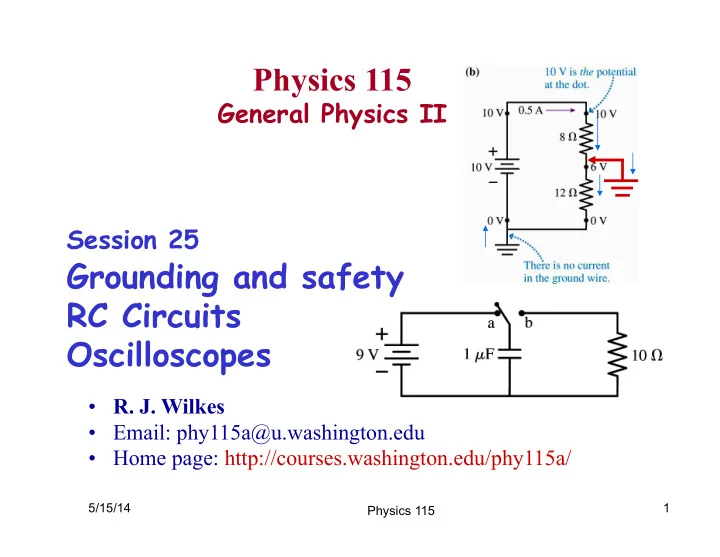
Physics 115 General Physics II Session 25 Grounding and safety RC Circuits Oscilloscopes R. J. Wilkes Email: phy115a@u.washington.edu Home page: http://courses.washington.edu/phy115a/ 5/15/14 1 Physics 115 Lecture Schedule Today


slide-1
SLIDE 1

Physics 115

General Physics II Session 25

Grounding and safety RC Circuits Oscilloscopes

5/15/14 1

  • R. J. Wilkes
  • Email: phy115a@u.washington.edu
  • Home page: http://courses.washington.edu/phy115a/

Physics 115

slide-2
SLIDE 2

Today

Lecture Schedule

5/15/14 2 Physics 115

slide-3
SLIDE 3

5/15/14 3

Grounding and GFI outlets

Electrical power wiring codes require a ground line – in North America it is the rounded 3rd prong of electrical

  • plugs. The ground line is supposed to be connected

directly to the Earth (Vearth=0).

(Caution: houses wired before the 1960s may have no 3rd wire! Often homeowners replace old 2-prong outlets with 3-prong

  • utlets...)

Circuit operation depends only on potential differences, so appliances etc should not be affected by the presence

  • r absence of a ground connection.

Because the ground connection is connected at only

  • ne point, no current should flow through the ground
  • connection. However, if some part of a circuit is

accidentally connected to ground another way (wire rubs

  • n case?), current will flow through the ground line.

GFI (ground fault interruption) circuits, widely used, in bathroom wiring, detect current flow in the ground line and interrupt power automatically when it occurs. They prevent many accidental electrocutions. CHECK your GFI outlets by pressing the ‘TEST’ button – power should go off; then RESET to restore protection.

Physics 115

Wiring conventions: Black wire = “hot” White = “neutral” (should be grounded) Green = ground (must be grounded)

slide-4
SLIDE 4

5/15/14 4

RC Exponential Decay

/ /

( )

t RC t

Q t Q e Q e

τ − −

= =

/ /

( ) ( )

t RC t RC t

Q dQ t I t e dt RC I e I e

τ − − −

= = = =

1/ 1/ 2.71828 0.367879 e = =

Define RC time constant: τ ≡ RC

I0 = Q0/RC

Physics 115

slide-5
SLIDE 5

Watching RC behavior with an oscilloscope

5/15/14 Physics 115 5

Oscilloscope = basic science research tool: makes plots of voltage vs time, with precision down to nanosec and microvolts. Old-fashioned ‘cathode ray tube’ (CRT) oscilloscope Electron beam is moved across phosphorescent screen, and deflected in proportion to V being observed: makes x-y plot of V vs time Modern digital oscilloscope: computer + display, (But controls are made like those of CRT scopes because people are used to them )

(V being observed)

slide-6
SLIDE 6

5/15/14 6

Example: Exponential Decay of current in RC Circuit

The switch has been in position a for a long time. It is changed to position b at t=0. What are the charge on the capacitor and the current through the resistor at t=5.0 µs?

  • 6

(10 )(1.0 10 F) 10 s RC τ µ = = Ω × =

  • 6
  • 6

(1.0 10 F)(9.0 V) 9.0 10 C

C

Q C V = Δ = × = ×

  • 6

(9.0 10 C) 0.90 A (10 s) Q I RC µ × = = =

/

  • 6

(5 s) (9.0 10 C)exp( .5) 5.5 C

t RC

Q Q e µ µ

= = × − =

/

(5 s) (0.90 A)exp( .5) 0.55 A

t RC

I I e µ

= = − =

Physics 115

slide-7
SLIDE 7

5/15/14 7

Reverse process: Charging a Capacitor

Using the Loop Law: ε − R ΔQ Δt − 1 C Q = 0

Calculus tells us solution is: Q(t) = a +be

− t RC ,

for which ΔQ Δt = − b RC # $ % & ' (e

− t RC

At t = 0, I = ΔQ Δt = ε R = − b RC ⇒ b = −εC At t = ∞, I = 0 ⇒V =ε and Q = a ⇒VC = a =εC

So Q(t) =εC −εC e

− t RC =εC 1−e − t RC

" # $ $ % & ' ' = Qmax 1−e

− t RC

" # $ $ % & ' ' RC = time constant for RC circuit (units = seconds) Exponentially approaches max Q

Physics 115

slide-8
SLIDE 8

Example: battery and 2 capacitors in series

5/15/14 Physics 115 8

A battery (internal resistance r=2

  • hms, open-circuit emf = 10V) is

connected at t=0 to two capacitors in series: C1 = 2 µf, C2 = 3 µf. What is the time constant for this circuit? What is the charge on the capacitors at t=5.0 µs? Equivalent C:

CEQ = 1 1/ C1 +1/ C2 = C1C2 C1 +C2 = 2µF

( ) 3µF ( )

2µF

( )+ 3µF ( )

=1.2µF time constant τ = RC = 2Ω

( ) 1.2µF ( ) = 2.4µs

At t = ∞, I = 0 ⇒VC =ε and QMAX =VCC =εCEQ QMAX =10V (1.2µF) =12µC Q(t) = Qmax 1−e

− t RC

% & ' ' ( ) * * = Qmax 1−e

− 5µs 2.4µs

% & ' ' ( ) * * = Qmax 1−exp(−2.08)

( ) =12µC 0.875 ( ) =10.5µC

slide-9
SLIDE 9

5/15/14 9

Clicker Question 1

The 1F capacitor is initially charged with 1 C. The time constant for the discharge of this capacitor is: (a) 5 s; (b) 4 s; (c) 2 s; (d) 1 s; (e) the capacitor does not discharge because the resistors cancel.

Physics 115

slide-10
SLIDE 10

5/15/14 10

Clicker Question

The 1F capacitor is initially charged with 2 C. The time constant for the discharge of this capacitor is: (a) 5 s; (b) 4 s; (c) 2 s; (d) 1 s; (e) the capacitor does not discharge because the resistors cancel.

Physics 115

slide-11
SLIDE 11

11

Put bar magnet on a cork and float it in a dish of water. The magnet turns and aligns itself with the north-south direction. The end of the magnet that points north is called the magnet’s north-seeking pole, or simply its north pole. The other end is called the south-seeking, or just the south pole.

Magnetism: definitions of poles

5/15/14 Physics 115

slide-12
SLIDE 12

12

Bring the north poles of two bar magnets near to each other. Then bring the north pole of one magnet near the south pole of another magnet. When the two north poles are brought near, a repulsive force between them is observed. When the a north and a south pole are brought near, an attractive force between them is observed. Sounds familiar! Same as for electric charges: like repel, unlike attract. Bar magnet is like an electric dipole (+ and – charge pair)

Magnetism: properties of poles

5/15/14 Physics 115

slide-13
SLIDE 13

13

Cut a bar magnet in half. Can you isolate the north pole and the south pole on separate pieces?

  • No. When the bar is cut in half, two complete (but weaker) bar

magnets are formed, each with a north pole and a south pole. The same result would be found, even if the magnet was sub-divided down to the microscopic level.

Magnetism: dipoles – monopoles?

5/15/14 Physics 115

slide-14
SLIDE 14

14

Experiment: Bring a bar magnet near an assortment of

  • bjects.

Some objects, e.g. steel paper clips, iron ore, nickel coins, certain ceramics, will be attracted to the magnet. Other objects, e.g., glass beads, aluminum foil, copper tacks, will be unaffected. No simple connection between magnetism and type of material (conductor, insulator, metal, non-metal) Also: objects that are attracted to the magnet are equally attracted by the north and south poles of the bar magnet.

Magnetism: only some materials are magnetic

5/15/14 Physics 115

slide-15
SLIDE 15

15

1. Like electricity, magnetism is a long range force. The compass needle responds to the bar magnet from some distance away. 2. Magnetism is not the same as electricity. Magnetic poles are similar to charges but have important differences. 3. Magnets have two poles, “north” (N) and “south” (S). Like poles repel and opposite poles attract. 4. Poles of a magnet can be identified with a compass. A north magnetic pole (N) attracts the south-seeking end of the compass needle (which is a south pole). 5. Some materials (e.g., iron) stick to magnets and others do not. The materials that are attracted are called magnetic materials. 6. Magnetic materials are attracted by either pole of a magnet. This is similar in some ways to the attraction of neutral objects by an electrically charged rod by induced polarization.

Conclusions from this collection of facts:

5/15/14 Physics 115