related project works in France Dr. Ya Brigitte ASSOA French - - PowerPoint PPT Presentation

related project works in france
SMART_READER_LITE
LIVE PREVIEW

related project works in France Dr. Ya Brigitte ASSOA French - - PowerPoint PPT Presentation

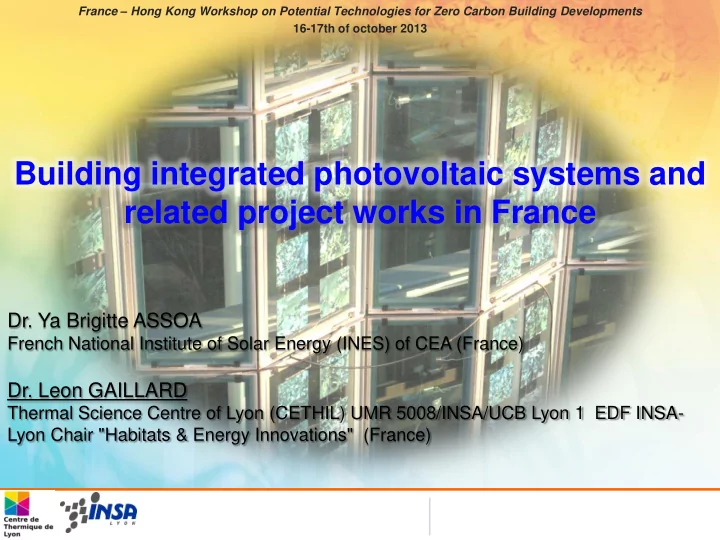
France Hong Kong Workshop on Potential Technologies for Zero Carbon Building Developments 16-17th of october 2013 Building integrated photovoltaic systems and related project works in France Dr. Ya Brigitte ASSOA French National Institute of


slide-1
SLIDE 1

Building integrated photovoltaic systems and related project works in France

  • Dr. Ya Brigitte ASSOA

French National Institute of Solar Energy (INES) of CEA (France)

  • Dr. Leon GAILLARD

Thermal Science Centre of Lyon (CETHIL) UMR 5008/INSA/UCB Lyon 1 EDF INSA- Lyon Chair "Habitats & Energy Innovations" (France)

France – Hong Kong Workshop on Potential Technologies for Zero Carbon Building Developments 16-17th of october 2013

slide-2
SLIDE 2

ZCB Hong Kong – France workshop 17/10/2013

leon.gaillard@insa-lyon.fr

Outline

  • BIPV context in France
  • The Building Energy Laboratory (LEB) at INES
  • Examples of BIPV projects at INES

– Focus on the project ANR Perrformance BIPV

  • Double-skin components at INSA-Lyon & CETHIL

– Focus on the project: ADEME RESSOURCES

2

slide-3
SLIDE 3

ZCB Hong Kong – France workshop 17/10/2013

leon.gaillard@insa-lyon.fr

  • Special features in France:

 Fully integrated BIPV system (noted IAB):

  • - Integration in the roof plane (max 2cm over) of an

enclosed building (4 walls);

  • - Replacement of building materials;
  • - Insurance of watertightness mainly with PV

modules;  Simplified BIPV system (noted ISB):

  • - PV modules plane have to be parallel to the roof

plane of an enclosed building (4 walls);

  • - Replacement of building materials;
  • Insurance of watertightness without the PV modules

contribution;

  • Special feeding tariffs according to these conditions

Rooftop BIPV system: French context

  • General definition:

(see European Construction Product Directive (CPD 89/106/EEC) and SEAC BIPV report 2013).

  • Integration as part of the building envelope structure
  • Replacement of conventional building material.

3

slide-4
SLIDE 4

ZCB Hong Kong – France workshop 17/10/2013

leon.gaillard@insa-lyon.fr

Market trends of BIPV

 Three PV modules technologies mainly used :

  • glazed and opaque,
  • glazed and semi transparent,
  • flexible.

 Design of new products suitable for integration (roof, façade, sunshade…): tiles, shingles, curtain walls, blinds, waterproofing membranes ...

4

slide-5
SLIDE 5

ZCB Hong Kong – France workshop 17/10/2013

leon.gaillard@insa-lyon.fr

INES scope in Building (Building Energy Laboratory (LEB) activities) Ventilation

IAQ/EAQ Air tightness

Windows

  • Glazed surfaces
  • Coupling of PV,

Thermal & Visual comfort

  • Passive heat gain
  • Rolling shutters
  • Control strategy

Structures

Thermal Inertia

BIPV systems Facades, roofs

Solar thermal systems

  • Individual solar hot water systems
  • Collective solar water heater with

additional fuel boiler

  • Solar combined systems
  • Inter-seasonal thermal storage
  • Solar cooling

Thermal

  • Insulation layers
  • Thermal exchanges
  • Water transfers
  • Life cycle analysis (LCA)

5

slide-6
SLIDE 6

ZCB Hong Kong – France workshop 17/10/2013

leon.gaillard@insa-lyon.fr

INES Integration platform: Test platform for building and BIPV systems

View of Test platform Integration of PV modules into building roofs: residential, industrial and agricultural applications

Experimental house #2 Cast concrete + ext insulation Experimental house #1 Concrete blocks (double wall) + intern. insulation Experimental house #3 Wooden frame + integrated insulation Concentration Solar Production Model Armadillo Box – Solar Decathlon 2010 PASSYS cells PASSYS cells

(variable and fixed orientation)

Experimental house #4 brick house + integrated insulation Meterological station 6

slide-7
SLIDE 7

ZCB Hong Kong – France workshop 17/10/2013

leon.gaillard@insa-lyon.fr

Examples of BIPV projects at INES: Rooftop integration on reference houses Avancis Photowatt Luxol Solar Century

7

slide-8
SLIDE 8

ZCB Hong Kong – France workshop 17/10/2013

leon.gaillard@insa-lyon.fr

Examples of INES projects on BIPV: Integration into roof (test benches)

Integration of solar PV/T hybrid collectors into building roofs: Electrical production and preheat air thermal production for fodder drying: agricultural application Integration of PV tiles : residential application Integration of flexible polycristallin PV modules into a roof membrane: industrial application

  • Meteorological (Irradiation, Tamb, Vwind, Dwind) measurements on test benches.
  • Aerodynamic, thermal and electrical measurements.

Main objectives:

  • Analysis of BIPV systems behaviour in real

conditions;

  • Validation of numerical models.

8

slide-9
SLIDE 9

ZCB Hong Kong – France workshop 17/10/2013

leon.gaillard@insa-lyon.fr

Tests benches at INES site (Le Bourget du Lac) and at CSTB site (Sophia Antipolis)

Examples of INES projects on BIPV: Performance BIPV ANR project

SOLAIRE FRANCE

Research centers Engineering consultants Manufacturers

Objectives

  • Reliable forecast of electrical performance of domestic

rooftop BIPV systems.

  • Analyse and compare electrical and thermal performance of

typical BIPV systems.

  • Develop a predictive model for electrical performance of

BIPV systems based on thermal and electrical response.

9

slide-10
SLIDE 10

ZCB Hong Kong – France workshop 17/10/2013

leon.gaillard@insa-lyon.fr

Instrumentation and monitoring system Cross section of a simplified BIPV system

  • 7 BIPV systems commercially available in France in 2010
  • Common features
  • Rated power ~2kW, poly-Si modules (series interconnection)
  • Grid-tied inverters
  • Naturally ventilated air-gaps between modules and insulation
  • Design/site differences
  • 3 IAB and 2 ISB configurations (35 m²)
  • Installer/manufacturer standards for each BIPV system
  • Climate: 6 systems at Chambéry, 1 at Sophia Antipolis
  • Variable slope (0° to 50°): 15° or 30°

Monitoring box under a test bench Thermocouple bonding

Performance BIPV ANR project: Presentation

10

slide-11
SLIDE 11

ZCB Hong Kong – France workshop 17/10/2013

leon.gaillard@insa-lyon.fr

Impact of simplified BIPV configuration (ISB):

  • larger system thermal conductance k-values so better thermal coupling with the building;
  • lower PV modules temperatures (thicker air gap) so higher electrical production

Performance BIPV ANR project: Analysis of experimental results

STC (sunny) Gi=1000W/m² Tc=25°C USA (sunny) Gi=1 kW/m² Ta=20°C Ws=1 m/s PR (sunny)

  • Electrical and Thermal performance measures (filtered, comparative data)

Kth using stationary and dynamic models 5 6 7 8 9 10 11 BIPV

11

slide-12
SLIDE 12

ZCB Hong Kong – France workshop 17/10/2013

leon.gaillard@insa-lyon.fr

  • Coupled electrical-thermal model
  • 2 independently developed models for TRNSYS
  • Coupling: module temperature  dissipated heat
  • Successive substitution method
  • Electrical model
  • 1D PV array (Newton Raphson)
  • Typical 5-parameter 1-diode model
  • Configured using flashtest data

Integration into TRNSYS 17 (Fortran)

Performance BIPV ANR project: Modelling

  • Thermal model
  • 2D nodal model (layers and slope)
  • Discretisation of air cavity

12

slide-13
SLIDE 13

ZCB Hong Kong – France workshop 17/10/2013

leon.gaillard@insa-lyon.fr

Coupled model: fast convergence (~5 iterations) and stable Model-data RMS error: <2% clear days; <10% mostly cloudy days Performance impact of ISB/IAB choice: d(Kth )~5W/m²/K = d(Y

A)~5%/an

Validation using typical days: Separate validation of electrical and thermal parts Temperature precision ~2K, dynamic behaviour reproduced Uncertainties in electrical model limited by parameter identification

Electrical power DC

Performance BIPV ANR project: Models validation

Time (h)

13

slide-14
SLIDE 14

ZCB Hong Kong – France workshop 17/10/2013

leon.gaillard@insa-lyon.fr

Ventilated PV double skin facades at INSA-Lyon CETHIL

PV skin (glazed/PV) glazed wall building primary wall PV skin (glazed/PV) PV skin (opaque PV) PV skin (opaque PV) PV skin (glazed/PV)

Building energy efficiency context

  • Improve electrical and thermal performance, for renovation and new builds
  • Cool PV components (improve yield and lifetime)
  • Solar chimney (natural ventilation) or pre-heating (mechanical ventilation)
  • Envelop as active component of an integrated building energy system

Issues

  • Multipurpose components (shade, noise protection, aesthetics, ...)
  • Complex urban environment (wind, shadowing, occupants, ...)

‘Summer’ configuration: natural ventilation to exterior

14

slide-15
SLIDE 15

ZCB Hong Kong – France workshop 17/10/2013

leon.gaillard@insa-lyon.fr

Project RESSOURCES: prototype PV double skin

HBS-Technal ETNA-B ETNA-A

geometry Pleated DSF Veranda/roof Facade/roof Width 4 m 3 m 3 m PV Facade height 7.4 m 5.6 m 5.6 m PV roof length

  • 8.7 m (34° incline)

6.9 m (45° incline) Air-gap depth ~0.6-0.8 m (prism) 0.7-0.44 m (roof outlet) 0.7 m PV orientation S.W. S.W. S.W.

15

slide-16
SLIDE 16

ZCB Hong Kong – France workshop 17/10/2013

leon.gaillard@insa-lyon.fr

Project RESSOURCES: exploratory comparative analysis summer winter

CETHIL|PRELIMINARY CETHIL|PRELIMINARY CETHIL|PRELIMINARY CETHIL|PRELIMINARY

Typical days

  • Clear daily cycles in

system response

  • Seasonal variation

for sunny days with little wind Spurious features

  • Bloc3: power losses in

summer

  • Disruptions to incident

radiation, especially in winter Data analysis using aggregated queries to a MySQL database

16

slide-17
SLIDE 17

ZCB Hong Kong – France workshop 17/10/2013

leon.gaillard@insa-lyon.fr

Project RESSOURCES: data visualisation and correlation analysis

HBS bloc 3 HBS bloc 1

Capet plots: seasonal envelop, features correlated with time Correlation plots: departures from simple response curve  Local horizon effects responsible for punctual losses in production

CETHIL|PRELIMINARY CETHIL|PRELIMINARY CETHIL|PRELIMINARY CETHIL|PRELIMINARY

17

slide-18
SLIDE 18

ZCB Hong Kong – France workshop 17/10/2013

leon.gaillard@insa-lyon.fr

Conclusion and outlook

| PAGE 18

Design and forecast

  • Need for reliable numerical models to predict BIPV system performance
  • Need to harmonize BIPV standards between countries
  • Need for innovative products suitable for PV modules integration

Experimental Valiadation

  • Need to demonstrate performance of BIPV system compared to BAPV
  • Need to demonstrate performance of natrually ventilated BIPV facade components
  • Long term degradation of BIPV systems to be assessed

Monitoring Techniques for BIPV installations in urban environments

  • Diagnostic information: discrimination of nominal and anomalous behaviour
  • Comparative analysis simplifies interpretation
  • Adapt data-mining techniques to allow more exploratory analyses

谢谢

thank you!

18