
SLIDE 1
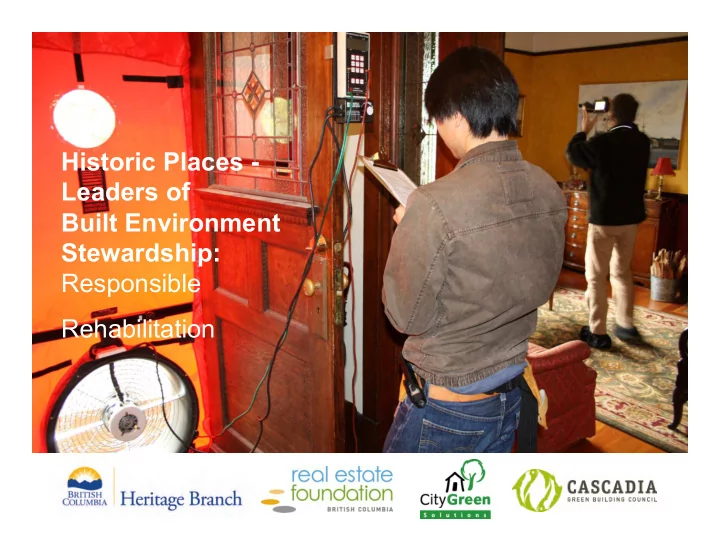
Rehabilitation This presentation is jointly-funded by the Real - - PowerPoint PPT Presentation
Historic Places - Leaders of Built Environment Stewardship: Responsible Rehabilitation This presentation is jointly-funded by the Real Estate Foundation of British Columbia and the BC Government Heritage Branch The Real Estate Foundation
The rehabilitation of existing buildings has the potential to be a restorative act that will promote the emergence
communities.
Traditionally constructed dwelling units targeted for retrofits:
units in BC (about 14% of the total housing stock in BC)
are formally recognised for their heritage value.
1950s residential building stock vulnerable to climate action through low awareness
contemporary energy efficiency standards.
In British Columbia, rehabilitation and upgrading work on historic places can access a variety of legislative and regulatory provisions not available to existing buildings generally. These provisions allow an economic, social and environmental balance to the way we work with heritage building stock.
BC Building Code – Table A-1.1.1.1 Alternative Compliance Methods for Fire Safety in Heritage Buildings BC Building Code - Whole building energy performance calculations using HOT 2000 software offered as an alternative to prescriptive insulation standards. Homeowner Protection Act – the Substantial Reconstruction Guidelines give a legally- binding opinion of how much rehabilitation work can take place before a full building code upgrade is triggered. Energy Efficiency Standards Regulation- new windows and doors in historic places may be traditionally constructed and do not need to comply with CSA A4000 Livesmart for Homes – offers an incentive for storm sashes in historic homes – a first in Canada
Because of this, historic places are becoming models of stewardship for existing buildings. And as the sustainability benefits of an historic places approach begin to be recognized more widely, it is anticipated that building legislation and regulation will follow a similar course.
The energy efficiency of historic buildings can be increased in ways sympathetic to their historic character, for example through draught-proofing, improved insulation or bringing internal shutters back into use. Changing to a condensing flue gas boiler and improving heating controls or the introduction
significantly improve energy performance. English Heritage
Because it necessarily involves the conservation of energy and natural resources, historic preservation has always been the greenest of the building arts… preservation is the ultimate recycling. Richard Moe, President U.S. National Trust for Historic Preservation
Both heritage conservation and sustainability aim to
historic places, this includes considering the inherent performance and durability of their character- defining assemblies, systems and materials, and the minimal interventions required to achieve the most effective sustainability improvements. Parks Canada Standards and Guidelines for the Conservation of Historic Places in Canada
The three pillars of sustainable development: social, economic and environmental are all integral to the rehabilitation of
preserve our culture by paying tribute to the people and events that built our communities. They attract tourists, and their rehabilitation creates
jobs and job training thereby contribution to our economy. In addition, their conservation saves tonnes of debris from the landfill - the ultimate form of recycling. Vancouver Heritage Foundation
new building increases energy demand
decades before their operational energy savings offset the embodied energy of construction
that supports that oft quoted statement of Richard Moe?
Where are the opportunities for energy efficiency in historic places? What are the unique challenges of working with historic places?
All building components emit infrared energy (heat). Thermal imaging cameras make this infrared energy
thermal properties indicate differences in material or condition.
2008 BC Commercial/Institutional Sector Energy Consumption
From NRCan’s OEE’s Comprehensive Energy Use Database, 1990 to 2008
End use ¡ % ¡ Space Heating ¡ 51.9 ¡ Water Heating ¡ 8.0 ¡ Space Cooling ¡ 2.4 ¡ Lighting ¡ 12.0 ¡ Auxiliary Equipment ¡ 15.2 ¡ Auxiliary Motors ¡ 9.9 ¡ Street Lighting ¡ 0.6 ¡
Regular maintenance also helps the building to perform in the way that was originally intended. Damp and significant draughts are more often the result of inadequate maintenance or ill- considered changes, rather than
construction of the building. English Heritage
investment, upgrade insulation in
more capable of adaptation without damaging the special character of historic place
knee ¡wall ¡voids. ¡
cathedral ¡ceilings ¡ unless ¡a ¡con7nuous ¡ air ¡gap ¡on ¡the ¡cold ¡ side ¡can ¡be ¡built ¡in ¡ as ¡these ¡surfaces ¡are ¡ prone ¡to ¡extremes ¡
exposure ¡and ¡are ¡ more ¡likely ¡to ¡ experience ¡ ¡ inters77al ¡ condensa7on ¡
cavi7es ¡may ¡be ¡ insulated ¡
condensa7on ¡are ¡ minimised ¡due ¡to ¡ interior ¡paint ¡ac7ng ¡as ¡ a ¡vapour ¡barrier ¡in ¡ coastal ¡BC. ¡
interior ¡BC ¡that ¡ experience ¡extreme ¡ cold, ¡the ¡likelihood ¡of ¡ inters77al ¡ condensa7on ¡in ¡such ¡ thin ¡cavity ¡fill ¡is ¡
R ¡1.32 ¡ R ¡3.15 ¡
hEp://www.for.gov.bc.ca/heritage/ ¡
House as a System The various parts of a house/ building work together as a system to create a comfortable, durable and energy efficient buildings. The house system itself interacts with both its surrounding environment and with its occupants. Goal: Consider the impact of single retrofits on the whole system.
Greater ¡exchange ¡with ¡fabric ¡ Greater ¡diffusion ¡losses ¡ Greater ¡air ¡leakage ¡ Use ¡of ¡mechanical ¡ven(la(on ¡ Stack ¡effect ¡ AMc ¡ven(la(on ¡common ¡to ¡both ¡ ¡
Ventilation
remove moisture
disrupt this balance
upgrades, air sealing and insulation with ventilation to avoid moisture, mold and air quality issues
soft, weak or permeable materials
fabric as closely as possible
introducing impermeable materials
practice
ensuring the optimum performance and durability of traditional buildings
insulation or moisture barriers causes unpredictable redirection of moisture
What resources exist to support energy efficiency in historic places?
Publications and Websites
– Standards and Guidelines – CMHC – English Heritage – Technical Preservation Services
– BC Heritage Branch – Vancouver Heritage Foundation – National Trust
Advice
departments
– Heritage Resource Managers – Energy Efficiency Consultants – Architects – Trades
– Heritage Legacy Fund – Workshop Program
– Restore It! – House Call – Get on the Register – True Colours
– Repairs and maintenance – Designation/ registration – Larger rehabilitation projects
– LiveSmart BC Efficiency Incentive Program – Towns for Tomorrow
– National Historic Sites Cost-Sharing Program
– Local Governments – Real Estate Foundation – CMHC
NOTE: Eligibility often restricted
components emit infrared energy.
cameras make this infrared energy visible.
thermal properties aids in the identification of previously undetectable faults,
repairs and enhancing the energy efficiency
building.
This presentation has illustrated:
stewardship for existing buildings
and cities as we address climate change in the built environment.
already built
and how that helps us to make better decisions about suitable upgrades
creativity in upgrading historic places that are not available to ‘normal’ existing buildings