Regulatory Incentives to Promote RE Investment International Forum - - PowerPoint PPT Presentation

regulatory incentives to promote re investment
SMART_READER_LITE
LIVE PREVIEW

Regulatory Incentives to Promote RE Investment International Forum - - PowerPoint PPT Presentation

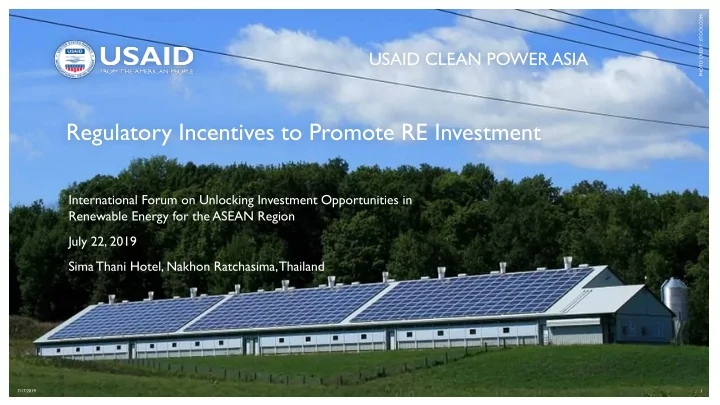
PHOTO CREDIT: ISTOCK.COM USAID CLEAN POWER ASIA Regulatory Incentives to Promote RE Investment International Forum on Unlocking Investment Opportunities in Renewable Energy for the ASEAN Region July 22, 2019 SimaThani Hotel, Nakhon Ratchasima,


slide-1
SLIDE 1

7/17/2019 1

Regulatory Incentives to Promote RE Investment

International Forum on Unlocking Investment Opportunities in Renewable Energy for the ASEAN Region July 22, 2019 SimaThani Hotel, Nakhon Ratchasima, Thailand

PHOTO CREDIT: ISTOCK.COM

USAID CLEAN POWER ASIA

slide-2
SLIDE 2
  • USAID Clean Power Asia Overview
  • Policies and regulatory incentives for RE

– Existing incentives in ASEAN – Barriers for RE adoption – Supporting regulations

  • Supporting activities

– Solar pilot auction in Lao PDR – DPV economic and technical impacts and policies in Southeast Asian countries – Energy storage system application in Vietnam

  • Looking forward to the future – Emerging trends

Content

7/17/2019 2

slide-3
SLIDE 3

USAID Clean Power Asia – Overview

 5 years: June 2016 – June 2021  Regional clean energy program  Focus on Lower Mekong countries (Lao PDR, Thailand, Vietnam and Cambodia) + SE Asian countries (the Philippines, etc.)  Goals:

  • 15 laws/policies/regulations
  • $750 M USD investment

mobilization

  • 500 MW of installed RE
  • 3.5 M tCO2e reduction

 Implemented by Abt Associates and partners  Funded by USAID (United States Agency for International Development)

Provide market signal Establish market Scale up market

Aims to increase deployment in ‘grid-connected’ renewable energy in SE Asia

7/17/2019 3

slide-4
SLIDE 4
  • Improved data and tools
  • Consideration of RE in power sector planning
  • Incentivizing RE and removing policy and regulatory barriers
  • Mobilizing investment through improved bankability and facilitating

financing Focused on individual country (LM and Southeast Asia)

  • Promote RE Data Explorer and other planning tools
  • ASEAN Interconnection Masterplan Study 3rd update (AIMS III)
  • Scaling up data, planning approaches and tools, policies and

regulations and investment mobilization regionally

Regional Activities

7/17/2019 4

USAID Clean Power Asia – Overview

slide-5
SLIDE 5
  • Improved data and tools
  • Consideration of RE in power sector planning
  • Incentivizing RE and removing policy and regulatory barriers
  • Mobilizing investment through improved bankability and facilitating

financing Focused on individual country (LM and Southeast Asia)

  • Promote RE Data Explorer and other planning tools
  • ASEAN Interconnection Masterplan Study 3rd update (AIMS III)
  • Scaling up data, planning approaches and tools, policies and

regulations and investment mobilization regionally

Regional Activities

USAID Clean Power Asia – Overview

7/17/2019 5

slide-6
SLIDE 6

Policy and regulatory incentives for RE

7/17/2019 6

slide-7
SLIDE 7

Feed-in Tariff (FIT)

  • Administratively set the price to promote development
  • Provide incentives to increase return on investment
  • Typically use in the early stages for RE promotion

Competitive Procurement

  • Competitive bidding or tenders for energy
  • Scaling up capability
  • Transparency and typically lower cost

Net Metering

  • Net metering/billing
  • Self consumption
  • Buy all sell all

Renewable Portfolio Standards (RPS) and Tradeable RECs

  • Increase RE in portfolio of generators/distributors
  • Create market for RECs (Renewable Energy Credits)

Other Incentives

  • Tax incentives (tax/import duty exemptions)
  • Soft loan
  • Capital subsidy

Policies supporting RE

Source: Smithsonianmag.com

7/17/2019 7

slide-8
SLIDE 8

Existing RE targets and incentives in ASEAN

Source: USAID Clean Power Asia (2017). DESIGNING RENEWABLE ENERGY INCENTIVES AND AUCTIONS: LESSONS FOR ASEAN 7/17/2019 8

slide-9
SLIDE 9

Barriers for RE investment

Lack of understanding and awareness of RE

  • Technical know-how
  • Impact understanding
  • Capacity

Funding and resources Technical limitation

  • RE resource availability
  • Equipment/Supply availability
  • Grid access

Financial risks

  • Lack of financing options
  • Off-taker risks
  • Country risks

Lack of / unclear / inconsistent supporting regulations Permitting and Approval Processes Policy Uncertainties

7/17/2019 9

slide-10
SLIDE 10

Supporting regulation to promote RE investment

Supporting Regulations

Power Offtake Grid Connection Technical Standards Permitting

  • Offtaker
  • Tariff regime
  • Contract terms
  • Grid code
  • Distribution code
  • Grid connection check
  • Grid impact study
  • Equipment standards
  • Installation standards
  • Technology specific
  • Standard process
  • Approval time
  • Website/Online

platform

  • Inspections

7/17/2019 10

slide-11
SLIDE 11

Cambodia Lao PDR Thailand Vietnam

Supporting regulations related to power purchasing

 Need supporting regulations for solar development  Need supporting regulations for VRE development  Inconsistency among utilities  Tariff for rooftop is still being decided (ERC)  Least acceptable contract term – 20 years  Limited time for PPA regime – until June 2019 (waiting for new/revised Decision)  Offtaker risk

Grid connection regulations

 Need distribution code  Out-of-date transmission code (since 2009)  Need update for national grid code (since 2014 and focused mostly for hydro)  Need distribution code  Inconsistent grid connection requirements between EGAT, MEA, PEA  Need detail regulation of performance standards and technical connection requirements (such as real-time communication for capacity >1MW) in grid code

Technical standards

 Need installation standards  Need technical and installation standards  Current LEPTS* focused

  • n hydro

 Need revision to building and fire code to accommodate solar rooftop  Need installation standards  Need revision to building and fire code to accommodate solar rooftop

Permitting process

 Need permitting process for solar  Need permitting process for solar  Much paperwork needed  Difficult to track application status  Lack of support to answer questions  Unclear permitting process  Need convenient platform and clear guidelines Involves many government authorities and varies across the different provinces

Summary of regulation gap analysis in LM countries

Source: Review of Supporting Regulations (USAID Clean Power Asia, 2017), Why are grid code important (ERAV) *LEPTS – Lao Electrical Power Technical Standards

7/17/2019 11

slide-12
SLIDE 12

Supporting activities of USAID Clean Power Asia

7/17/2019 12

7/17/2019 12

slide-13
SLIDE 13

Supporting activity – Solar pilot auction in Lao PDR

Policy Support Regulation Support Coordination

Capacity Building Auction Design Auction Documents Auction Process

Assess Requirements Technical Connection Requirements for solar Technical Standards for solar Term of Reference for Pre-Feasibility Study for solar Term of Reference for Final-Feasibility Study for solar Lao Grid Code (2014) LEPTS (Lao Electrical Power Technical Standards) New Existing

Auction Package

Bidding documents

Auction Implementation

Legend

Bid Requirements Bid Evaluation

Site Selection Assessment

7/17/2019 13

slide-14
SLIDE 14

Study of DPV impact on utility revenue and rate

Report - DPV impact on utility revenue and rate (Nov 27, 2017) Policy Brief (Aug 17, 2017) NREL, ERI (Chula) Proposed net billing policy (DEDE)

Thailand Previous activities

Study three DPV impact analyses

Report – DPV economic and technical impacts for the Philippines (Mar 15, 2019) NREL, LBN Revised net-metering policy (DOE, ERC)

Philippines

International review Customer Economics

Report – Chapter 1 on international review (Jan 17, 2019) Report – Chapter 4.2 on customer economics (Mar 13, 2019) USAID V-LEEP, NREL Revised net-metering policy to replace Decision 11 (EREA)

Vietnam

DPV impact studies Customer economics Utility revenue and rate T echnical impact International review

Current activities

  • 1. T

echnical input to DC (May-July 2019)

  • 2. Experts for public consultation events

(Aug 2019)

  • 3. Post-public consultation support

(Aug-Sep 2019) Activities: Support Department Circular (DC) on NM policy

Philippines

T echnical input to DC (similar to policy brief) – July 2019

Output

Supporting activity – DPV economic and technical impacts and policies in Southeast Asian countries

Activities Output Partners Policy Impact

7/17/2019 14
slide-15
SLIDE 15

Supporting activity – Energy Storage System in Vietnam (1/2)

USAID Clean Power Asia EREA/MOIT

USAID V-LEEP

Chapter 1 - Overview of Energy Storage System Chapter 3 - Developing the Energy Storage Market in Vietnam Chapter 4 – Assessment of the value of battery energy storage projects in Vietnam

T echnical Analysis

Chapter 2 - Role of Energy Storage in Vietnam

Economic Analysis

ESS Study

Subcontract Input

7/17/2019 15

slide-16
SLIDE 16

Supporting activity – Energy Storage System in Vietnam (2/2)

Identify Issues and Refining Scope

  • Many solar projects

coming online

  • Limited grid

capacity causing congestion and curtailment

  • Determine base

case and scenarios Data Collection

  • Existing and

upcoming solar projects

  • Load

demand/profile

  • Single Line Diagram
  • Substation and

distribution transformers

  • SCADA
  • Grid expansion

plan Grid Modeling

  • Using grid modeling

tool and data to develop model

  • Verify and validate

model accuracy from SCADA data Run Simulation and Optimization

  • Quantify grid

congestion

  • Curtailment to

reduce congestion

  • Apply BESS to

alleviate congestion and curtailment

  • Optimize BESS

sizing and lifespan Analyze Result - Technical

  • Applicability of

BESS to address grid congestion and curtailment

  • Limitations and

shortfalls

  • Recommendations

Technical Analysis Economic Analysis

Data Collection

  • 1 week data points

for substation capacity

  • Hourly load data
  • Capital Cost
  • Financial

Assumptions

  • Tariff/FiT

Economic Evaluation

  • Determine Payback

Period, NPV, IRR for solar PV and solar PV + BESS Analyze Result - Economic

  • Cost effectiveness
  • Value stream of

BESS

  • Recommendations

Policy and Regulatory Recommendations

BESS = Battery Energy Storage System

Result from T echnical Analysis is used in the Economic Analysis

7/17/2019 16

slide-17
SLIDE 17

Looking forward to the future – Emerging trends

7/17/2019 17

slide-18
SLIDE 18

DER Management and DRP Energy Storage Microgrids and Community Energy Data Analytics, IoT and AI Energy Blockchain and Prosumers Grid Parity and Declining RE Prices

Renewable energy emerging trends

Source: blueandgreentomorrow.com

  • Management and planning of distributed

resources or decentralized generators (rooftop PV, energy storage, wind, behind-the-meter generation, etc.)

DER – Distributed Energy Resources DRP – Distributed Resource Planning AI – Artificial Intelligence IoT – Internet of Things

  • Storage prices are declining
  • Technology is improving for charging

and discharging

  • Deployment at project site or grid

level

  • Backup for commercial/industrial

(replacing diesel engine)

  • Small home use + rooftop
  • Grid connected microgrid for

community with self generation (PV, wind, storage, etc.)

  • Reduce loss in transmission
  • Self managed, secure driven by

consumer

  • Smart Grid
  • Declining prices for RE generation
  • Energy storage allowed

dispatchability

  • Becoming more competitive with

fossil fuel

  • Digital ledger used for decentralized

transaction

  • Enable peer-to-peer energy trading
  • Facilitate prosumer growth
  • Machine learning to help with
  • ptimization and efficiency
  • Automation and forecasting

7/17/2019 18

slide-19
SLIDE 19

Additional information

7/17/2019 19

slide-20
SLIDE 20

International best practices for VRE integration

Power offtake Grid connection Technical standards Permitting

 > 20 years contract term  Local utilities should be regulated to buy electricity from electricity producers  Take and pay all electricity  Determine a fixed tariff  Denominate in a foreign currency  Offtaker takes risk if law changes  Exempt producers from force majeure  Allow offshore arbitration  Limit termination by offtaker  Allow collateral assignment  Offtaker payment support  Offtaker bears risk of interconnection  Grid connection rules are required at first stage of solar integration  A basic grid code rather than a complex one at the first stage  Learn and adapt grid codes from experienced countries  Grid code often comes closely with supporting mechanisms  Each stage of VRE penetration needs different grid connection requirements  Modify building code, fire code, electrical code to accommodate VRE facility  Refer to international practice for technical specific equipment standards, installation standards, etc.  Online permit processing  Website for information  Reasonable permit fees  Expedited permit process  Permitting checklists  Permitting templates  Consistency process across jurisdictions  Eliminate excessive inspections  Train permitting staff in VRE  Set point of contact

Source: Review of Supporting Regulations (USAID Clean Power Asia, 2017)

7/17/2019 20

slide-21
SLIDE 21

7/17/2019 21

  • Ms. Amanda Van den Dool

USAID Regional Development Mission for Asia AtheneeT

  • wer, 25th Floor

63 Wireless Road Patumwan, Bangkok T el: +66 2257 3000 Email: avandendool@usaid.gov

USAID CLEAN POWER ASIA

  • Ms. Dana Kenney

USAID Clean Power Asia Abdulrahim Place, Suite 501 990 Rama IV Road Bangrak, Bangkok 10500 T el: +66 2026 3065 Email: Dana_Kenney@abtassoc.com