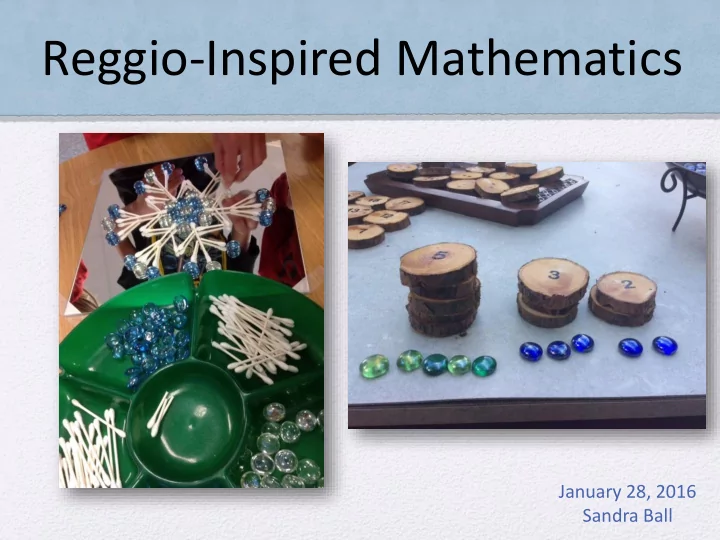
SLIDE 1 Reggio-Inspired Mathematics
January 28, 2016 Sandra Ball
SLIDE 2 Explore the Provocations and Materials
- Play, connect, and reflect:
- How do the materials spark interest?
- How can you modify the
provocations to meet the needs of various students?
SLIDE 3 Learning Intentions
- I can identify Reggio-Inspired practices that I
might use in my classroom.
- I will be able to use and create provocations.
- I will be able to identify the important essentials
- f mathematics.
- I understand how provocations can meet the
needs of all your students.
SLIDE 4
Original Reggio-Emilia School
SLIDE 5
Reggio- Emilia School Today
SLIDE 6 Reggio Emilia Philosophy of Education
- Developed by Loris Malaguzzi, parents and teachers in
Reggio Emilia Italy
- Viewed the child as capable and creative
- Environment is third teacher
- Pedagogy of listening
- Responsive, emergent curriculum
- Socially constructed learning, collaborative
- Importance of relationships
SLIDE 7
We Don’t Live in Italy
SLIDE 8 Reggio-Inspired Practices
- Image of the child as capable, creative and
responsible for their own learning
- Create an aesthetic environment that is a place for
wonder
- Focus on Big Ideas and an emergent curriculum
- Use of loose parts, natural and mathematically
structured materials
- Use of documentation to make learning visible
SLIDE 9 Surrey Inquiry Project
- How might Reggio-inspired practices enrich the teaching
and learning of mathematics in K-3 classrooms?
- How can we “make learning visible” for our youngest
students?
- How can playful inquiry enhance mathematical
understanding?
SLIDE 10 The Role of the Teacher is to …
- create an inquiry based environment
- listen and ask questions
- ‘toss the ball’ back to students to keep them thinking
- help students uncover the curriculum
- document and make the learning visible
- enable students to build on their understanding
SLIDE 11 Tossing the Ball
- As students engage in the provocations and
conversations, the teacher listens and reflects.
- The teacher then ‘tosses’ the responsibility for
thinking back to the student by asking open ended questions.
- The student elaborates and make thinking more
visible .
- Teacher looks for 3 pieces of evidence over time.
SLIDE 12
Asking students the right questions is far more important than telling them the right answers.
SLIDE 13 Open Ended Questions
- What do you notice?
- How might you try that in a different way?
- What connections can you make?
- What else might you discover?
- What do you see in your head ?
- What questions did you ask yourself ?
SLIDE 14 “Provocations, or invitations, inspire and invite students to explore, investigate and discover. Provocations are intentional in their intended purpose, such as being based on students’ interest or linked to curriculum or assessment for learning purposes. They present materials that are beautiful and inviting to students. Provocations include options for students but also involve enabling constraints, thus opening possibilities by limiting choices.” Janice Novakowski
SLIDE 15 Provocations
specifically to do something
- Implied Prompt – provide a
model
- Open Exploration – put out
materials and allow students to investigate
SLIDE 16 Loose Parts…
- need to be intentional and purposeful
- allow students to make meaning through
exploration and play
- can be used any way children choose to represent
thinking
- can encourage creativity and imagination
- can encourage open ended learning
- are used on mats to help student focus
SLIDE 17
Materials Need to Inspire
SLIDE 18 Reggio-Inspired Mathematics Kits
- Number
- Pattern
- Measurement
- Geometry
SLIDE 19
Revised Curriculum Big Ideas
Number represents and describes quantity. Developing computational fluency comes from a strong sense of number. We can describe, measure and compare spatial relationships. Analyzing data and chance help use to compare and interpret. We use patterns to represent identified regularities and to form generalizations.
SLIDE 20
What`s Important…
SLIDE 21 Content
- Gr. 1 - ways to make 10
- decomposing 10 into parts
- numbers to 10 can be arranged and recognized
Gr.2 – repeating and increasing patterns
- exploring more complex repeating patterns
(e.g. positional patterns, circular patterns)
- identifying the core of repeating patterns
- increasing patterns using manipulatives,
sounds, actions and numbers (0 to 100)
SLIDE 22
Curricular Competencies
SLIDE 23
Curricular Competencies
Communicating Thinking Personal and Social
SLIDE 24
Number
SLIDE 25
Can you stack 5 rocks?
SLIDE 26
How many ways can you make…?
SLIDE 27
How can you show …?
SLIDE 28
How can you make different numbers?
SLIDE 29
What parts make a whole?
SLIDE 30 What parts are represented
SLIDE 31
What numbers can you build on a ten frame?
SLIDE 32
What can you find out about numbers?
SLIDE 33
Popscicle Ten Frame Tutorial
SLIDE 34
How might you count this collection?
SLIDE 35
How do reflections help us think about doubling?
SLIDE 36
How might you sort these numbers?
SLIDE 37
SLIDE 38
How might you represent numbers?
SLIDE 39
Choose 3 digits. What numbers can you make?
SLIDE 40
SLIDE 41
What can you find out about numbers?
SLIDE 42
SLIDE 43
How might you compare and order numbers?
SLIDE 44
SLIDE 45
What does part whole thinking look like?
SLIDE 46
Pattern
SLIDE 47
What different patterns can you make?
SLIDE 48
How many different patterns can you make?
SLIDE 49
SLIDE 50
SLIDE 51
SLIDE 52
What is the pattern core?
SLIDE 53
SLIDE 54
Do patterns always make straight lines?
SLIDE 55
SLIDE 56
SLIDE 57
SLIDE 58
How might you use a grid to make a pattern?
SLIDE 59
What is a growing pattern?
SLIDE 60
Can a pattern repeat and increase at the same time?
SLIDE 61
SLIDE 62
What patterns live in designs?
SLIDE 63
SLIDE 64
SLIDE 65
Measurement
SLIDE 66
How do we measure?
SLIDE 67
What do you notice?
SLIDE 68
What does it mean to measure?
SLIDE 69
How might you compare and order these?
SLIDE 70
How does measuring things help us?
SLIDE 71
SLIDE 72
What measurement tools can you use?
SLIDE 73
SLIDE 74
SLIDE 75
How can measuring tools help us?
SLIDE 76
Geometry
SLIDE 77
Can you make these shapes?
SLIDE 78
SLIDE 79
What can you discover about shapes?
SLIDE 80
SLIDE 81
How can you combine shapes to make new shapes?
SLIDE 82
SLIDE 83
How do reflections help us think about symmetry?
SLIDE 84
What shapes can you create?
SLIDE 85
SLIDE 86
SLIDE 87
What do you notice about lines and shapes?
SLIDE 88 Documentation
Learning stories written to the child about what …
- the student doing/learning.
- the teacher notices (You are being a mathematician when
you…).
- guiding questions the teacher will ask.
- connections are being made to the math.
…and shared with other students and parents.
SLIDE 89
SLIDE 90
Documentation Panels
SLIDE 91 Reflecting Back
- Materials need to be accessible for students
- Focus on one area of mathematics
- Teacher’s knowledge of curriculum is essential
- Provide exploration time with materials
- Develop respect and care of materials
- Building in routines and language
SLIDE 92 Developing Provocations
- Planning with intention
- Being thoughtful about the materials
- Choose Big Ideas, curricular competencies,
and/or content from the curriculum
- How will you provoke thinking and learning?
- What materials will you need?
- Will you use direct, implied or open exploration
prompts?
- How do you anticipate your students will engage
with your provocation?
SLIDE 93
Lulu.com
SLIDE 94
SLIDE 95 “Stand aside for a while and leave room for learning, observe carefully what children do, and then, if you have understood well, perhaps teaching will be different from before.”
Loris Malaguzzi
SLIDE 96