
SLIDE 1
Slide 1 / 93 Slide 2 / 93
Thermodynamics
Slide 3 / 93 Chemical Thermodynamics
The Golden Gate Bridge is painted regularly to slow down the inevitable rusting of the iron on the bridge. In this unit you will study how heat and temperature relate to work and energy and apply principles of thermodyamics to predict when chemical reactions will occur.
Slide 4 / 93 First Law of Thermodynamics
Recall a system is a portion of the universe that has been chosen for studying the changes that take place within it in response to varying conditions. A system can be relatively simple, like a glass of water, or it can be complex, like a planet, or the entire Universe can be considered a system.
Slide 5 / 93 First Law of Thermodynamics
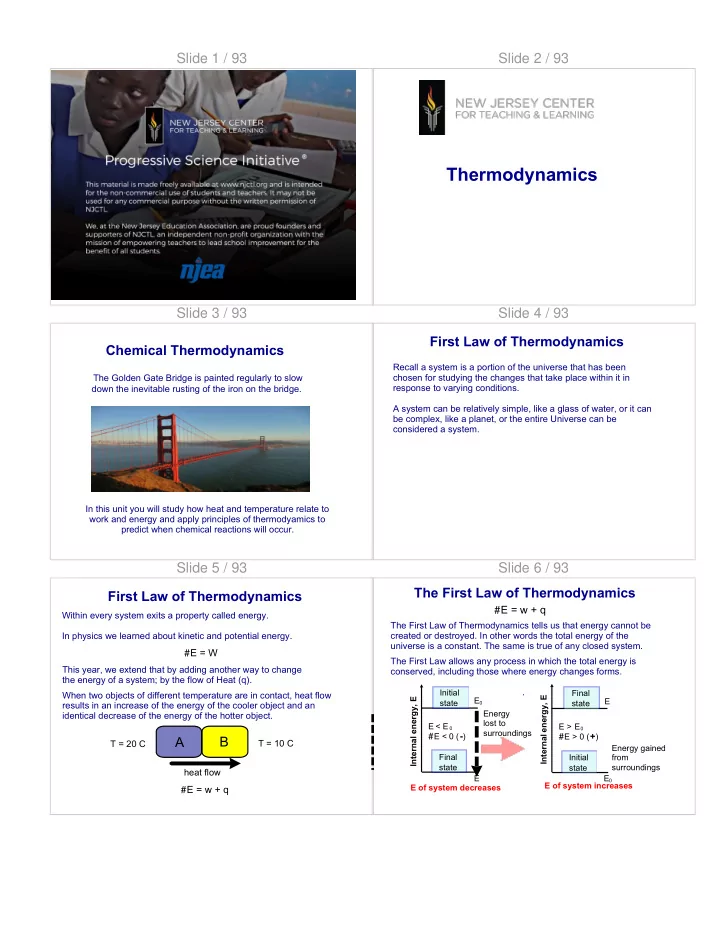
Within every system exits a property called energy. In physics we learned about kinetic and potential energy. This year, we extend that by adding another way to change the energy of a system; by the flow of Heat (q). When two objects of different temperature are in contact, heat flow results in an increase of the energy of the cooler object and an identical decrease of the energy of the hotter object.
A B
heat flow T = 20 C T = 10 C
#E = W #E = w + q
Slide 6 / 93 The First Law of Thermodynamics
#E = w + q
The First Law of Thermodynamics tells us that energy cannot be created or destroyed. In other words the total energy of the universe is a constant. The same is true of any closed system. The First Law allows any process in which the total energy is conserved, including those where energy changes forms. .
Initial state Final state E of system decreases Internal energy, E E < E 0
#E < 0 (-)
E E0 Energy lost to surroundings Initial state Final state E of system increases Internal energy, E Energy gained from surroundings E > E0
#E > 0 (+)
E E0