REF2021 REF2021 the countd the countdown wn REF census 31 July - - PowerPoint PPT Presentation

ref2021 ref2021 the countd the countdown wn
SMART_READER_LITE
LIVE PREVIEW

REF2021 REF2021 the countd the countdown wn REF census 31 July - - PowerPoint PPT Presentation

REF2021 REF2021 the countd the countdown wn REF census 31 July 2020 REF submission 27 November 2020 645 days to go. REF 2021 Panel criteria and working methods Follow us on Twitter @REF_2021 Prof David Price Email us:


slide-1
SLIDE 1

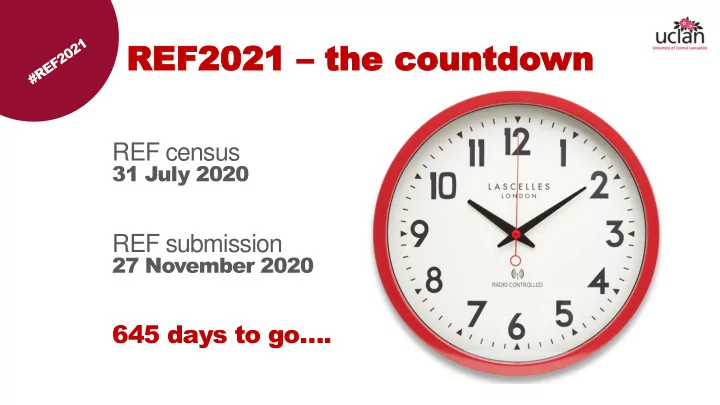
REF2021 REF2021 – the countd the countdown wn

REF census

31 July 2020

REF submission

27 November 2020

645 days to go….

slide-2
SLIDE 2

REF 2021 Panel criteria and working methods

Follow us on Twitter @REF_2021 Email us: info@ref.ac.uk

Prof David Price Chair of Panel B

slide-3
SLIDE 3

2021 framework

Overall quality

Outputs

FTE x 2.5 = number of

  • utputs required

Impact

Impact case studies

Environment

Environment data and template

60% 25% 15%

slide-4
SLIDE 4

Expert panels

  • 34 sub-panels working under the guidance of four main panels with

advice from Equality and Diversity and Interdisciplinary Research advisory panels (EDAP and IDAP)

  • Two-stage appointment process (via nominations):
  • 1. Criteria-setting phase – sufficient members appointed to ensure

each sub-panel has appropriate expertise

  • 2. Assessment phase – recruitment in 2020 of additional panel

members and assessors to ensure appropriate breadth of expertise and number of panel members necessary for the assessment phase, informed by the survey of institutions’ submission intentions in 2019.

slide-5
SLIDE 5

Interdisciplinary advisers

  • Interdisciplinary Research Advisory Panel
  • oversee application of agreed principles and processes
  • Main panel interdisciplinary leads
  • facilitate cross-panel liaison
  • oversee calibration exercise for IDR outputs
  • Sub-panel interdisciplinary advisers
  • At least two per sub-panel
  • Offer guidance to sub-panels on assessment of IDR outputs
  • Liaise with advisers on other panels
slide-6
SLIDE 6

Expert panels

Main panel res esponsibilities

  • Developing the panel criteria and

working methods

  • Ensuring adherence to the

criteria/procedures and consistent application of the overall assessment standards

  • Signing off the outcomes

Sub-panel responsibilities

  • Contributing to the main panel criteria

and working methods

  • Assessing submissions and

recommending the outcomes

slide-7
SLIDE 7

Consultation

  • 294 respondents
  • Views sought on clarity – broad agreement (70% +) across most areas
  • Some areas showing well over 80% agreement
  • Mixed views on key issues
slide-8
SLIDE 8

Panel criteria

Ai Aims

  • build on REF 2014 criteria to create continuity
  • achieve consistency across the main panels, where possible, while taking into account

disciplinary differences Str Structure

  • Unit of assessment (UOA) descriptors
  • Panel criteria (submissions, outputs, impact, environment)
  • Working methods
slide-9
SLIDE 9

Key changes following consultation

  • Research independence
  • Staff in non UK-based units
  • Co-authorship statements
  • Submitting co-authored outputs more than once
  • Version of output to be submitted
  • Double weighting
  • Continued impact case studies
  • Increased focus on equality and diversity in environment
slide-10
SLIDE 10

Independent researchers

  • ‘An individual who undertakes self-directed research, rather than carrying out another

individual’s research programme’

  • Research assistants / associates not normally eligible
  • GOS includes generic indicators, including:
  • Being named as principal investigator
  • Holding an independently won, competitively awarded fellowship where research independence is

a requirement. (List at www.ref.ac.uk/guidance)

  • Leading a research group or a substantial or specialised work package.
  • Main Panels C and D supplementary criteria – independent researchers

1. In addition to the generic criteria specified in the ‘Guidance on submissions’, Main Panels C and D also consider that the following attributes may generally indicate research independence in their disciplines:

  • Being named as a Co-I on an externally funded research grant/award.
  • Having significant input into the design, conduct and interpretation of the research.
slide-11
SLIDE 11

Staff in non-UK based units

  • Staff employed by the UK HEI and based outside the UK will be eligible if

if th the prim rimary focus of

  • f th

their research act activity on

  • n th

the ce census date is is cle clearly an and dir irectly con

  • nnected to
  • th

the su submitting unit it base ased in in th the UK.

  • HEIs should use guidance on demonstrating a substantive connection to help

determine whether they are eligible

  • Eligible staff should be returned to HESA. REF team is working with HESA to update

their guidance.

slide-12
SLIDE 12

Substantive connection

  • Statement required for staff on 0.20-0.29 FTE
  • evidence of participation in and contribution to the unit’s research environment
  • evidence of wider involvement in the institution
  • evidence of research activity focused in the institution
  • period of time with the institution
  • Statement not required where particular personal and discipline-related

circumstances apply

slide-13
SLIDE 13

Outputs

As Assessed ag again inst thr three crit criteria ia:

  • Originality - the extent to which the output makes an important and innovative

contribution to understanding and knowledge in the field

  • Significance - the extent to which the work has influenced, or has the capacity to

influence, knowledge and scholarly thought, or the development and understanding

  • f policy and/or practice
  • Rigour - the extent to which the work demonstrates intellectual coherence and

integrity, and adopts robust and appropriate concepts, analyses, theories and methodologies Sc Scored on

  • ne to
  • four star (or

(or uncl classif ified)

  • Each main panel sets out its own understanding of the starred quality levels
slide-14
SLIDE 14

Outputs – interdisciplinary research

  • For the purposes of the REF, interdisciplinary research is understood to achieve
  • utcomes (including new approaches) that could not be achieved within the

framework of a single discipline. Interdisciplinary research features significant interaction between two or more disciplines and/or moves beyond established disciplinary foundations in applying or integrating research approaches from other disciplines.

  • HEIs are invited to identify outputs that meet this definition. This process is

is dis istin inct fr from a request for cross-referral.

  • There will be no
  • ad

advantage or

  • r dis

isad advantage in the assessment in identifying outputs as interdisciplinary.

  • No penalty for incorrectly identifying outputs as interdisciplinary (or not).
slide-15
SLIDE 15

Outputs – co-authored

  • Institutions may only attribute co-authored outputs to individual members of staff

who made a a su substantia ial rese search con

  • ntrib

ibution to the output

  • Main Panel A: For each submitted co-authored output where there are fif

fifteen or

  • r

more authors and where the submitted member of staff is not identified as the lead

  • r corresponding author, institutions are required to affirm the substantial

contribution to the research by the submitted member of staff.

  • Sub-panel 9: for outputs with more th

than 15 15 co-authors and where the submitted member of staff is not identified as the lead or corresponding author, specific information is required about the author’s contribution (max. 100 words)

  • Main Panels C and D: not require the submission of information about the individual

co-author’s contribution but may seek to verify via audit.

slide-16
SLIDE 16

Outputs – co-authored

  • Consulted on whether HEIs should be able to submit an output more

than once in a submission to a UOA

  • Mixed response from sector – suggested disciplinary differences might be

justified

  • Main Panels A-C will not permit this
  • Main Panel D will permit submission up to two tim

imes.

  • Such outputs may make up max. 5% of submission.
  • Cannot be combined with double-weighting
slide-17
SLIDE 17

Outputs – version

  • Proposed in draft guidance that HEIs submitting outputs of former staff

must submit the version that was made publicly available when they were employed by that institution

  • Feedback from sector and consultation with panels revealed preference

for submitting final version

  • Concerns that it is not always possible to identify the final version (e.g.

for practice outputs)

  • HEIs can submit either version made available during employment or

final version

slide-18
SLIDE 18

Outputs – double-weighting

  • Alignment of criteria in Main Panels C and D
  • All main panels will require a statement to accompany all

all double-weighting requests

  • Removal of reference to the ‘disciplinary norm’
  • Expectation that most books will warrant double-weighting BUT this is not automatic
  • Suggestion in consultation that HEIs should submit a ranked list of reserve outputs,

rather than linking them to specific outputs. Panels agreed that this was unnecessarily complicated

slide-19
SLIDE 19

Outputs – open access

  • Outputs deposited as soon after

the point of acceptance as possible, and no la later than three months after this date from 1 April 2018.

  • Deposit exception from 1 April

2018 – outputs remain compliant if they are deposited up to three months after the date of publication.

  • Additional flexibility – 5% tolerance

band (or r one output) per submission to a UOA

slide-20
SLIDE 20

Impact

Consistency wit ith REF 2014

  • Impact remains non-portable
  • 2* quality threshold
  • Timeframe:
  • 1 January 2000 - 31 December 2020 for underpinning research
  • 1 August 2013 - 31 July 2020 for impacts

Refinements

  • Impact template integrated into Environment statement
  • Impact on teaching within (and beyond) own HEI is eligible
  • Enhanced clarity on scope of underpinning research – bodies of work
  • Guidance on submitting continued impact case studies
  • Enhanced guidance on public engagement
slide-21
SLIDE 21

Impact – criteria

As Assessed ag again inst tw two crit criteria ia:

  • Reach (u

(updated defin init ition): Reach will be understood as the extent and/or diversity of the beneficiaries of the impact, as relevant to the nature of the impact. Reach will be assessed in terms of the extent to which the potential constituencies, number or groups of beneficiaries have been reached; it will not be assessed in purely geographic terms, nor in terms of absolute numbers of beneficiaries. The criteria will be applied wherever the impact occurred, regardless of geography or location, and whether in the UK or abroad

  • Significance - the degree to which the impact has enabled, enriched, influenced,

informed or changed the performance, policies, practices, products, services, understanding, awareness or wellbeing of the beneficiaries.

slide-22
SLIDE 22

Impact – continued case studies

  • Case studies continued from examples submitted to REF 2014 are eligible
  • Must meet the same eligibility criteria, including the length of the window for

underpinning research (1 January 2000 to 31 December 2020) and the assessment period (1 August 2013 to 31 July 2020) for the impact described

Main Panel A supplementary criteria – continued case studies

  • 231. Main Panel A will assess each case study on merit and wishes to receive information on

how any continued case study relates to that submitted in REF 2014. Panel members will have access to the REF 2014 database1 and may refer to this to understand the context of the 2021 case study. Main Panels B, C and D supplementary criteria – continued case studies

  • 232. The sub-panels will assess each case study on merit and do not wish to receive information
  • n how any continued case study relates to that submitted to REF 2014. If any such information is

provided, the sub-panels will not take it into account during the assessment process.

slide-23
SLIDE 23

Impact – types and indicators

  • Panels welcome case studies that describe an

any typ type(s) of impact

  • Panel will welcome, and assess equitably, case studies describing impacts achieved

through public engagement, either as the main impact described or as one facet of a wider range of impacts.

  • Impact on teaching within (and beyond) own HEI is eligible
  • Case studies must provide a clear and coherent narrative supported by verifiable

evidence and indicators

  • Should provide evidence of reach and significance of the im

impacts, as distinct from evidence of dissemination or uptake

  • Annex A includes an extensive – but not exhaustive – list of examples of impact and

indicators, including evaluation frameworks from non-HE organisations

slide-24
SLIDE 24

Impact – underpinning research

  • Panels recognise that the relationship between research and impact can be indirect

and non-linear

  • Underpinning research as a whole must be min. 2* quality
  • Case studies must include up to six key references (not every output referenced has

to be 2*) – HEIs can consult the outputs glossary in the Guidance on submissions

  • Can also include indicators of quality e.g. evidence of peer-reviewed funding, prizes or

awards for individual outputs etc.

  • May be a body of work produced over a number of years or may be the output(s) of a

particular project

  • Must be produced by someone working at the HEI within the scope of the UOA

descriptor

  • Does not need to be a Category A eligible staff member
  • Impact case study can be returned to different UOA from the outputs that underpin it
slide-25
SLIDE 25

Environment

As Assessment cri criteria ia:

  • Vitality - the extent to which a unit supports a thriving and inclusive research culture

for all staff and research students, that is based on a clearly articulated strategy for

  • research and enabling its impact, is engaged with the national and international

research and user communities and is able to attract excellent postgraduate and postdoctoral researchers.

  • Sustainability - the extent to which the research environment ensures the future

health, diversity, well-being and wider contribution of the unit and the discipline(s), including investment in people and in infrastructure.

slide-26
SLIDE 26

Environment template

Se Sectio ions

  • a. Unit context, research and impact strategy.
  • b. People, including:
  • a. staffing strategy and staff development
  • b. research students

c. equality and diversity.

  • c. Income, infrastructure and facilities.
  • d. Collaboration and contribution to the research base, economy and

society.

Information from 2014 impact template to be included across the four sections Increased emphasis on equality and diversity (not limited to ‘People’)

slide-27
SLIDE 27

Environment template

Weig ightin ing

  • Main Panel A, B and C will attach equal weighting to each of the four

sections

  • Recognising the primary role that people play as the key resource in the arts

and humanities, Main Panel D will attach differential weight to sections:

  • Unit context and structure, research and impact strategy (25%)
  • People (30%)
  • Income, infrastructure and facilities (20%)
  • Collaboration and contribution to the research base, economy and society (25%)
slide-28
SLIDE 28

Institutional level assessment of environment

  • Institutional-level information will be appended to the UOA-level

environment template and will be taken into account by the sub-panel when assessing the unit-level statement.

  • Pilot of the standalone assessment of the discrete institutional-level

environment will draw on this submitted information.

  • Outcomes from the separate pilot exercise will not

t be included in REF 2021 but will inform future research assessment.

  • Increase in word limit to min. 4,000 words.
  • Further guidance and criteria to be published in summer 2019

following consultation.

slide-29
SLIDE 29

Timetable

Spring/summer 2019 Submission deadline for codes of practice: 7 June 2019 Invitation to request multiple submissions, case studies requiring security clearance, and exceptions to submission for small units Launch beta version of submission system Autumn 2019 Pilot of the REF submission system; Survey of submissions intentions opens; Invitation to submit reduction requests for staff circumstances December 2019 Survey of submissions intentions complete Final deadline for requests for multiple submissions, case studies requiring security clearance, and exceptions to submission for small units Publication of approved codes of practice Early/mid 2020 Formal release of the submission systems and technical guidance Invitation to HEIs to make submissions Appointment of panel members & assessors for assessment phase Deadline for staff circumstances requests 31 July 2020 Census date for staff End of assessment period (for impact, environment, and data about research income and research doctoral degrees awarded) 27 November 2020 Closing date for submissions

slide-30
SLIDE 30

Further information

  • www.ref.ac.uk (includes all relevant documents and FAQs)
  • Enquiries from staff at HEIs should be directed to their nominated institutional

contact (available at www.ref.ac.uk/contact)

  • Other enquiries to info@ref.ac.uk