Gestalt Theory and its Application in Instructional Design Karen - - PowerPoint PPT Presentation

gestalt theory and its application in instructional design
SMART_READER_LITE
LIVE PREVIEW

Gestalt Theory and its Application in Instructional Design Karen - - PowerPoint PPT Presentation

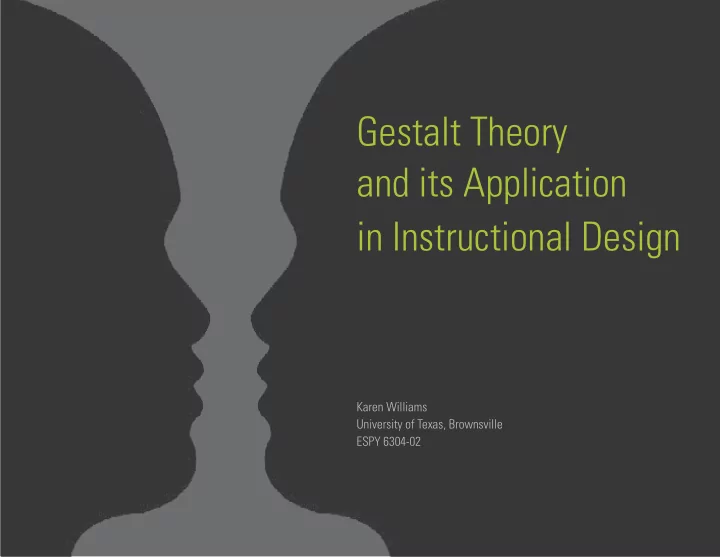
Gestalt Theory and its Application in Instructional Design Karen Williams University of Texas, Brownsville ESPY 6304-02 1 Gestalt Theory: History and Overview 2 Application of Gestalt Theory in Education 3 Gestalt Theory And Instructional

slide-1
SLIDE 1

Gestalt Theory and its Application in Instructional Design

Karen Williams University of Texas, Brownsville ESPY 6304-02

slide-2
SLIDE 2

1 Gestalt Theory: History and Overview 2 Application of Gestalt Theory

in Education

3 Gestalt Theory And Instructional

Design

4 Activity: Use of Gestalt Theory in

Computer Based Learning Application

slide-3
SLIDE 3

History and Overview

Gestalt is a word of German origin. It means form, pattern, and/or confjguration. A confjguration or pattern offers an “organization” to the perceptions of individual experiences. The operational principle of Gestalt psychology is that the brain is holistic and with self-organizing tendencies. What this means is that the human eye sees objects in their entirety prior to perceiving their individual parts. Gestalt theory emphasizes wholeness and organization.

cOntents

slide-4
SLIDE 4

Max Wertheimer, who along with Wolfgang Kohler and Kurt Koffka, conducted research which fjrst demonstrated relationships between visual stimulus confjgurations, i.e. “parts” and experienced “wholes.” This led to the conclusion that relationships between visual stimulus and perception is not haphazard but instead is a phenomena which can be studied and categorized.

cOntents

slide-5
SLIDE 5

The Gestaltist motto is:

the whole is greater than the sum of the parts

Gestalt theory emerged in opposition to the leading theory of the time, Behaviorism. Behaviorism states that psychology should concern itself with the observable behavior of people and animals, and not with the unobservable events that take place in their minds. The Gestaltist stance is the opposite— perception and what takes place in the mind is what matters.

cOntents

slide-6
SLIDE 6

Four basic assumptions of Gestalt theory:

1) Study “molar” rather than “molecular” behavior. 2) Organisms respond to segregated sensory wholes rather than to specifjc stimuli as isolated and independent events. 3) Individuals respond not to their geographic environment but to their perception of their environment. 4) How the stimuli is organized is a dynamic part of the process and infmuences the perception of the individual.

cOntents

slide-7
SLIDE 7

The essential question for any Gestalt practitioner is:

how does the individual perceive their geographical environment and visual stimuli?

Therefore the essential question for any Gestalt theory application is:

how should the visual stimuli be arranged in order to facilitate learning, creative problem solving, and insight?

cOntents

slide-8
SLIDE 8

Application of Gestalt theory in education

For Gestalt theorists learning is a special problem of perception. Research in this area has focused on insight. Insight is described as seeing clearly into the heart of a problem. Perceptual reorganization of the environment or stimuli, coupled with the required background knowledge and a period of incubation, can lead to an “a-ha moment” also known as insight.

cOntents

slide-9
SLIDE 9

For the classroom environment Wertheimer differentiated between arbitrary or “senseless learning” and “meaningful learning.” While Wertheimer did not recommend specifjc teaching methods based upon Gestalt theory, he did advocate for instructors to facilitate students in the reorganization

  • f information and stimuli in order to shift their view of

the problem. An example of meaningful learning is teaching the relevant structure of the situation or problem. An example of senseless learning is rote memorization.

cOntents

slide-10
SLIDE 10

Gestalt theory never attained mainstream status as a learning theory. It lacks a set of clearly defjned principles and its researchers have only presented us with these general suggestions for problem- solving situations: 1) Embed the problem or learning task in concrete, actual situations. 2) The instructor should provided guided discovery during problem solving in the form of cues or hints to help learners reorganize their perception. 3) Do not teach rote memorization. 4) When students get stuck on a problem allow them to take a break, self-refmect and give the insight and solution time to incubate.

cOntents

slide-11
SLIDE 11

Gestalt theory and Instructional Design

Being a family of psychological theories, Gestalt theory has infmuenced many research areas since 1924, including visual design issues. Today, Gestalt theory is considered to be one of the essential foundations for instructional screen design. It is generally accepted that its implementation may improve educational screen design and consequently improve student learning.

cOntents

slide-12
SLIDE 12

Today, graphic design is actively engaged with the matter of interactivity and audience participation, and Gestalt theory offers a proven method for creating positive human learning experiences. Researchers have identifjed eleven specifjc laws of Gestalt theory that have a signifjcant implication for computerized instructional design. They are:

cOntents

slide-13
SLIDE 13

1) Balance/symmetry

A visual object will appear incomplete if the visual object is not balanced or symmetrical. A psychological sense

  • f equilibrium is usually achieve when visual weight is

evenly placed on each side of an axis.

cOntents

slide-14
SLIDE 14

2) continuation

The eye will instinctively derive and follow a direction from a visual fjeld.

cOntents

slide-15
SLIDE 15

3) closure

The mind tends to close gaps and complete unfjnished forms.

cOntents

slide-16
SLIDE 16

4) Figure-Ground

We distinguish the foreground and background in a visual

  • fjeld. The use of two different foreground colors let the

viewer perceive different things from the same illustration.

cOntents

slide-17
SLIDE 17

5) Focal Point

Every visual presentation needs a focal point or center of interest to catch the viewer’s attention and guide them to the next appropriate element.

cOntents

slide-18
SLIDE 18

6) Isomorphic correspondence

Viewers interpret images based upon previous experience.

cOntents

slide-19
SLIDE 19

7) Prägnanz

“Good form” is achieved when there is a simple design and/or good layout.

cOntents

slide-20
SLIDE 20

8) Proximity

Items placed near each other will appear to be one large group. Viewers mentally organize close elements into one coherent object.

cOntents

slide-21
SLIDE 21

9) similarity

Items that are similar tend to be grouped together.

cOntents

slide-22
SLIDE 22

10) simplicity

Viewer’s have an unconscious tendency to simplify visual

  • complexity. If the design is too complex or cluttered the

viewer may reach unintended conclusions.

cOntents

slide-23
SLIDE 23

11) Unity/Harmony

Viewers can determine an arrangement among elements if they look as if they belong together. If there is disharmony among closely spaced elements then confusion will result.

cOntents

slide-24
SLIDE 24

Activity:

On the following page are individual visual elements for the home page of a educational website. Using the 11 laws of Gestalt Theory for Instructional Design, re-arrange them to create a composition that facilitates user learning. Print out the page, cut out the individual pieces, and arrange them to acheive an online portal that is easy to comprehend and use.

cOntents

slide-25
SLIDE 25

cOntents

slide-26
SLIDE 26

References Chang, D.; Dooley, L. and Tuovinen, J. E. “Gestalt Theory in Visual Screen Design— A New Look at an old subject.” In: Selected Papers from the 7th World Conference on Computers in Education (WCCE’01), Copenhagen, Computers in Education 2001: Australian

  • Topics. Melbourne: Australian Computer Society, 2002, p. 5–12.

Gredler, M. Learning and Instruction: Theory Into Practice. (5th Ed.) Pearson Education. Upper Saddle River, NJ. 2005, p. 48-72. Moszkowicz, J. “Gestalt and Graphic Design: An Exploration of the Humanistic and Therapuetic Effects of Visual Organization.” Design Issues, Autumn 2011, 27( 4), p. 56-67. Preece, J., Rogers, Y., Sharp, H., Benyon, D., Holland, S. and Carey, T. Human Computer Interaction (1st Ed.). Wokingham, England, Addison-Wesley Publishing Company, 1994.

cOntents