Composition Unity, Gestalt Theory, Pattern, Balance, Scale, Rhythm, - - PowerPoint PPT Presentation

composition
SMART_READER_LITE
LIVE PREVIEW

Composition Unity, Gestalt Theory, Pattern, Balance, Scale, Rhythm, - - PowerPoint PPT Presentation

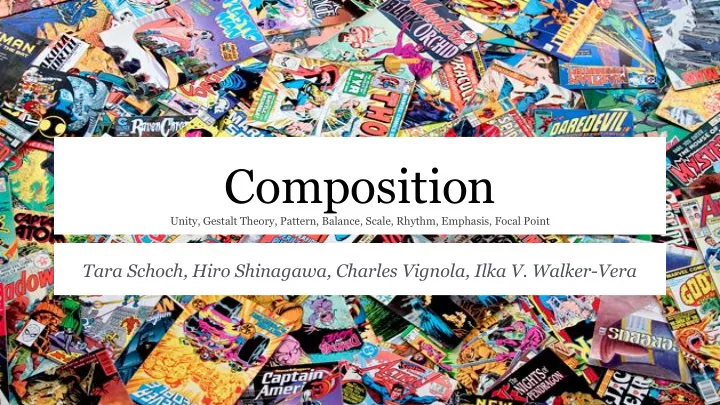
Composition Unity, Gestalt Theory, Pattern, Balance, Scale, Rhythm, Emphasis, Focal Point Tara Schoch, Hiro Shinagawa, Charles Vignola, Ilka V. Walker-Vera Unity and Variety Unity - Similarity Variety - Difference - Must be a Balance between

slide-1
SLIDE 1

Composition

Unity, Gestalt Theory, Pattern, Balance, Scale, Rhythm, Emphasis, Focal Point

Tara Schoch, Hiro Shinagawa, Charles Vignola, Ilka V. Walker-Vera

slide-2
SLIDE 2

Unity and Variety

Unity - Similarity Variety - Difference

  • Must be a Balance between the two but

Together they make a cohesive and

lively composition

slide-3
SLIDE 3

Gestalt Theory

  • The Theory that Visual Information is

understood holistically before it is examined separately. Bigger Picture Closer Detail

slide-4
SLIDE 4

The 6 Essential Aspects

1) Grouping 2) Containment 3) Repetition 4) Proximity 5) Continuity 6) Closure

slide-5
SLIDE 5
slide-6
SLIDE 6

Patterns Grids

the repetition of any visual element created through a series of intersecting lines

slide-7
SLIDE 7

Balance

The distribution of weight or force within a composition.

  • Weight and Gravity
  • Symmetrical Balance
  • Radial Symmetry
  • Asymmetrical Balance
  • Expressive Use of Balance
slide-8
SLIDE 8

Weight and Gravity

Symmetrical Balance Approximate Symmetry

Symmetrical Balance

same similar

slide-9
SLIDE 9

Radial Symmetry Asymmetri cal Balance Expressive Uses of Balance

slide-10
SLIDE 10

Scale

The size of a visual medium relative to the size of a human.

slide-11
SLIDE 11

The size of the heads pictured here are normal relative to each

  • ther, but small

to a human, as is seen by the largeness of the hand holding the bases.

slide-12
SLIDE 12

The faucet pictured is large scale, meaning it is larger than it normally would be relative to the size of a person.

slide-13
SLIDE 13

Rhythm

Using repetition in visual mediums in

  • rder to create

the illusion of movement.

slide-14
SLIDE 14

The repeating image, but varying distance from the focal point, gives the image the illusion that it is moving.

slide-15
SLIDE 15

Emphasis: attention and increase visual and conceptual impact

isolation

  • Focal point: compositional device
  • Emphasis: visual elements
  • Anomaly: break from norm

placement

  • centricity: compressive compositional force
  • eccentricity: expansive compositional force
slide-16
SLIDE 16

anomaly

slide-17
SLIDE 17

Centricity and Eccentricity

slide-18
SLIDE 18

Contrast: 2 or more forces operating in opposition

Three types:

  • scale
  • shape
  • color
slide-19
SLIDE 19

contrast in scale

slide-20
SLIDE 20

contrast in shape

slide-21
SLIDE 21

contrast in color