RECURRENCE WHAT CAUSES CLUSTER HEADACHES? Occasionally referred to - - PDF document

recurrence
SMART_READER_LITE
LIVE PREVIEW

RECURRENCE WHAT CAUSES CLUSTER HEADACHES? Occasionally referred to - - PDF document

10/4/18 QUESTIONS : CLUSTER HEADACHES: 1. Have any of you heard of cluster THE WORST PAIN POSSIBLE? headaches? 2. Do you know someone who suffers from cluster headaches? WHAT ARE CLUSTER HEADACHES? TRIGEMINAL NERVE A neurological


slide-1
SLIDE 1

10/4/18 1

CLUSTER HEADACHES:

THE WORST PAIN POSSIBLE?

QUESTIONS:

  • 1. Have any of you heard of cluster

headaches?

  • 2. Do you know someone who suffers

from cluster headaches?

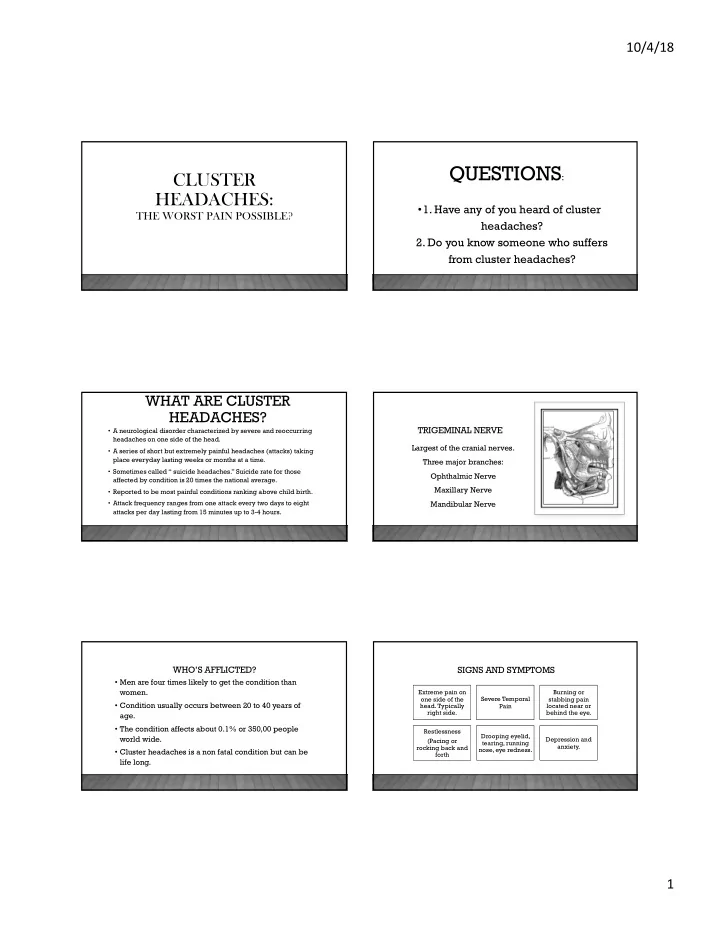
WHAT ARE CLUSTER HEADACHES?

  • A neurological disorder characterized by severe and reoccurring

headaches on one side of the head.

  • A series of short but extremely painful headaches (attacks) taking

place everyday lasting weeks or months at a time.

  • Sometimes called “ suicide headaches.” Suicide rate for those

affected by condition is 20 times the national average.

  • Reported to be most painful conditions ranking above child birth.
  • Attack frequency ranges from one attack every two days to eight

attacks per day lasting from 15 minutes up to 3-4 hours.

TRIGEMINAL NERVE

Largest of the cranial nerves. Three major branches: Ophthalmic Nerve Maxillary Nerve Mandibular Nerve

WHO’S AFFLICTED?

  • Men are four times likely to get the condition than

women.

  • Condition usually occurs between 20 to 40 years of

age.

  • The condition affects about 0.1% or 350,00 people

world wide.

  • Cluster headaches is a non fatal condition but can be

life long.

SIGNS AND SYMPTOMS

Extreme pain on

  • ne side of the
  • head. Typically

right side. Severe Temporal Pain Burning or stabbing pain located near or behind the eye. Restlessness (Pacing or rocking back and forth Drooping eyelid, tearing, running nose, eye redness. Depression and anxiety.

slide-2
SLIDE 2

10/4/18 2

WHAT CAUSES CLUSTER HEADACHES?

  • Main cause is still unknown. Possible hypothalamus disorder.
  • Risk factors may include exposure to tobacco smoke and family

history of the condition.

  • People with a first degree relative with the condition are about

14-48 times more likely to develop the condition.

  • Up to 20% of people with cluster headaches have positive

family history.

  • Possible genetic factors need more research as current

evidence for genetic inheritance is very limited.

RECURRENCE

  • Occasionally referred to as “alarm headaches” because of the

regularity of their recurrence striking at a precise time each day.

  • Cluster headaches have been known to awaken individuals

from sleep.

  • The recurrence of cluster headache grouping occur more often

around spring and autumn equinoxes.

  • Attack frequency may be highly unpredictable showing no

regularity at all.

DIAGNOSIS

  • There are no confirmatory tests for cluster headaches.
  • Cluster headaches are often misdiagnosed and may be

confused with migraines.

  • People with cluster headaches typically experience a

diagnostic delay before getting a correct diagnosis.

  • A headache diary is recommended and can be useful in

tracking when and where pain occurs, the severity, and how long the pain lasts so an accurate diagnosis can be made.

TREATMENT MANAGEMENT

  • Oxygen treatment: Typically given with a non-rebreather mask

at 12-15 liters per minute for 15-20 minutes . About 70% of people find relief within 15 minutes.

  • Triptans: Sumatriptan and zolmitriptan have been shown to

improve symptoms during an attack. Sumatriptan reportedly being better of the two medications.

  • The use of opioids in the management of cluster headaches is

not recommended and may make symptoms worse.

  • GammaCore (non-invasive vagus nerve stimulator) for the

acute treatment of pain associated with episodic cluster headache in adult patients.

PREVENTION TREATMENT?

  • Medications for prophylaxis include: Divalproex, Lithium, and

Verapamil.

  • Verapamil is the recommended preventive therapy.
  • Steroids such as prednisone, but is generally discontinued after

8-10 days due to little evidence to support long term use.

RESEARCH

  • Less the 2 million dollars have been spent on

research in last 25 years.

  • Very limited research for a part of small

population affected.

slide-3
SLIDE 3

10/4/18 3

CONTROVERSIAL RESEARCH

  • Some case reports suggest that ingesting tryptamines such as

psilocybin (magic mushrooms) or dimethyltryptamine (DMT) can reduce pain and interrupt headache cycles.

  • A 2006 survey of 53 individuals with cluster headaches said that

psilocybin extended remission periods.

  • There is research for Bromo-LSD underway in Germany for

cluster headaches. It holds promise of effectively treating cluster cycles and attacks without the psychedelic effects of LSD.

  • Legality for patients and medical professionals.

SUPPORT

  • Understanding and Support are important in helping

those who suffer with the condition.

  • There are support groups available through WebMD,

Facebook, and Clusterbusters.com

QUESTIONS???