Extended Binary Trees Recurrence relations After today, you should - - PowerPoint PPT Presentation

extended binary trees recurrence relations
SMART_READER_LITE
LIVE PREVIEW

Extended Binary Trees Recurrence relations After today, you should - - PowerPoint PPT Presentation

Extended Binary Trees Recurrence relations After today, you should be able to explain what an extended binary tree is solve simple recurrences using patterns } Today: Extended Binary Trees (on HW9) Recurrence relations, part 1 }


slide-1
SLIDE 1

Extended Binary Trees Recurrence relations

After today, you should be able to… …explain what an extended binary tree is …solve simple recurrences using patterns

slide-2
SLIDE 2

} Today:

  • Extended Binary Trees (on HW9)
  • Recurrence relations, part 1

} GraphSurfing Milestone 2

  • Two additional methods: shortestPath(T start, T end)

and stronglyConnectedComponent(T key)

  • Tests on Living People subgraph of Wikipedia

hyperlinks graph

  • Bonus problem: find a “challenge pair”

– Hard to solve optimally! Longest path problem

slide-3
SLIDE 3

} Today:

  • Extended Binary Trees (on HW9)
  • Recurrence relations, part 1

} Due later:

  • Hardy’s Taxi, part two: efficiency boost!

– Some HW1 solutions took 60+ sec to find the 4th taxicab #. Now you’ll try to find the 50,000th one in the same time! …3 or 4 nested for-loops won’t work.

slide-4
SLIDE 4

Bringing new life to Null nodes!

slide-5
SLIDE 5

} Not a single NULL_NODE,

but many NULL_NODEs

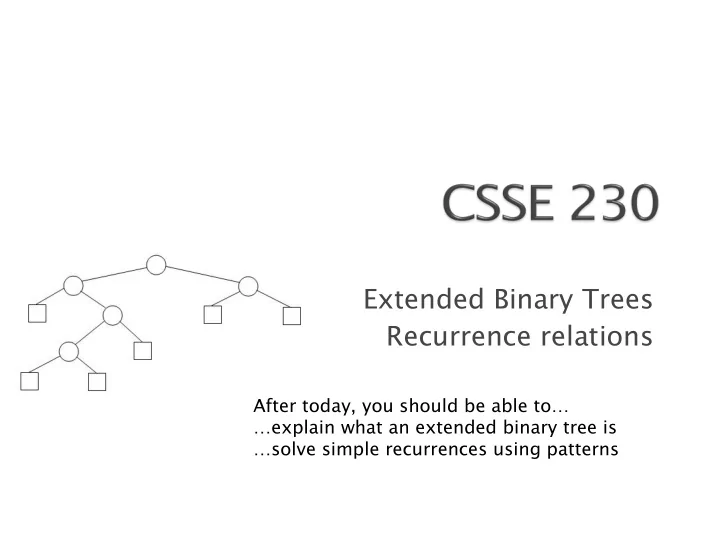
} An Extended Binary tree is either

  • an ex

exter ernal l (n (null) ll) node de, or

  • an (in

inter ernal) root node and two

EBTs TL and TR.

} We draw internal nodes as circles and external nodes as

squares.

  • Generic picture and detailed picture.

} This is simply an alternative way of viewing binary trees,

in which we view the external nodes as “places” where a search can end or an element can be inserted. 1-2

slide-6
SLIDE 6

} Pro

Propert rty P(N): For any N>=0, any EBT with N internal nodes has _______ external nodes.

} Pro

Prove by by str trong g indu ducti tion, based on the recursive definition.

  • A notation for this problem: IN(T), EN(T)

3-5

Hint (reminder): Find a way to relate the properties for larger trees to the property for smaller trees.

slide-7
SLIDE 7

A technique for analyzing recursive algorithms

slide-8
SLIDE 8
slide-9
SLIDE 9

} Split the sequence in half } Where can the maximum subsequence appear? } Three possibilities :

  • entirely in the first half,
  • entirely in the second half, or
  • be

begi gins in the first half and en ends in the second half

6

slide-10
SLIDE 10

1.

Using recursion, find the maximum sum of fir first half of sequence

2.

Using recursion, find the maximum sum of se second nd half of sequence

3.

Compute the max of all sums that begin in the first half and end in the second half

  • (Use a couple of loops for this)

4.

Choose the largest of these three numbers

slide-11
SLIDE 11

What’s the run-time? 7 N = array size

slide-12
SLIDE 12

Runtime = Recursive part + non-recursive part 8

slide-13
SLIDE 13

} Write a Re

Recu currence ce Re Relation

  • T(N) gives the run-time

as a function of N

  • Two (or more) part definition:

– Base case, like T(1) = c – Recursive case, like T(N) = T(N/2) + 1

So, what’s the recurrence relation for the recursive MCSS algorithm? 9

slide-14
SLIDE 14

10 10 Runtime = Recursive part + non-recursive part

slide-15
SLIDE 15

T(N) = 2T(N/2) + q(N) 10 10 Runtime = Recursive part + non-recursive part T(1) = 1

slide-16
SLIDE 16

} An equation (or inequality) that relates the

nth element of a sequence to certain of its predecessors (recursive case)

} Includes an initial condition (base case) } So

Solu lutio ion: A function of n.

} Similar to differential equation, but discrete

instead of continuous

} Some solution techniques are similar to

  • diff. eq. solution techniques
slide-17
SLIDE 17

} One strategy: look

look for

  • r pa

patte ttern rns

} Examples:

As As class:

  • T(0) = 0, T(N) = 2 + T(N-1)
  • T(0) = 1, T(N) = 2 T(N-1)
  • T(0) = T(1) = 1, T(N) = T(N-2) + T(N-1)

On On quiz iz:

  • T(0) = 1, T(N) = N T(N-1)
  • T(0) = 0, T(N) = T(N -1) + N
  • T(1) = 1, T(N) = 2 T(N/2) + N

(just consider the cases where N=2k)

11 11-15 15

slide-18
SLIDE 18

} Find patterns } Telescoping } Recurrence trees } The master theorem

14 14-15 15

slide-19
SLIDE 19