Reconnaissance and Emerging Strategies to Enable Human Exploration - - PowerPoint PPT Presentation

reconnaissance and emerging strategies to enable human
SMART_READER_LITE
LIVE PREVIEW

Reconnaissance and Emerging Strategies to Enable Human Exploration - - PowerPoint PPT Presentation

Reconnaissance and Emerging Strategies to Enable Human Exploration of Mars Richard (Rick) Davis SMD Assistant Director for Science and Exploration NASA Headquarters NOTE ADDED BY JPL WEBMASTER: This content has not been approved or adopted by


slide-1
SLIDE 1

1

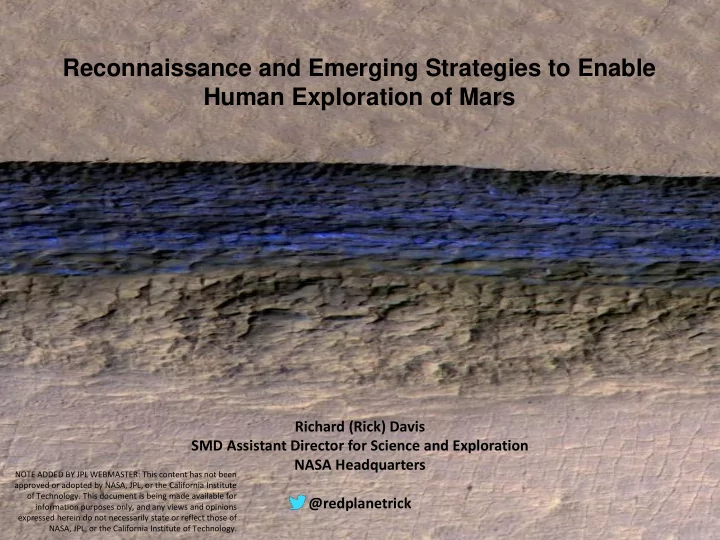
Reconnaissance and Emerging Strategies to Enable Human Exploration of Mars

Richard (Rick) Davis SMD Assistant Director for Science and Exploration NASA Headquarters @redplanetrick

NOTE ADDED BY JPL WEBMASTER: This content has not been approved or adopted by NASA, JPL, or the California Institute

  • f Technology. This document is being made available for

information purposes only, and any views and opinions expressed herein do not necessarily state or reflect those of NASA, JPL, or the California Institute of Technology.

slide-2
SLIDE 2

2

Outline

  • Water and the Human Landing Sites Study (HLS2)
  • Mars Subsurface Ice and Hydrated Mineral Maps
  • Potentially Needed Future Missions from the

International Mars Exploration Working Group (IMEWG)

  • Growing Awareness of Potential Need for Civil

Engineering

  • Mars Exploration Planning Analysis Group Science Goal

IV: Prepare for Human Exploration

slide-3
SLIDE 3

3

Water and the Human Landing Sites Study (HLS2)

This effort is a joint Human Exploration and Operations Mission Directorate (HEOMD) / Science Mission Directorate (SMD) study

  • Four Major Questions:

– Is it really there? – Can you really produce it economically? – How much water do you need? – If the feedstock drives location, what does that mean for landing, launching to go home, and living there?

slide-4
SLIDE 4

4

Subsurface Ice Maps

Pushing the Ice-Boundary Line Equatorward

Northern Hemisphere Datasets used: MONS, TES, THEMIS, SHARAD, Geomorphology (imagery and elevation data)

Ice Consistency (Ci)

(0-5m from Surface)

Pathare+2018 (Shallow) *Pe18 (Deep) *St16 (Deep) *Br15 (Deep) SWIM contiguous ice (Ci>0.3) SWIM discontiguous ice (Ci>0.3)

The SWIM Project has:

  • Detected more equatorward contiguous and discontiguous shallow (<5 m)

ice than previously found across the Northern Hemisphere

  • Increased radar reflector coverage across the Northern Hemisphere, detecting

more equatorward deep ice, and improving estimates of material composition

Legend Prior shallow (<1 m) ice from neutrons SWIM contiguous ice consistency >0.3 SWIM discontiguous ice consistency >0.3 Previously published deep (>15m) ice southern boundary

*Pe18: Peterson et al. 2018; St16: Stuurman et al. 2016; Br15: Bramson et al. 2015

SWIM detected deep (>15m) ice southern boundary Region not mapped due to high elevation (not landable by human-class vehicles) Depth to Base of Ice (m)

Derived from SWIM Radar Analysis

Pre-Decisional Information -- For Planning and Discussion Purposes Only

Next Steps: Currently evaluating potential extension activities to this project that will increase coverage to the Southern Hemisphere and incorporate additional, improved mapping techniques.
slide-5
SLIDE 5

5

Global Hydrated Mineral Water Abundance Map

From: Carter et al., IAS Paris-Sud University

Next Steps: Future studies based on new knew knowledge revealed by these mapping projects are currently being considered, including a potential update to the M-WIP Study and a potential second Mars human landing site selection workshop.

slide-6
SLIDE 6

6

  • Mars Sample Return

– Accomplish Decadal Science Priorities – In addition, MSR is probably needed to confirm the mechanical properties of the regolith/dust (abrasiveness, oxidizing potential particle size, etc.), how it will interact with surface systems (e.g., suits, rovers, habitats, etc.), and potential human health hazards (toxicity, respiratory, potential extant life, etc.)

  • Water Recon

– Identify near surface ice – Assess Potential of Hydrated Minerals – Ground Truthing – Ease of access

  • Special Regions Drill

– Search for life – Characterize the water

  • For ISRU
  • For potential human use
  • Next-Gen Weather Capabilities

(Orbital and Surface)

– Density Profiles

  • (EDL)

– Winds Aloft – Potential Microbial Transport

  • Improved Communications

– Increased data rate

Potentially Needed Future Missions

From International Mars Exploration Working Group

slide-7
SLIDE 7

7

Growing Awareness of Potential Need for Civil Engineering on the Moon and Mars

  • Landing large spacecraft on loose regolith in a low gravity environment has the

potential to disturb huge plumes of rock and dust posing a threat to any mission infrastructure nearby

  • There is growing awareness that civil engineering efforts may be needed to create

landing pads and/or roads

  • Understanding these challenges requires a more in-depth understanding of the
  • verburden at potential human landing sites
slide-8
SLIDE 8

8

MEPAG Science Goal IV: Prepare for Human Exploration

slide-9
SLIDE 9

9

For More Information

Visit our website: http://www.nasa.gov/journeytomars/mars-exploration-zones Follow us on Twitter: @RedPlanetRick Join our disto list, by contacting us at: NASA-Mars-Exploration-Zones@mail.nasa.gov