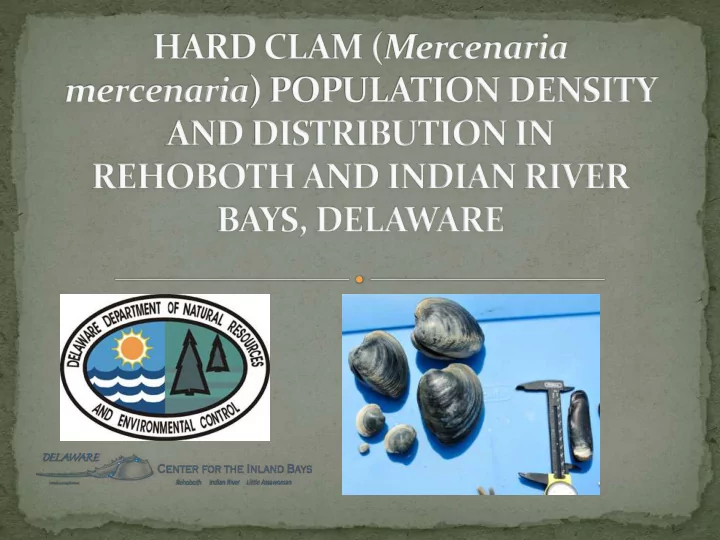
SLIDE 1
SLIDE 2
Identify areas of high clam densities to focus efforts of
reclassification of growing areas if possible
Look for changes in clam densities and distributions
from previous surveys
Collect the necessary data for any potential
aquaculture efforts
SLIDE 3
Unfunded Federal mandate which strictly controls the
harvest of bi-valve molluscan shellfish( clams, oysters, mussels, etc.) through State Shellfish Programs
State Shellfish Programs establish harvest areas
following strict regulations
State Shellfish Programs are audited by U.S. Food and
Drug Administration annually
SLIDE 4
1968 Grab Survey1 1976 Venturi Suction Dredge2 2011 Duplicated Sample technique of 1976 survey
SLIDE 5 Dredge utilizes water pressure from 4” water pump to
“vacuum” all clams and sediment to a minimum depth
Assume 100% efficiency based on pre-sampling tests Collects clams that are less than 1 centimeter in length
SLIDE 6
Restricted Harvest Seasonally Restricted # clams/m2
Figure 1. Rehoboth Bay site specific clam densities and harvest classifications
SLIDE 7
Figure 2. Indian River Bay site specific clam densities and harvest classifications
SLIDE 8 2 1 Nautical Miles
1975-76 2010
Figure 3. Density distribution of Mercenaria mercenaria Rehoboth Bay area 3
SLIDE 9
1975-76 2010
Figure 4. Density distribution of Mercenaria mercenaria Indian River Bay area3
SLIDE 10
Figure 5. Hard clam densities of 2011 survey using spline interpolation with a 25m x 25m grid.
SLIDE 11 Statistical Test Result P-value Rehoboth Bay clam density: 1976 versus 2011 Not Significant P=0.45 Indian River Bay clam density: 1976 versus 2011 Not Significant P=0.36 Rehoboth Bay versus Indian River Bay clam density: 1976 Significant P<0.001 Rehoboth Bay versus Indian River Bay clam density: 2011 Significant P=0.049
Table 1. Comparison of clam densities between years and between bays (Wilcoxon two-sample test).
SLIDE 12 Statistical Test Result P-value Rehoboth Bay clam density: 1976 versus 2011 Not Significant P=0.31 Indian River Bay clam density: 1976 versus 2011 Not Significant P=0.34 Rehoboth Bay versus Indian River Bay clam density: 1976 Significant P<0.0001 Rehoboth Bay versus Indian River Bay clam density: 2011 Not Significant P=0. 296
Table 2. Comparison of the distributions of clam densities between years and between bays (Kolmogorov-Smirnov two-sample test).
SLIDE 13 0.00 0.05 0.10 0.15 0.20 0.25 0.30 0.35 0.40 2 4 6 8 10 12 14 16 18 20 22 24 26 28 30 32 Proportion of All Observations Clams/m2
Indian River Bay 2011
0.00 0.05 0.10 0.15 0.20 0.25 0.30 0.35 0.40 2 4 6 8 10 12 14 16 18 20 22 24 26 28 30 32 Proportion of All Observations Clams/m2
Indian River Bay 1976
0.00 0.05 0.10 0.15 0.20 0.25 0.30 0.35 0.40 2 4 6 8 10 12 14 16 18 20 22 24 26 28 30 32 Proportion of All Observations Clams/m2
Rehoboth Bay 1976
0.00 0.05 0.10 0.15 0.20 0.25 0.30 0.35 0.40 2 4 6 8 10 12 14 16 18 20 22 24 26 28 30 32 Proportion of All Observations Clams/m2
Rehoboth Bay 2010
Figure 6. Distribution of clam catches in the 1976 and 2011 surveys.
SLIDE 14
General survey conducted at 10 stations using a bull
rake and hand rake to determine if any bi-valve shellfish were present
Only 9 clams were found at all 10 sites Sites were selected to represent all areas of the bay Majority of clams were found near Southern portion of
the bay
SLIDE 15
Use available data to make educated management
decisions
Identify survey method which provides statistically
similar data but is less costly and intensive
SLIDE 16 1) Humphries, E. and F.C. Daiber. 1967. Shellfish Survey
Indian River Bay and Rehoboth Bay, Delaware. Technical Report. Northeast Marine Health Sciences Laboratory. Public Health Service. Narragansett, Rhode Island. 2) Cole, R.W. and L.W. Spence. 1976. Shellfish Survey of Rehoboth Bay and Indian River Bay. Technical
- Report. Delaware Department of Natural Resources
and Environmental Control. Division of Fish and Wildlife. 3) Lynch, Rebecca. 2012. Inland Bay Clam Density Comparison Maps. Delaware Department of Natural Resources and Environmental Control. Division of Fish and Wildlife
SLIDE 17
The Center for the Inland Bays
2 year project totaling $20,000 EPA pass-through funds
Richard Wong, Statistical Analysis, DNREC Fisheries Bart Wilson-GIS Support, The Center for the Inland Bays Field Crew-Gene Shaner and Zac Moffitt Bryan Bloch-GIS Environmental Scientist II DNREC