Recent developments in RegESM modeling system and plans to support - - PowerPoint PPT Presentation

recent developments in regesm modeling system and plans
SMART_READER_LITE
LIVE PREVIEW

Recent developments in RegESM modeling system and plans to support - - PowerPoint PPT Presentation

Eighth ICTP Workshop on the Theory and Use of Regional Climate Models | 23 May 3 June 2016 Recent developments in RegESM modeling system and plans to support higher resolution and multi-component applications Ufuk UtkuTuruncoglu 1,2 (1)


slide-1
SLIDE 1

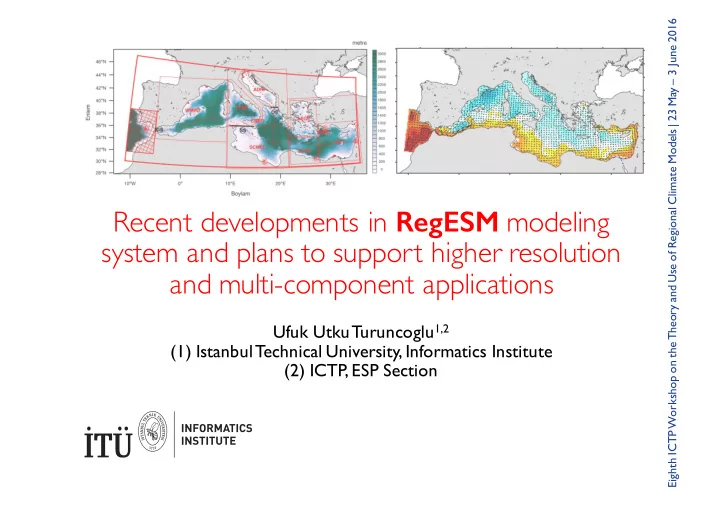
Recent developments in RegESM modeling system and plans to support higher resolution and multi-component applications

Ufuk UtkuTuruncoglu1,2 (1) Istanbul Technical University, Informatics Institute (2) ICTP, ESP Section

Eighth ICTP Workshop on the Theory and Use of Regional Climate Models | 23 May – 3 June 2016

slide-2
SLIDE 2
  • It is represented by complex and non-linear interaction

between different elements (atmosphere, hydrosphere, geosphere and biosphere).

  • All the processes have different spatial and temporal scales

Earth System

http://wearebrainstorm.com/products/earth-science-set-of-4-prints

slide-3
SLIDE 3
  • All the processes have different spatial and temporal scales
  • Response time under forcing also differs

Earth System …

IPCC Report

slide-4
SLIDE 4
  • Defines interaction between components to simulate the

state of the climate system in regional and global scale

  • ESMs include processes, impacts, and complete feedback

cycles; for example, they can simulate droughts as well as the resulting change in plant cover due to the drought, which may lead to more or less drought (Heavens et al, 2013).

  • Climate Model vs. Earth System Model

Earth System Models

http://www.climateurope.eu/earth-system-modeling-a-definition/

blue boxes represent the processes included in a climate model; green boxes represent the additional components that may be included in an Earth System Model

slide-5
SLIDE 5
  • Higher resolution representation of physical processes
  • Includes more sophisticated physical parameterizations and

additional processes along with their non-linear interactions

  • It might also include human behavior (pollution, irrigation etc.)
  • Apart from the global ESMs, they require boundary condition

(global ESMs, reanalysis datasets etc.), which adds extra complexity to the system

Regional Earth System Modeling (RESM)

dynamical downscalling

Prein et al., 2015 @ Reviews of Geophysics

slide-6
SLIDE 6

RESM@ITU and @ICTP - History

Year Description Domains 2012

  • No driver

RegCM is hosting also ocean component

  • Single ocean model is supported (ROMS)
  • Poor mass and energy conservation for exchange fields
  • No automatized extrapolation (unaligned land-sea masks !!!)
  • Hard to include additional components such as river, wave etc.

Caspian Sea (Turuncoglu et al., 2013; GMD) 2013

  • Centralized driver using ESMF’s NUOPC layer (via connectors)
  • All components are plugged into the driver
  • Added support for two different ocean model component

(ROMS and MITgcm)

  • Mass and energy conservation is improved via customized bilinear

interpolation along with global conservation support

  • Support for extrapolation (unaligned land-sea masks)
  • River Routing (Max Planck’s HD) component is included
  • Med. Sea

2014 2015

  • The wave component (ECMWF’s WAM) is included (Surenkok &

Turuncoglu, 2015; EGU)

  • Extensive benchmarking (PRACE – 2010PA2442)
  • Med. Sea

Black Sea 2016

  • ESMF library is updated to 7.0.0
  • Validation for Mediterranean domain

(Turuncoglu & Sannino, 2016; CD – under revision)

  • Extensive validation with different configuration (2/3/4 component,

different coupling intervals etc.) – paper is on-the-way

  • Med. Sea

Caribbean Indian Ocean South Atlantic

slide-7
SLIDE 7

RESM@ITU and @ICTP - History

Year Description Domains 2012

  • No driver

RegCM is hosting also ocean component

  • Single ocean model is supported (ROMS)
  • Poor mass and energy conservation for exchange fields
  • No automatized extrapolation (unaligned land-sea masks !!!)
  • Hard to include additional components such as river, wave etc.

Caspian Sea (Turuncoglu et al., 2013; GMD) 2013

  • Centralized driver using ESMF’s NUOPC layer (via connectors)
  • All components are plugged into the driver
  • Added support for two different ocean model component

(ROMS and MITgcm)

  • Mass and energy conservation is improved via customized bilinear

interpolation along with global conservation support

  • Support for extrapolation (unaligned land-sea masks)
  • River Routing (Max Planck’s HD) component is included
  • Med. Sea

2014 2015

  • The wave component (ECMWF’s WAM) is included (Surenkok &

Turuncoglu, 2015; EGU)

  • Extensive benchmarking (PRACE – 2010PA2442)
  • Med. Sea

Black Sea 2016

  • ESMF library is updated to 7.0.0
  • Validation for Mediterranean domain

(Turuncoglu & Sannino, 2016; CD – under revision)

  • Extensive validation with different configuration (2/3/4 component,

different coupling intervals etc.) – paper is on-the-way

  • Med. Sea

Caribbean Indian Ocean South Atlantic

slide-8
SLIDE 8
  • Model components merged with ESMF/NUOPC

RegESM Design

atmosphere (RegCM) land (BATS)

  • cean

(ROMS / MITgcm) sea ice unnamed driver land (CLM) river routing (HD) initial and boundary conditions anthropogenic emissions natural emissions full gas chemistry aerosol wave (WAM) initial conditions initial conditions ESMF+NUOPC

Two different land surface model Two different ocean model

ATM: ICTP’s RegCM 4.4 / 4.5 OCN: Rutgers Univ. ROMS (r737) MITgcm (63s / 64s) WAV: ECMWF’s WAM 4.5.3 MPI RTM: Max Planck’s HD (1.0.2 modified) Special thanks to

  • Prof. Stefan Hagemann

# Following combination of model components can be used: 2 component: ATM-OCN, ATM-WAV, 3 component: ATM-OCN-RTM, 4 component: ATM-OCN-WAV-RTM

slide-9
SLIDE 9
  • Test with Mediterranean domain (Standard + Extended)
  • Tests:
  • Different coupling interval (30 min., 1 hour, 3 hours)
  • Different execution type (sequential vs. concurrent)
  • Different number of component (ATM-OCN, ATM-OCN-RTM)
  • Test Environment:
  • CURIE @ France (PRACE – 2010PA2442)

Performance Benchmark @ PRACE

ATM-Extended ATM OCN

ATM: 12 km - 24 layer OCN: 1/12 deg. - 32 layer (ROMS) # extended domain is configured to feed the computational resources

slide-10
SLIDE 10
  • Individual model components

Performance Benchmark …

Better scaling results for extended domain To find best 2d decomposition parameters for ROMS

slide-11
SLIDE 11
  • Coupling interval (only two component)
  • The effect of coupling interval is very limited J
  • 30 min case has more fluctuations (it might be related with

the overload of the cluster)

  • It is better to repeat tests couple of time to take more reliable

measurements L

Performance Benchmark …

# core % diff 30m/1hr % diff 3hr/1hr 64

  • 0.38

1.29 128 1.06 2.15 192 1.45 2.89 256 1.86 1.58 288 9.20 0.95 320

  • 1.27

5.55 336 17.50 3.84 384 29.66 0.18 416 13.04

  • 0.92

528 13.50

  • 4.83

576 9.57

  • 0.75

640 1.93 8.68 AVG 8.09 1.72

slide-12
SLIDE 12
  • Number of model components (const. coupling time step)
  • Last processor is shared between OCN and RTM
  • RTM component reduces the performance ~ 30% in higher

processor counts L

  • Solutions:
  • Integrated RTM component (with RegCM4, i.e. Chym)
  • Using higher resolution and parallelized (MPI) RTM component

such as RAPID etc. It could also help to improve river rep.

Performance Benchmark …

Sequential coupling

slide-13
SLIDE 13
  • Atmosphere: RegCM4 revision 4283 (~50 km)
  • Ocean: ROMS revision783 (1/12 deg. ~ 9 km)
  • Closed boundary in Atlantic – used as a buffer zone
  • The coupling time step is 3 hour
  • ATM-OCN: wind stress, net heat and freshwater flux (E-P), shortwave rad.,

surface pressure and OCN-ATM: sea surface temperature

  • Prescribed river discharge (generated by Max Planck HD model)

Model for Mediterranean Basin

The Scientific and Technological Research Council of Turkey (TUBITAK) founded 2 year project (under grant 113Y108), ended in Dec. 2015

# It is the first attempt for the validation of ROMS (Regional Ocean Modeling System) ocean model for Med.

slide-14
SLIDE 14
  • Sea Surface Temperature

Validation

SST anomaly

  • ver Med. Sea

Seasonal SST Climatology ERSST used in standalone simulation

Turuncoglu and Sannino, 2016 @ CD

slide-15
SLIDE 15
  • Surface Wind and

Circulation

Validation …

Wind speed underestimated

  • ver Gulf of Lion

# coupled model tends to decrease wind speed over the sea when it is compared with standalone simulation

Surface and 300 m circulation is well represented

Turuncoglu and Sannino, 2016 @ CD

slide-16
SLIDE 16
  • Heat flux components
  • ver Med.
  • Coupled and

Standalone model simulations are very similar except LHF

  • The net heat flux is

in the range for both CPL and STD runs

Validation …

SWF LWF SWF+LWF SH LH NET CORE.2 180.41

  • 81.24

99.17

  • 20.18
  • 99.80
  • 20.81

NOCS 200.02

  • 62.21

137.81

  • 8.79
  • 91.93

37.10 EINT 218.26

  • 100.14

114.12

  • 17.03
  • 112.12
  • 15.03

R50E 200.75

  • 82.34

118.41

  • 11.38
  • 121.72
  • 14.70

C50E 200.70

  • 81.31

119.39

  • 9.85
  • 110.52
  • 0.99

The coupled model reduces LH over Mediterranean Sea

Turuncoglu and Sannino, 2016 @ CD

slide-17
SLIDE 17
  • E, P and E-P
  • ver Med.
  • Coupled model

tends to reduce evaporation

  • The monthly

distribution of E, P and E-P are very similar for STD and CPL

  • The accepted

E-P is 1000 mm/yr

Validation …

Turuncoglu and Sannino, 2016 @ CD

slide-18
SLIDE 18
  • Spatial distribution
  • f E, P and E-P
  • The effect of coupled

model is more apparent in EMED

  • The CPL model

has more P in south of EMED

  • The E-P estimates

are consistent with available obs. for CPL model

Validation …

Turuncoglu and Sannino, 2016 @ CD

slide-19
SLIDE 19
  • Currently, ITU is a data provider for MedCORDEX project
  • Both coupled (RegCM4+ROMS) and standalone model

simulations (RegCM4) are uploaded

  • Spatial resolution is MED44
  • Daily and monthly averages of surface variables
  • Monthly average of atmospheric variables (ua, va, ta, z) at 850 and 500

mb

  • Documentation of simulations
  • ITU-RegCM4 - http://mistrals.sedoo.fr/?editDatsId=1434
  • ITU-RegESM1 - http://mistrals.sedoo.fr/?editDatsId=1433
  • Turuncoglu and Sannino, 2016 @ Climate Dynamics
  • Data Access
  • It is distributed via MedCORDEX database
  • https://www.medcordex.eu/medcordex_help_get.php

Data Access

slide-20
SLIDE 20
  • Atmosphere: RegCM4.4 (20 km)
  • Ocean: MITgcm (1/12 deg. ~ 9 km)
  • Closed boundary in Atlantic – used as a buffer zone
  • The coupling time step is 3 hour
  • ATM-OCN: wind stress, net heat and freshwater flux (E-P), shortwave rad.,

surface pressure and OCN-ATM: sea surface temperature

  • River Routing: Max Planck’s HD model (17 major rivers)

Collaboration between # ICTP # ENEA # ITU to create three component model (Mariotti et al. 2016 @ CORDEX 2016)

High Res. Model for Med. Basin

slide-21
SLIDE 21
  • Precipitation (1979-2013 climatology)
  • Evaporation

Validation

STD CPL OBS STD-OBS CPL-OBS

# This reduction is mainly associated with a decrease of evaporation over the sea # precipitation pattern is well represented: a slight overestimation is

  • bserved in Alps and Eastern Europe

where the orography is more accentuated # coupled model (CPL) reduces the bias over Med. Basin compared with GPCP observations respect to the same comparison with standalone model simulation (STD).

STD CPL

slide-22
SLIDE 22
  • Circulation at 20 m and Sea Surface Height (SSH)

Validation …

  • a. MITgcm
  • b. MITgcm_RegESM
  • c. MyOcean
  • d. MITgcm SSH
  • e. MITgcm_RegESM SSH
  • f. Aviso ADT SSH

# Surface circulation (m/s) is well represented in both standalone and coupled model with respect to MyOcean

  • Med. Reanalysis (1987-2012) and Aviso (1993-2012) datasets.

# Reduced evaporation (Eastern-Med.) affects the strength of Rhodes Gyre.

slide-23
SLIDE 23
  • Sea Surface Temperature (SST) and Salinity (SSS)

Validation …

# Both coupled and standalone exhibit both positive/negative significant biases (up to 1ºC) in the SST with respect MyOcean and Era-Interim SST in areas where air-sea interactions are dominant (Adriatic Sea, Gulf of Lions, Rhodes Gyre, Aegean Sea). # Spatial distribution of SSS is well represented except Adriatic Sea where both models overestimate the SSS # In the Ionian the northward shift of MAW in the coupled and MyOcean lead to lower values of SSS with respect the standalone.

  • a. MITgcm SST
  • b. MITgcm-RegESM

SST

  • c. MyOcean SST
  • d. ERA-Interim SST
  • e. MITgcm SSS
  • f. MITgcm-RegESM

SSS

  • g. MyOcean SSS
slide-24
SLIDE 24

Extensive Testing of Modeling System

Run Short Name Run Id Coupling Type Coupling Time Step Active Models Description AO1 A1 Explicit 30 mins ATM+OCN AO2 A2 Explicit 1 hour ATM+OCN AO3 A3 Explicit 3 hours ATM+OCN base run AO4 A5 Semi-implicit 3 hours ATM+OCN AW1 B1 Explicit 3 hours ATM+WAV u and v <-> rough. AW2 B2 Explicit 3 hours ATM+WAV wdir, friction vel.<-> rough. AOR C1 Explicit 3 hours ATM+OCN+RTM river discharge as SBC AORW D1 Explicit 3 hours ATM+OCN+RTM+WAV Standalone E, F, G, H

  • ATM/OCN/RTM/WAV
slide-25
SLIDE 25
  • Inter-annual variability and monthly climatology of E, P and E-P
  • The effect of

WAV component is minimal in E, P and E-P

  • The OCN

mainly affects the E-P balance by reducing E and P

  • The monthly

climatology is also modified

Comparison based on # used models

A – ATM-OCN B – ATM-WAV C – ATM-OCN-RTM D –ATM-OCN-RTM-WAV

slide-26
SLIDE 26

Applications

ATM OCN RTM Models RegCM 4.4.5.9 MITgcm c63s HD Res. 50 km, 18L 170x216 1/6º, 45L 276x408 0.5º global ICBC ERA-Int ERSST 0.25º MOM

  • nline

ATM Details CLM, UW- PBL, MIT KPP 30 major rivers

  • Coupled with RegESMdriver
  • 3 hours coupling intervalbetween ATM and OCN

and 1 day in interaction with RTM

  • 1979-2007 (25 years)

ATM OCN RTM Models RegCM 4.4.5.7 MITgcm c64s HD Res. 20 km, 23L 353x253 1/12º, 75L 276x408 0.5º global ICBC ERA-Int ERSST 12 km ALADIN

  • nline

ATM Details BATS Grell+MIT GGL90 17 major rivers

  • Coupled with RegESMdriver
  • 3 hours coupling intervalbetween ATM and OCN

and 1 day in interaction with RTM

  • 1979-2013 (35 years)

Mediterranean Central Asia

ATM OCN RTM Models RegCM 4.4.5.9 MITgcm c63s HD Res. 50 km, 23L 330x206 1/8º, 40L 800x510 0.5º global ICBC ERA-Int ERSST 0.25º MOM

  • nline

ATM Details CLM, UW- PBL, MIT KPP 7 major rivers

  • Coupled with RegESMdriver
  • 3 hours coupling intervalbetween ATM and OCN

and 1 day in interaction with RTM

  • ?

ATM OCN RTM Models RegCM 4.4.5.9 MITgcm c63s HD Res. 50 km, 23L 308x170 1/8º, 40L 1050x540 0.5º global ICBC ERA-Int ERSST 0.25º MOM

  • nline

ATM Details CLM, Grell, KF KPP 10 major rivers

  • Coupled with RegESMdriver
  • 3 hours coupling intervalbetween ATM and OCN

and 1 day in interaction with RTM

  • ?

South Atlantic Central America

slide-27
SLIDE 27

1/ easy to use and extend flexible modeling system 2/ model components can be upgraded easily 3/ state-of-art driver design that follows common conventions / standards 4/ ready to use with new non-hydrostatic core 5/ supports both CLM and BATS 1/ only global conservation is supported and might have a problem for large domains 2/ the bottleneck due to sequential RTM component 3/ WAM uses 1d decomposition and limits higher number of processor for seq. type coupling 1/ sharp gradient between interactive and prescribed SST (issue #12) 2/ no wind rotation algorithm for Polar Stereographic (POLSTR) projection (issue #14)

RegESM Modeling System

slide-28
SLIDE 28

Plans: Short - Mid - Long

# Description Domains 1

  • Using modeling system for different applications and domains
  • Future climate scenarios using CMIP5 models
  • Med. Sea.

Black Sea Caspian Sea 2

  • New applications using hydrostatic core at higher spatial (3-12 km)

and temporal resolution for Med-CORDEX-2, extreme events and fast-moving processes

  • Med. Sea.

3

  • Wave effect on current (WEC): 1) gradient of radiation stress

tensor or 2) vortex force (VF)

  • Additional wave component such as

WW3 to support curvilinear grids in the wave component. It will allow to cover whole atmospheric model domain

  • Higher resolution river routing component for better

representation of rivers (i.e. Chym, CaMa-Flood etc.) 4

  • Continuous Integration (CI)
  • Standardization of model installation (integrate with Travis-

ci to test the build)

  • Usage of virtualization technologies such as Docker

containers to run and test modeling system in the cloud (Google, Azure, Amazon etc.) 5

  • New approaches to analyze fast-moving processes in high res.
slide-29
SLIDE 29

Questions !!!

ufuk.turuncoglu@itu.edu.tr http://faculty.itu.edu.tr/turuncogl1/

https://developer.nvidia.com/index