
SLIDE 1
Learning From Data Lecture 18 Radial Basis Functions
Non-Parametric RBF Parametric RBF k-RBF-Network
- M. Magdon-Ismail
CSCI 4100/6100 recap: Data Condensation and Nearest Neighbor Search
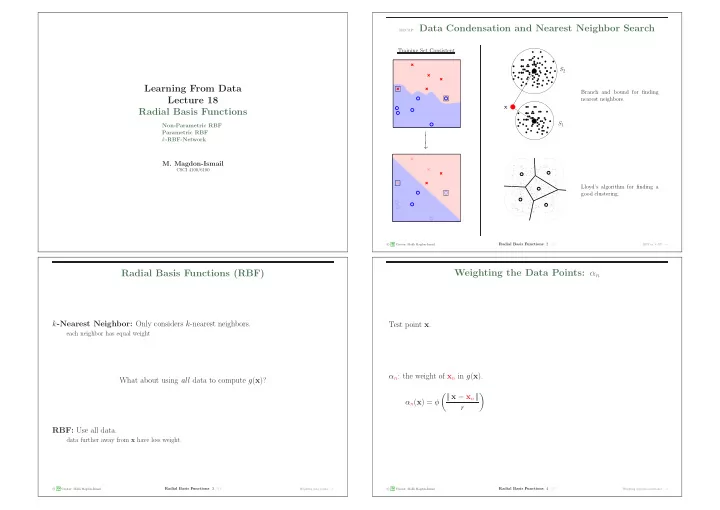
Training Set Consistent
− − − →
S1 S2 x Branch and bound for finding nearest neighbors. Lloyd’s algorithm for finding a good clustering.
c A M L Creator: Malik Magdon-Ismail
Radial Basis Functions: 2 /31
RBF vs. k-NN − →
Radial Basis Functions (RBF)
k-Nearest Neighbor: Only considers k-nearest neighbors.
each neighbor has equal weight
What about using all data to compute g(x)? RBF: Use all data.
data further away from x have less weight.
c A M L Creator: Malik Magdon-Ismail
Radial Basis Functions: 3 /31
Weighting data points − →
Weighting the Data Points: αn
Test point x. αn: the weight of xn in g(x). αn(x) = φ | | x − xn | | r
- decreasing function of |
| x − xn | |
Most popular kernel: Gaussian φ(z) = e− 1
2z2.
Window kernel, mimics k-NN, φ(z) =
- 1
z ≤ 1, z > 1,
c A M L Creator: Malik Magdon-Ismail
Radial Basis Functions: 4 /31
Weighting depends on distance − →