Read-Copy Update User Todays Lecture System Calls Kernel (RCU) - - PDF document

read copy update
SMART_READER_LITE
LIVE PREVIEW

Read-Copy Update User Todays Lecture System Calls Kernel (RCU) - - PDF document

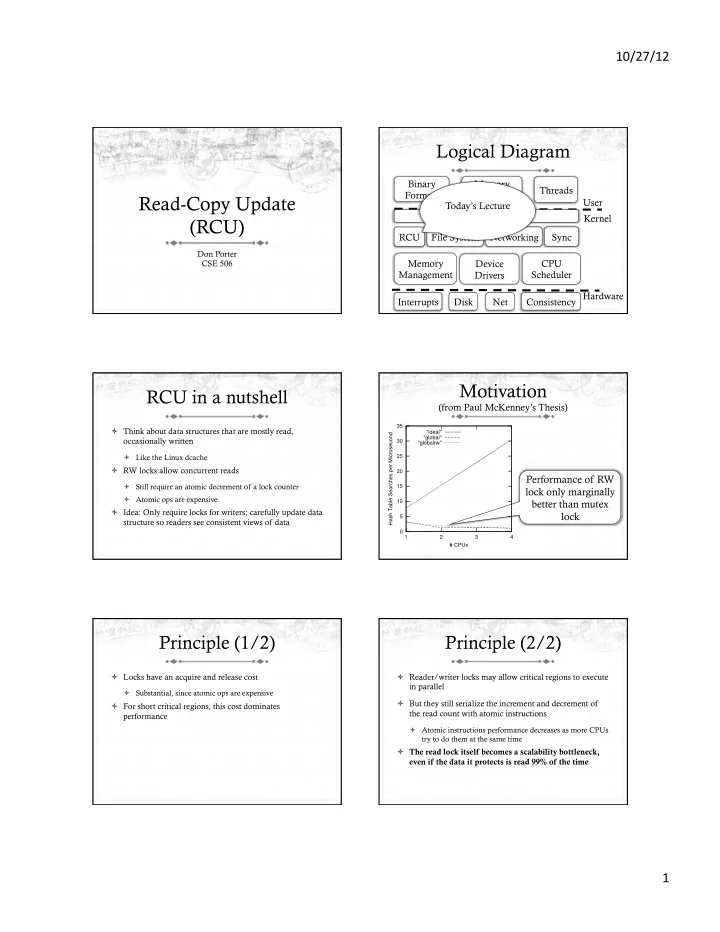
10/27/12 Logical Diagram Binary Memory Threads Formats Allocators Read-Copy Update User Todays Lecture System Calls Kernel (RCU) RCU File System Networking Sync Don Porter CSE 506 Memory Device CPU Management Scheduler


slide-1
SLIDE 1

10/27/12 ¡ 1 ¡

Read-Copy Update (RCU)

Don Porter CSE 506

Logical Diagram

Memory Management CPU Scheduler User Kernel Hardware Binary Formats Consistency System Calls Interrupts Disk Net RCU File System Device Drivers Networking Sync Memory Allocators Threads Today’s Lecture

RCU in a nutshell

ò Think about data structures that are mostly read,

  • ccasionally written

ò Like the Linux dcache

ò RW locks allow concurrent reads

ò Still require an atomic decrement of a lock counter ò Atomic ops are expensive

ò Idea: Only require locks for writers; carefully update data structure so readers see consistent views of data

Motivation

(from Paul McKenney’s Thesis)

5 10 15 20 25 30 35 1 2 3 4 Hash Table Searches per Microsecond # CPUs "ideal" "global" "globalrw"

Performance of RW lock only marginally better than mutex lock

Principle (1/2)

ò Locks have an acquire and release cost

ò Substantial, since atomic ops are expensive

ò For short critical regions, this cost dominates performance

Principle (2/2)

ò Reader/writer locks may allow critical regions to execute in parallel ò But they still serialize the increment and decrement of the read count with atomic instructions

ò Atomic instructions performance decreases as more CPUs try to do them at the same time

ò The read lock itself becomes a scalability bottleneck, even if the data it protects is read 99% of the time

slide-2
SLIDE 2

10/27/12 ¡ 2 ¡

Lock-free data structures

ò Some concurrent data structures have been proposed that don’t require locks ò They are difficult to create if one doesn’t already suit your needs; highly error prone ò Can eliminate these problems

RCU: Split the difference

ò One of the hardest parts of lock-free algorithms is concurrent changes to pointers

ò So just use locks and make writers go one-at-a-time

ò But, make writers be a bit careful so readers see a consistent view of the data structures ò If 99% of accesses are readers, avoid performance-killing read lock in the common case

Example: Linked lists

A C E B Reader goes to B B’s next pointer is uninitialized; Reader gets a page fault

Insert(B)

This implementation needs a lock

Example: Linked lists

A C E B Reader goes to C or B---either is ok

Insert(B)

Example recap

ò Notice that we first created node B, and set up all

  • utgoing pointers

ò Then we overwrite the pointer from A

ò No atomic instruction or reader lock needed ò Either traversal is safe ò In some cases, we may need a memory barrier

ò Key idea: Carefully update the data structure so that a reader can never follow a bad pointer

ò Writers still serialize using a lock

Example 2: Linked lists

A C E Reader may still be looking at C. When can we delete?

Delete (C)

slide-3
SLIDE 3

10/27/12 ¡ 3 ¡

Problem

ò We logically remove a node by making it unreachable to future readers

ò No pointers to this node in the list

ò We eventually need to free the node’s memory

ò Leaks in a kernel are bad!

ò When is this safe?

ò Note that we have to wait for readers to “move on” down the list

Worst-case scenario

ò Reader follows pointer to node X (about to be freed) ò Another thread frees X ò X is reallocated and overwritten with other data ò Reader interprets bytes in X->next as pointer, segmentation fault

Quiescence

ò Trick: Linux doesn’t allow a process to sleep while traversing an RCU-protected data structure

ò Includes kernel preemption, I/O waiting, etc.

ò Idea: If every CPU has called schedule() (quiesced), then it is safe to free the node

ò Each CPU counts the number of times it has called schedule() ò Put a to-be-freed item on a list of pending frees ò Record timestamp on each CPU ò Once each CPU has called schedule, do the free

Quiescence, cont

ò There are some optimizations that keep the per-CPU counter to just a bit

ò Intuition: All you really need to know is if each CPU has called schedule() once since this list became non-empty ò Details left to the reader

Limitations

ò No doubly-linked lists ò Can’t immediately reuse embedded list nodes

ò Must wait for quiescence first ò So only useful for lists where an item’s position doesn’t change frequently

ò Only a few RCU data structures in existence

Nonetheless

ò Linked lists are the workhorse of the Linux kernel ò RCU lists are increasingly used where appropriate ò Improved performance!

slide-4
SLIDE 4

10/27/12 ¡ 4 ¡

Big Picture

ò Carefully designed data structures

ò Readers always see consistent view

ò Low-level “helper” functions encapsulate complex issues

ò Memory barriers ò Quiescence

RCU “library” Hash List Pending Signals

API

ò Drop in replacement for read_lock:

ò rcu_read_lock()

ò Wrappers such as rcu_assign_pointer() and rcu_dereference_pointer() include memory barriers ò Rather than immediately free an object, use call_rcu(object, delete_fn) to do a deferred deletion

Code Example

From fs/binfmt_elf.c

rcu_read_lock(); prstatus->pr_ppid = task_pid_vnr(rcu_dereference(p->real_parent)); rcu_read_unlock();

Simplified Code Example

From arch/x86/include/asm/rcupdate.h

#define rcu_dereference(p) ({ \ typeof(p) ______p1 = (*(volatile typeof(p)*) &p);\ read_barrier_depends(); // defined by arch \ ______p1; // “returns” this value \ })

Code Example

From fs/dcache.c

static void d_free(struct dentry *dentry) { /* ... Ommitted code for simplicity */ call_rcu(&dentry->d_rcu, d_callback); } // After quiescence, call_rcu functions are called static void d_callback(struct rcu_head *rcu) { struct dentry *dentry = container_of(head, struct dentry, d_rcu); __d_free(dentry); // Real free }

From McKenney and Walpole, Introducing Technology into the Linux Kernel: A Case Study

200 400 600 800 1000 1200 1400 1600 1800 2000 2002 2003 2004 2005 2006 2007 2008 2009 # RCU API Uses Year Figure 2: RCU API Usage in the Linux Kernel

slide-5
SLIDE 5

10/27/12 ¡ 5 ¡

Summary

ò Understand intuition of RCU ò Understand how to add/delete a list node in RCU ò Pros/cons of RCU