
SLIDE 1
Reaching rural areas in the social protection response to COVID-19:
- pportunities and challenges
Welcome to the webinar
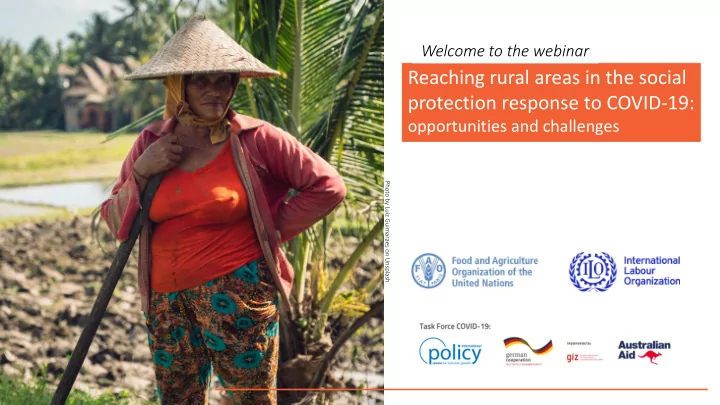
Photo by Luiz Guimaraes on Unsplash
Reaching rural areas in the social protection response to COVID-19: - - PowerPoint PPT Presentation
Welcome to the webinar Reaching rural areas in the social protection response to COVID-19: opportunities and challenges Photo by Luiz Guimaraes on Unsplash simultaneous interpretation Ho How to o acce ccess fr from th the e smartphone
Reaching rural areas in the social protection response to COVID-19:
Welcome to the webinar
Photo by Luiz Guimaraes on Unsplash
Ho How to
ccess fr from you
eb browser Ho How to
ccess fr from th the e smartphone app
sporgwebinar;
English option and click on CONNECT;
sporgwebinar and select Eng English:
Acc ccès à part rtir de e vot
vigateur web eb Acc ccès à part rtir de e vot
sporgwebinar
CONNECT.
sporgwebinar et sélectionner Fr French. Puis appuyer sur CONNECT.
This joint effort is inspired by colleagues and
issemin inate and dis iscu cuss th the e mos
ecent con
esponses es to
19. The initiative has three major components:
1. A weekly special edition of a dedicated ne newsle letter, featuring a compilation of relevant information from all over the world on social protection initiatives dealing with COVID-19; 2. Weekly web ebin inars to foster discussions and exchanges; 3. An on
ine com
ity to systematise the information gathered
Photo by Gelani Banks on Unsplash
#SPcovid19 #COVID19 #SPresponses
Soci cial Protection and Child ild Marr rriage: Evid idence, Practice and Opportunities
Thursday, 30 July at 9 AM (EDT/GMT-4)
Next webinar at socialprotection.org:
Photo by Emma Roorda on Unsplash
socialprotection.org presents:
Speakers Cecilia Mbaka, Head of the National Social Protection Secretariat, Kenya Reema Nanavaty, Director of the Self Employed Women's Association's (SEWA), India Mounir Cherif, Social Protection Expert, Tunisia Lixia Tang, Deputy Dean, College of International Development and Global Agriculture, China Agricultural University Discussant Kroum Markov, Social Protection Policy Specialist, ILO Moderator Ana Ocampo, Social Protection Officer, FAO
Reaching rural areas in the social protection response to COVID-19:
Reaching rural areas in the social protection response to COVID-19:
Speaker
Cecilia Mbaka
National Social Protection Secretariat, Kenya
Cecilia Mbaka the Head of the National Social Protection Secretariat in Kenya’s State Department
Persons and as founding Director of the National Council for Persons with Disabilities. Ms Mbaka has more than 25 years’ experience providing strategic leadership and engagement of civil society and research stakeholders to advance policy development and strengthen service delivery to vulnerable persons. In recognition of her achievements in advancing the rights of the poor and vulnerable, including older people, she was in December 2017 awarded the Order of Grand Warrior (OGW) by the President of Kenya.
Reaching rural areas in the social protection response to COVID-19:
Speaker
Reema Nanavaty
Self Employed Women's Association's (SEWA), India
Reema Nanavaty has been working with the SEWA since over 35 years expanding its membership to over 1.5 million members, making it the single largest union of informal sector women workers. Reema facilitated rebuilding lives and livelihoods of 60000 earthquake affected rural women and 40000 riot-affected members. She is leading the rehabilitation programs in Afghanistan and in Sri Lanka; providing vocational training in rural livelihood security to war-affected widows. Reema
including 16 states, and also in 7 South-Asian countries, focusing on women’s economic empowerment by building women owned enterprises, building women led supply chains, introducing modern ICT-based tools and facilitating Green-Energy initiatives and livelihoods. Reema is currently member of the Advisory Council on Gender of the World Bank Group.
Reaching rural areas in the social protection response to COVID-19:
Speaker
Mounir Cherif
Social Protection Expert, Tunisia
Mounir Cherif is a social protection expert with thirty-four years of experience in the sector. He has extensive experience working in Tunisia, for instance at the Centre de Recherches et d'Etudes Sociales CRES and the Caisse Nationale de Sécurité Sociale CNSS, as well as providing technical assistance to other countries, in particular in Francophone Africa. He focuses his work mainly on innovative mechanisms to extend social security coverage to uncovered populations, and conducting assessments and strategic studies to ensure the sustainability of social security schemes.
Reaching rural areas in the social protection response to COVID-19:
Speaker
Lixia Tang
China Agricultural University
Agriculture (CISSCA), Head of Development of Development Management, College of Humanities and Development Studies, China Agricultural University. She has been involved in several research projects on poverty analysis and livelihood development, social public policy analysis, international development aid and China engagements in Africa. The field sites of her research work cover more than 20 provinces in China and several developing countries, e.g. Zambia, India, Thailand, Zimbabwe, Malawi, Tanzania and Ethiopia.
Reaching rural areas in the social protection response to COVID-19:
Speaker
Kroum Markov
ILO
Kroum Markov is working at the ILO since 2001, initially for the International Labour Standards Department on the application of ILO’s social security instruments and, since 2017, for the Social Protection Department (SOCPRO) as Social Protection Policy and Legal Specialist. He has developed a strong knowledge of ILO’s social security standards, providing technical support to the bodies responsible for monitoring the application of ILO Conventions and Recommendations. Through his work, he supports ILO constituents design and implement comprehensive Social protection policies and rights-based systems grounded in the principles enshrined in ILO
graduate diplomas in International Administration (DESS) and in International Economic Law (DEA) from the University of Paris I Panthéon-Sorbonne.
Reaching rural areas in the social protection response to COVID-19:
Moderator
Ana Ocampo
FAO
Ana Ocampo is a Social Protection Officer at FAO Headquarters. She focuses her work on the extension of social protection to rural populations, social protection and resilience, in particular in the context of climate change, as well as on the linkages between social protection and agriculture. She has experience in the social protection sector, supporting policy and programme reforms, design and implementation, in Latin America and the Caribbean, Southern Africa, and Central Asia. Prior to joining FAO, she has worked at the World Bank, the Inter-American Development Bank and UNICEF.
type them in the chat bar Also, interact with us on Twitter (@SP_Gateway):
#SPorgWebinar #SPcovid19 #COVID19 #SPresponses
Reaching rural areas in the social protection response to COVID-19:
Presented by: Cecilia Mbaka, Head Social Protection Secretariat in the Ministry of Labour and Social Protection 28 July 2020
REACHING RURAL AREAS IN THE SOCIAL PROTECTION RESPONSE TO COVID-19: OPPORTUNITIES AND CHALLENGES: A CASE FOR KENYA
this live below the poverty line;
peri-urban and core-urban; and informal settlements respectively;
aridity;
climatic shocks and are exposed to many other forms of vulnerabilities.
recoveries and 278 deaths. Majority of these cases are concentrated in Nairobi;
agricultural sector, the main livelihood source for the rural communities;
service industry sectors in rural and urban areas;
bound to disrupt food production by smallholder farmers;
small holder farmers in rural areas;
for COVID 19 in rural and urban areas;
cases of infections, the cases being reported in the rural areas are steadily rising since early July;
Programme worth USD 53.7M in response to the pandemic;
and urban areas is a priority ;
households from the effects the pandemic; majority of the recipients are in rural areas;
employment programmes in rural and urban areas;
available for the supply of farm inputs through e-vouchers;
producers to ensure continued gainful employment for thousands
and groups: children, teenagers, elderly and citizens with lifestyle diseases, counties with highest prevalence malnutrition;
current Government cash transfer beneficiaries in rural and urban areas to cushion them from effects of Covid-19 based on poverty and specific health indicators etc.
mechanisms;
Government and partners;
harmonized;
insurance with disparities of 12% and 27% in rural and urban areas respectively;
and above, social assistance programmes targeted leading to inclusion and exclusion errors;
Mounir CHERIF Consultant en protection sociale
Il concerne les fonctionnaires.
aujourd’hui à une couverture légale de la quasi totalité de la population active
salariés du secteur agricole à l’exception de ceux travaillant moins de 45 jours, pêcheurs, travailleurs non salariés ainsi que les catégories à faibles revenus)
Configuration du système
Salariés non agricoles (1961) Tunisiens à l’étranger (1989) Non salariés Agricole & non agricole (1982) Fonctionnaires de l’État Travailleurs précaires (2002) Salariés agricoles (1981)
Secteur public Secteur privé
Régimes spéciaux Salariés Agricole Amélioré (1989)
Caisse de Prévoyance et de retraite des Avocats
libellé RSA RSAA RNS Loi 2002-32
Population assujettie Salarié travaillant au moins 45 jours chez le même employeur
coopératives agricoles
employés sur des bateaux dont la jauge brute est inférieure à 30 tonneaux, pêcheurs indépendants et petits armateurs toute personne exerçant à titre principal une activité professionnelle pour son propre compte ou en qualité de mandataire
et exploitants des superficies ne dépassant pas 5 hectares en sec et 1 hectare en irrigué;
sur des bateaux dont la jauge brute ne dépasse pas cinq tonneaux, les pêcheurs indépendants et les armateurs Taux de Couverture 11,1% 19% 41,5% 14%
libellé RSA RSAA RNS Loi 2002-32
Financement Assiette Taux Cotisations Forfaitaire en fonction du statut du travailleur :
(ordinaire)
(spécialisé)
(qualifié) 12,29% L'ensemble des versements en espèces ou en nature 19,47% 10 classes d’adhésion de 1 à 18 SMAG 14,71% Forfaitaire : 2/3 SMAG 7,5%
libellé RSA RSAA RNS Loi 2002-32
Prestations 1) Assurance maladie (soins en nature)
cotisations Uniquement dans les structures publiques de soins 6,75% Choix entre le secteur public ou privé 6,75% Choix entre le secteur public ou privé 6,75%
structures publiques de soins 2,5% 2) Indemnité maladie et couche Taux 50% du SMAG affecté du coefficient d’adhésion, portée aux 2/3 au-delà de 45 jours puis rabaissée à 50% si prolongation au-delà de 180 jours 0,24% 2/3 du salaire journalier moyen plafonné à 2 fois le SMIG Ramenée à 50% si prolongation au- delà de 180 jours 0,6% 2/3 du revenu moyen soumis à cotisation pendant les 4 derniers trimestres plafonné à 2 fois le SMIG Ramenée à 50% si prolongation au- delà de 180 jours 0,51%
libellé RSA RSAA RNS Loi 2002
3) Prestations familiales Taux cotisations
familiales pour les trois premiers enfants payable trimestriel (21,960; 19,520 et 17,080 TDN) 4,5%
libellé RSA RSAA RNS Loi 2002-32
4) Indemnité de Décès Capital décès Taux cotisations indemnité journalière de maladie multiplié par :
l’assuré)
ans et +)
6 et 16 ans)
2 et 6 ans)
de 2 ans)
IDEM RSA
2/3 du revenu moyen soumis à cotisation pendant les 4 derniers trimestres plafonné à 2 fois le SMAG multiplié par
âgé de 16 ans et +)
ans)
Annuité de revenu plafonné à 6 SMAG majoré de 1douzième par année de cotisations majoré de 10% par enfant à charge 0,45%
libellé RSA RSAA RNS Loi 2002-32
5) Pension de Vieillesse, Invalidité & survivants
Annuité
Taux cotisations 60 ans 40 trimestres moyenne pondérée des 3 ou 5 dernières années 4% par an pour les 10 premières années et 2% par an par la suite plafonné à 80% (30 ans) 50% SMAG 5,25% 60 ans 40 trimestres moyenne pondérée des 3
années plafonnée à 6SMAG 4% par an pour les 10 premières années et 2% par an par la suite plafonné à 80% (30 ans) 50% SMAG 7,5% 65 ans 40 trimestres moyenne pondérée des coefficients de SMAG de toute la carrière 3% par an pour les 10 premières années et 2% par an par la suite plafonné à 80% (35 ans) 30% SMAG 7% 65 ans 40 trimestres 2/3 SMAG en vigueur 3% par an pour les 10 premières années et 2% par an par la suite plafonné à 80% (35 ans) 30% SMAG 5%
familles nécessiteuses (PNAFN) – 50 DTN-;
population exerçant une activité non assujettie à la Sécurité Sociale et percevant un revenu compris 1,5 et 2,5 SMIG (200 D);
DTN) ;
partiel ou total (200 DTN) sous condition d’affiliation à la SS et paiement des cotisations au titre du 4ème trimestre 2019 ou 1er trimestre 2020.
Reaching rural areas in the social protection response to COVID-19:
responses to COVID-19?
Soci cial Protection and Child ild Marr rriage: Evid idence, Practice and Opportunities
Thursday, 30 July at 9 AM (EDT/GMT-4)
Next webinar at socialprotection.org:
Photo by Emma Roorda on Unsplash
Make sure to answer our webinar survey, available after the session!