Raw Milk Legislation 2016 What Does It Mean? Brad Cochran, R.S. - - PowerPoint PPT Presentation

raw milk legislation 2016
SMART_READER_LITE
LIVE PREVIEW

Raw Milk Legislation 2016 What Does It Mean? Brad Cochran, R.S. - - PowerPoint PPT Presentation

Raw Milk Legislation 2016 What Does It Mean? Brad Cochran, R.S. Office of Environmental Health Services Public Health Sanitation Division Director Local Health Officer Summit April 9, 2016 Raw Milk Legislation 2016 Senate Bill 387 WV


slide-1
SLIDE 1

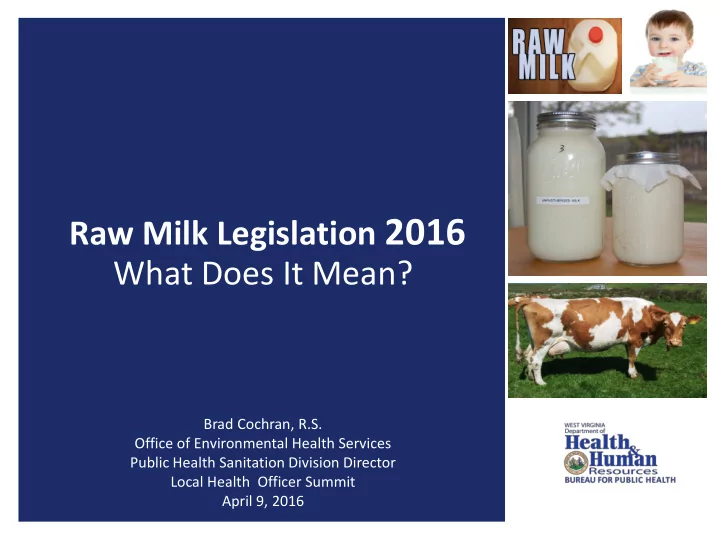
Raw Milk Legislation 2016 What Does It Mean?

Brad Cochran, R.S. Office of Environmental Health Services Public Health Sanitation Division Director Local Health Officer Summit April 9, 2016
slide-2
SLIDE 2

Raw Milk Legislation 2016

Senate Bill 387

  • WV Code §19-1-7.
  • Allows a person to enter into a herd share agreement to

consume raw milk.

  • Prohibits the sale or resale of raw milk obtained from a herd

share.

  • Agreement releases the herd seller from liability for inherent

dangers of consuming raw milk.

  • Animal health requirements.

1

slide-3
SLIDE 3

Raw Milk Legislation 2016 (Continued) Senate Bill 387

  • Illness reporting requirements.
  • Administrative penalty.
  • Rule Making Authority.
  • Becomes law on May 23, 2016.

2

slide-4
SLIDE 4

What is a Herd Share?

3

slide-5
SLIDE 5

Herd Share Agreement

  • Written ownership agreement.
  • Acquires a percentage ownership interest in a milk

producing animal.

  • Agrees to share cost for the care and boarding of the

animal.

  • Acknowledges the inherent dangers of consuming raw milk

particularly children, pregnant women, and those with a compromised immune system.

  • Agrees not to distribute raw milk.

4

slide-6
SLIDE 6

Herd Share Agreement (Continued)

  • The signed and executed shared animal ownership agreement

shall be filed by the herd seller with the Commissioner of Agriculture and shall contain the names, addresses and phone numbers of the herd seller and the responsible party so that either party may be contacted in the event of an illness.

5

slide-7
SLIDE 7

Public Health Concerns

  • Potential for outbreaks associated with consuming raw milk.
  • Proper diagnosis of illness.

6

slide-8
SLIDE 8

Contact Information

Brad Cochran, R.S., Public Health Sanitation Division Director Office of Environmental Health Services West Virginia Bureau for Public Health West Virginia Department of Health and Human Resources 350 Capitol Street, Room 313 Charleston, WV 25301-3713 Phone: (304) 356-4286 Fax: (304) 558-1071 Email: Brad.J.Cochran@wv.gov

7

slide-9
SLIDE 9

Joel Massey, MD Epidemic Intelligence Service Officer Local Health Officer Summit April 9, 2016

Dangers of Raw Milk Consumption

slide-10
SLIDE 10

Epidemiology Facts

  • The most common pathogens associated with raw milk are

Campylobacter, Salmonella, and Shiga toxin-producing E. coli.

  • Secondary transmission (person-to-person) occurs.
  • Children are disproportionately affected by diseases in raw milk.
  • West Virginia has investigated two outbreaks related to raw milk

consumption in the last five years.

9

slide-11
SLIDE 11

Regulation does not Prevent Outbreaks

  • States that allow raw milk sale report significantly more
  • utbreaks than those that do not.
  • Milk from a Connecticut farm where all regulatory standards

were met sickened 14 people.

  • In 2011, an outbreak of Campylobacter from a cow-share

program in Alaska identified cases far beyond those enrolled in the cow-share program.

10

slide-12
SLIDE 12

Outbreak Financial Burden Additional Investigation Cost: $182,427

  • Additional epidemiology staff needed to respond in outbreak

investigations resulting from raw milk were not funded.

  • Additional laboratory expenses for testing at the state lab were

not funded.

  • This is a conservative estimate based on primary cases only,

and would likely increase over time.

11

slide-13
SLIDE 13

Investigation Challenges Lab Confirmation not Performed

  • 10% of primary care providers prescribe antibiotics for

diarrheal illness without confirming the cause.

  • Culture-independent diagnostic tests (CIDT) do not provide

confirmation of a live pathogen or an isolate.

  • CIDT, without reflex culture of positive results, limits lab

investigation capacity of outbreaks.

12

slide-14
SLIDE 14

What Do Doctors Say? Healthcare Community Recommendation

  • The American Academy of Pediatrics strongly advises that

pregnant women, infants, and children consume

  • nly

pasteurized milk products.

  • The Infectious Disease Society of America (IDSA) recommends

avoidance of unpasteurized milk and treatment of diarrheal illness guided by an organism-specific diagnosis.

  • IDSA recommends testing of all patients with diarrhea >1 day

and signs or symptoms of severe illness (bloody stool, fever, dehydration).

13

slide-15
SLIDE 15

What Now? Plan to Respond to More Cases

  • Division of Infectious Disease Epidemiology resources can help

with investigations.

  • Proactive approach may reduce community distress.
  • Educate providers about lab confirmation of diarrheal illness.
  • Remind labs to send CIDT-positive results to the state lab.

14

slide-16
SLIDE 16

References

1. Castrodale, LJ, et al. Sharing Milk but Not Messages: Campybacteriosis Associated with Consumption of Raw Milk from a Cow-Share Program in Alaska, 2011. Journal of Food Protection, Vol 76, No 5. 2013: 744-747. 2. Guh, A, et al. Outbreak of Escherichia coli O157 Associated with Raw Milk, Connecticut, 2008. Clinical Infectious Disease. 51(12); 2010: 1411-1417. 3. American Academy of Pediatrics. Consumption of Raw or Unpasteurized Milk and Mild Products by Pregnant Women and Children-Policy

  • Statement. Pediatrics. Vol 133, No 1, 2014:175-179.

4. Infectious Disease Society of America. Practice Guidelines for the Management of Infectious Diarrhea. Clinical Infectious Disease. 32; 2001: 331-351. 5. Robinson, TJ, Scheftel, JM, Smith, KE. Raw Milk Consumption among Patients with Non-Outbreak–related Enteric Infections, Minnesota, USA, 2001-2010. Emerging Infectious Diseases. Vol 20, No 1. 2014:38-44. 6. Mungai EA, Behravesh CB, Gould LH. Increased outbreaks associated with nonpasteurized milk, United States, 2007–2012. Emerging Infectious

  • Diseases. Vol 21, No 1. 2015:119-122.

15

slide-17
SLIDE 17

Contact Information

Joel Massey, MD Epidemic Intelligence Service Officer Division of Infectious Disease Epidemiology West Virginia Bureau for Public Health West Virginia Department of Health and Human Resources 350 Capitol Street, Room 125 Charleston, WV 25301-3715 Office: (304) 356-4007 Fax: (304) 558-8736 Email: Joel.G.Massey@wv.gov

16