
SLIDE 1
r a t i o n a l f u n c t i o n s
MHF4U: Advanced Functions
Rational Functions of the Form ax + b cx + d
- J. Garvin
Slide 1/13
r a t i o n a l f u n c t i o n s
Rational Functions
Recall that a rational function is a ratio of two polynomial functions, p(x) and q(x), such that f (x) = p(x) q(x). Since q(x) = 0, there will often be some form of discontinuity, such as an asymptote of a hole. In this section, we will investigate rational functions that have the form f (x) = ax + b cx + d . Such functions have properties that are predictable, lending them to easy-to-draw graphs.
- J. Garvin — Rational Functions of the Form
ax + b cx + d Slide 2/13
r a t i o n a l f u n c t i o n s
Rational Functions
Example
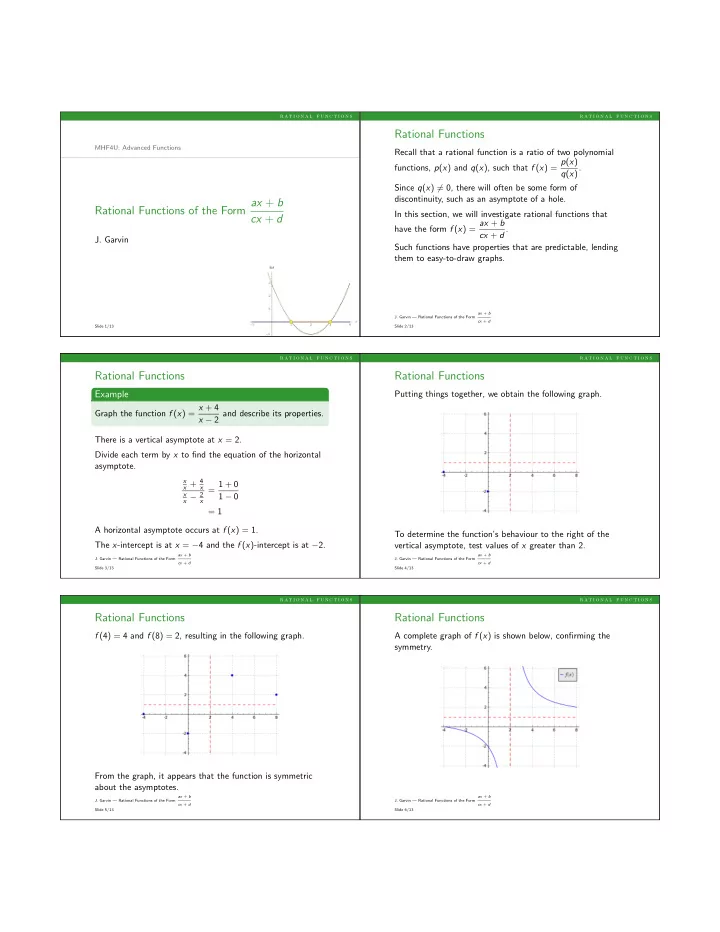
Graph the function f (x) = x + 4 x − 2 and describe its properties. There is a vertical asymptote at x = 2. Divide each term by x to find the equation of the horizontal asymptote.
x x + 4 x x x − 2 x
= 1 + 0 1 − 0 = 1 A horizontal asymptote occurs at f (x) = 1. The x-intercept is at x = −4 and the f (x)-intercept is at −2.
- J. Garvin — Rational Functions of the Form
ax + b cx + d Slide 3/13
r a t i o n a l f u n c t i o n s
Rational Functions
Putting things together, we obtain the following graph. To determine the function’s behaviour to the right of the vertical asymptote, test values of x greater than 2.
- J. Garvin — Rational Functions of the Form
ax + b cx + d Slide 4/13
r a t i o n a l f u n c t i o n s
Rational Functions
f (4) = 4 and f (8) = 2, resulting in the following graph. From the graph, it appears that the function is symmetric about the asymptotes.
- J. Garvin — Rational Functions of the Form
ax + b cx + d Slide 5/13
r a t i o n a l f u n c t i o n s
Rational Functions
A complete graph of f (x) is shown below, confirming the symmetry.
- J. Garvin — Rational Functions of the Form
ax + b cx + d Slide 6/13