Ranch Planning and Strategy: An example. Glen K. - - PDF document

ranch planning and strategy an example
SMART_READER_LITE
LIVE PREVIEW

Ranch Planning and Strategy: An example. Glen K. - - PDF document

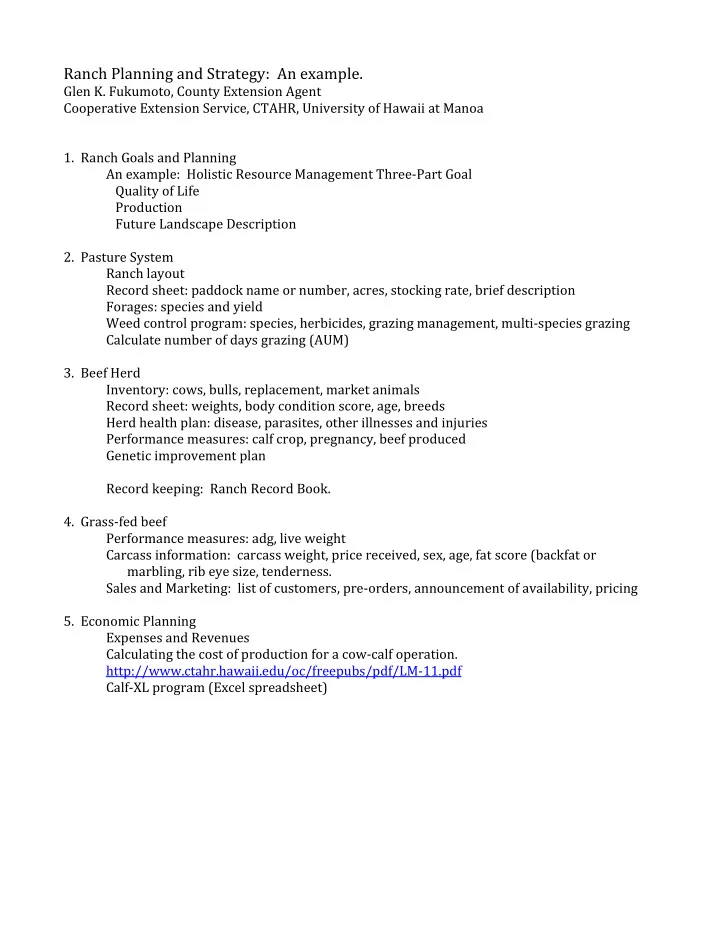
Ranch Planning and Strategy: An example. Glen K. Fukumoto, County Extension Agent Cooperative Extension Service, CTAHR, University of Hawaii at Manoa


slide-1
SLIDE 1

Ranch ¡Planning ¡and ¡Strategy: ¡ ¡An ¡example. ¡

Glen ¡K. ¡Fukumoto, ¡County ¡Extension ¡Agent ¡ Cooperative ¡Extension ¡Service, ¡CTAHR, ¡University ¡of ¡Hawaii ¡at ¡Manoa ¡ ¡ ¡

  • 1. ¡ ¡Ranch ¡Goals ¡and ¡Planning ¡

¡ An ¡example: ¡ ¡Holistic ¡Resource ¡Management ¡Three-­‑Part ¡Goal ¡ ¡ ¡ ¡ ¡Quality ¡of ¡Life ¡ ¡ ¡ ¡ ¡Production ¡ ¡ ¡ ¡ ¡Future ¡Landscape ¡Description ¡ ¡

  • 2. ¡ ¡Pasture ¡System ¡

¡ Ranch ¡layout ¡ ¡ Record ¡sheet: ¡paddock ¡name ¡or ¡number, ¡acres, ¡stocking ¡rate, ¡brief ¡description ¡ ¡ Forages: ¡species ¡and ¡yield ¡ Weed ¡control ¡program: ¡species, ¡herbicides, ¡grazing ¡management, ¡multi-­‑species ¡grazing ¡ Calculate ¡number ¡of ¡days ¡grazing ¡(AUM) ¡ ¡

  • 3. ¡ ¡Beef ¡Herd ¡

¡ Inventory: ¡cows, ¡bulls, ¡replacement, ¡market ¡animals ¡ ¡ Record ¡sheet: ¡weights, ¡body ¡condition ¡score, ¡age, ¡breeds ¡ Herd ¡health ¡plan: ¡disease, ¡parasites, ¡other ¡illnesses ¡and ¡injuries ¡ Performance ¡measures: ¡calf ¡crop, ¡pregnancy, ¡beef ¡produced ¡ Genetic ¡improvement ¡plan ¡ ¡ Record ¡keeping: ¡ ¡Ranch ¡Record ¡Book. ¡ ¡

  • 4. ¡ ¡Grass-­‑fed ¡beef ¡

¡ Performance ¡measures: ¡adg, ¡live ¡weight ¡ Carcass ¡information: ¡ ¡carcass ¡weight, ¡price ¡received, ¡sex, ¡age, ¡fat ¡score ¡(backfat ¡or ¡ marbling, ¡rib ¡eye ¡size, ¡tenderness. ¡ Sales ¡and ¡Marketing: ¡ ¡list ¡of ¡customers, ¡pre-­‑orders, ¡announcement ¡of ¡availability, ¡pricing ¡ ¡

  • 5. ¡ ¡Economic ¡Planning ¡

¡ Expenses ¡and ¡Revenues ¡ ¡ Calculating ¡the ¡cost ¡of ¡production ¡for ¡a ¡cow-­‑calf ¡operation. ¡ ¡ http://www.ctahr.hawaii.edu/oc/freepubs/pdf/LM-­‑11.pdf ¡ ¡ Calf-­‑XL ¡program ¡(Excel ¡spreadsheet) ¡ ¡

slide-2
SLIDE 2

RANCH ¡GOALS ¡AND ¡PLANNING ¡ ¡ Planning ¡and ¡Managing ¡the ¡Whole. ¡(from ¡Holistic ¡Resource ¡Management ¡course) ¡ ¡ Defining ¡the ¡Whole. ¡ ¡ People ¡ ¡ Family ¡members ¡ ¡ ¡ Employees ¡and ¡family ¡ ¡ ¡ Professional ¡people ¡ ¡ ¡ Friends ¡and ¡neighbors ¡ ¡ ¡ Recreation/Sportsmen ¡ ¡ ¡ Consumers ¡ ¡ ¡ Others ¡ ¡ Financial ¡ ¡ List ¡sources ¡of ¡money ¡that ¡could ¡be ¡used ¡to ¡support ¡your ¡goals. ¡ ¡ (Savings, ¡loans, ¡grants, ¡cost ¡share ¡programs, ¡trading ¡for ¡labor/supplies, ¡other) ¡ ¡ ¡ List ¡other ¡sources ¡of ¡assets, ¡including ¡livestock, ¡crops, ¡equipment. ¡ ¡ Land ¡and ¡Resource ¡Base ¡ ¡ List ¡all ¡the ¡land ¡resources ¡you ¡are ¡responsible ¡for ¡managing. ¡ ¡ ¡ Identify ¡land ¡resources ¡as ¡to ¡use ¡and ¡ownership. ¡ ¡ ¡ Is ¡there ¡a ¡non-­‑land ¡based ¡resource, ¡such ¡as ¡a ¡customer ¡need, ¡that ¡fits ¡your ¡situation ¡better? ¡ ¡ Reasons ¡for ¡Change ¡ ¡ Identify ¡the ¡concerns ¡or ¡problems ¡that ¡you ¡or ¡others ¡are ¡aware ¡of ¡in ¡the ¡management ¡of ¡ this ¡three ¡part ¡whole? ¡ ¡ ¡ Is ¡everything ¡OK ¡as ¡is, ¡or ¡Can ¡you ¡see ¡some ¡areas ¡that ¡need ¡work? ¡ ¡ ¡ List ¡these ¡items ¡of ¡concern ¡and ¡note ¡the ¡connections ¡between ¡the ¡three ¡parts? ¡

slide-3
SLIDE 3

Developing ¡the ¡3-­‑Part ¡Goal ¡ ¡ This ¡is ¡a ¡good ¡practice, ¡since ¡most ¡people ¡have ¡very ¡little ¡experience ¡at ¡setting ¡goals ¡for ¡yourself. ¡ ¡ Most ¡people ¡don't ¡know ¡how ¡to ¡develop ¡a ¡goal, ¡because ¡were ¡never ¡taught ¡how ¡to ¡do ¡it. ¡ ¡ Don’t ¡confuse ¡a ¡goal ¡with ¡an ¡action. ¡ ¡To ¡develop ¡goals ¡we ¡must ¡identify ¡the ¡values ¡and ¡ relationships ¡that ¡are ¡important ¡in ¡our ¡lives. ¡ ¡These ¡values ¡are ¡then ¡incorporated ¡into ¡the ¡3-­‑part ¡ goal ¡and ¡used ¡as ¡a ¡guide ¡in ¡our ¡management. ¡ ¡ Guidelines ¡when ¡forming ¡your ¡goals. ¡ If ¡possible, ¡sit ¡with ¡those ¡who ¡you ¡have ¡identified ¡in ¡the ¡whole ¡to ¡be ¡managed. ¡ Build ¡trust ¡and ¡acceptance ¡of ¡the ¡people ¡involved. ¡ Goals ¡must ¡be ¡written ¡down, ¡short ¡statements ¡or ¡phases. ¡ Statement ¡should ¡contain ¡what ¡you ¡want ¡(not ¡statements ¡about ¡how ¡you ¡plan ¡to ¡get ¡there) ¡ Review ¡your ¡goals ¡often ¡and ¡make ¡changes ¡as ¡you ¡develop ¡greater ¡understanding ¡about ¡people ¡ and ¡land. ¡ ¡ Part ¡1. ¡ ¡Quality ¡of ¡Life/Human ¡Values ¡ The ¡quality ¡of ¡life ¡portion ¡of ¡the ¡goal ¡should ¡define ¡the ¡values ¡and ¡relationships ¡that ¡are ¡being ¡ sought ¡by ¡all ¡the ¡people ¡involved ¡in ¡the ¡management ¡of ¡the ¡resources. ¡ ¡ Answering ¡these ¡questions ¡can ¡help ¡you ¡to ¡get ¡started: ¡

  • 1. ¡ ¡What ¡are ¡those ¡things ¡that ¡I ¡appreciate ¡most ¡about ¡my ¡life ¡today? ¡ ¡Identify ¡those ¡things ¡that ¡I ¡

don’t ¡want ¡to ¡see ¡changed. ¡

  • 2. ¡ ¡What ¡are ¡some ¡things ¡that ¡I ¡would ¡like ¡to ¡change ¡in ¡my ¡life? ¡
  • 3. ¡ ¡What ¡things ¡do ¡your ¡society ¡and ¡community ¡provide ¡that ¡enable ¡you ¡to ¡live ¡the ¡life ¡that ¡you ¡

choose? ¡

  • 4. ¡ ¡Identify ¡those ¡items ¡that ¡you ¡contribute ¡back ¡to ¡the ¡well ¡being ¡of ¡your ¡community ¡and ¡society? ¡

¡ Part ¡2. ¡ ¡Forms ¡of ¡Production ¡ List ¡those ¡items ¡that ¡we ¡must ¡produce ¡to ¡sustain ¡our ¡quality ¡of ¡life. ¡ ¡(No ¡doubt, ¡money ¡is ¡required, ¡ thus ¡to ¡meet ¡these ¡financial ¡requirements ¡we ¡define ¡the ¡need ¡for ¡profitability ¡from ¡various ¡ sources). ¡ ¡ In ¡addition ¡to ¡profit, ¡people ¡also ¡identify ¡the ¡quality ¡of ¡the ¡product ¡that ¡they ¡are ¡trying ¡to ¡produce ¡

  • r ¡the ¡surroundings ¡they ¡want ¡to ¡create. ¡ ¡Identify ¡anything ¡else ¡that ¡you ¡need ¡to ¡produce ¡to ¡

support ¡your ¡values. ¡ ¡Describe ¡those ¡items ¡in ¡short ¡statements. ¡ ¡ ¡ Part ¡3. ¡ ¡Future ¡Resource ¡Base ¡ Describe ¡how ¡the ¡landscape ¡must ¡function ¡to ¡indefinitely ¡sustain ¡the ¡production, ¡which ¡will ¡in ¡ turn, ¡sustain ¡the ¡quality ¡of ¡life. ¡ ¡Describe ¡the ¡Water ¡cycle, ¡Mineral ¡cycle, ¡Succession ¡and ¡Energy ¡ Flow ¡of ¡your ¡pastureland, ¡forestland, ¡and/or ¡cropland. ¡ ¡

slide-4
SLIDE 4

Example ¡of ¡3-­‑Part ¡Goal ¡Statements: ¡

Quality ¡of ¡Life ¡

  • To ¡maintain ¡our ¡traditional ¡way ¡of ¡life ¡and ¡provide ¡the ¡opportunity ¡for ¡our ¡children ¡to ¡take ¡over ¡the ¡

management ¡of ¡this ¡land ¡if ¡they ¡desire. ¡

  • To ¡develop ¡a ¡healthy ¡life-­‑style ¡with ¡a ¡balance ¡of ¡work, ¡play ¡and ¡learning. ¡
  • To ¡live ¡in ¡a ¡beautiful, ¡peaceful ¡setting ¡with ¡clean ¡water ¡and ¡air. ¡
  • To ¡be ¡a ¡major ¡stabilizing ¡influence ¡in ¡the ¡community ¡and ¡to ¡contribute ¡greatly ¡to ¡community ¡well-­‑being ¡and ¡
  • regeneration. ¡
  • Commit ¡to ¡and ¡support ¡a ¡loving ¡relationship ¡with ¡my ¡family, ¡and ¡harmony ¡with ¡friends ¡and ¡neighbors. ¡
  • To ¡have ¡financial ¡security ¡and ¡good ¡health ¡(mental, ¡physical ¡and ¡spiritual) ¡

¡ Production ¡

  • To ¡support ¡the ¡quality ¡of ¡life ¡defined, ¡we ¡must ¡be ¡involved ¡in ¡enterprises ¡that ¡are ¡profitable. ¡ ¡This ¡profit ¡may ¡

come ¡from ¡livestock, ¡crops, ¡recreation, ¡services ¡or ¡any ¡other ¡enterprise ¡that ¡does ¡not ¡ham ¡the ¡quality ¡of ¡life ¡ we ¡seek. ¡

  • Products ¡that ¡we ¡produce ¡will ¡be ¡wholesome, ¡natural ¡and ¡marketable. ¡
  • Will ¡produce ¡an ¡aesthetically ¡pleasing ¡environment ¡that ¡provides ¡open ¡space, ¡solitude, ¡clean ¡air ¡and ¡water. ¡

¡ Future ¡Landscape ¡Pastureland: ¡

  • Soil ¡surfaces ¡will ¡be ¡covered ¡with ¡litter ¡and ¡growing ¡plants. ¡
  • Soils ¡will ¡be ¡covered ¡with ¡a ¡diverse ¡mixture ¡of ¡grass, ¡forbs ¡and ¡shrubs. ¡
  • Small ¡areas ¡of ¡heavy ¡brush ¡will ¡be ¡planned ¡to ¡support ¡a ¡diversity ¡of ¡wildlife. ¡
  • Energy ¡flow ¡will ¡be ¡high ¡in ¡relation ¡to ¡time, ¡area ¡of ¡leaf ¡and ¡the ¡volume ¡of ¡leaves ¡available ¡to ¡capture ¡light. ¡

¡ Future ¡Landscape ¡Cropland: ¡

  • We ¡will ¡manage ¡for ¡highly ¡productive ¡living ¡soils ¡of ¡great ¡complexity. ¡
  • These ¡soils ¡will ¡be ¡covered ¡with ¡living ¡or ¡dead ¡plant ¡material. ¡
  • Soils ¡will ¡be ¡well ¡aerated ¡and ¡very ¡high ¡in ¡humus. ¡
  • Fields ¡will ¡be ¡small ¡with ¡a ¡wide ¡variety ¡of ¡crops ¡and ¡great ¡diversity ¡of ¡plants ¡and ¡animals ¡will ¡be ¡planned. ¡
  • Optimum ¡levels ¡of ¡sunshine ¡will ¡be ¡harvested ¡within ¡the ¡constraints ¡of ¡the ¡environment. ¡

¡

Another ¡Example ¡of ¡3-­‑Part ¡Goal ¡Statements: ¡

Quality ¡of ¡Life ¡ ¡

To ¡have ¡a ¡healthy ¡lifestyle ¡that ¡revolves ¡around ¡our ¡family ¡values. ¡ ¡We ¡want ¡to ¡live ¡in ¡a ¡small ¡sustainable ¡ community ¡where ¡we ¡feed ¡a ¡sense ¡of ¡belonging ¡and ¡responsibility. ¡ ¡We ¡want ¡the ¡freedom ¡to ¡make ¡our ¡living ¡ from ¡the ¡land ¡and ¡act ¡according ¡to ¡our ¡beliefs. ¡ ¡We ¡desire ¡adequate ¡services ¡and ¡resources ¡to ¡educate ¡our ¡ children ¡and ¡the ¡opportunity ¡for ¡them ¡to ¡continue ¡to ¡live ¡and/or ¡work ¡on ¡our ¡family’s ¡land. ¡ ¡We ¡want ¡to ¡feel ¡

  • ur ¡work ¡and ¡lives ¡are ¡meaningful. ¡

¡

Forms ¡of ¡Production ¡ ¡

Profit ¡from ¡livestock, ¡wildlife, ¡crops ¡and ¡native ¡plants. ¡ ¡Clean ¡water ¡and ¡air. ¡ ¡A ¡quiet, ¡organized ¡surrounding ¡ with ¡beautiful ¡views ¡and ¡trees. ¡ ¡Profit ¡from ¡recreation, ¡tourism ¡and ¡other ¡public ¡activities ¡that ¡do ¡not ¡conflict ¡ with ¡our ¡values. ¡ ¡

Landscape ¡Description ¡ ¡

The ¡general ¡view ¡of ¡the ¡landscape ¡will ¡be ¡of ¡successional ¡complexity. ¡ ¡Many ¡varieties ¡of ¡grasses, ¡forbs, ¡brush ¡ and ¡trees ¡will ¡be ¡present ¡where ¡possible. ¡ ¡Minerals ¡with ¡cycle ¡effectively ¡and ¡rapidly ¡from ¡various ¡depths ¡in ¡ the ¡soil ¡and ¡at ¡the ¡soil ¡surface. ¡ ¡Bare ¡soil ¡surfaces ¡will ¡be ¡minimal. ¡ ¡Wildlife ¡habitat ¡containing ¡cover, ¡feed ¡and ¡ water ¡will ¡be ¡an ¡integral ¡part ¡of ¡our ¡final ¡landscape ¡successional ¡picture. ¡ ¡Restoration ¡of ¡native ¡flora ¡will ¡be ¡a ¡ part ¡of ¡our ¡landscape. ¡ ¡Precipitation ¡will ¡be ¡effective ¡and ¡erosion ¡is ¡minimal. ¡ ¡Streamside ¡areas ¡are ¡stable ¡and ¡ dominated ¡by ¡trees ¡of ¡many ¡age ¡classes. ¡ ¡Energy ¡flow ¡will ¡be ¡high ¡towards ¡the ¡production ¡of ¡livestock, ¡ wildlife, ¡crops ¡and ¡a ¡beautiful ¡surrounding. ¡

¡

slide-5
SLIDE 5

Another ¡example ¡of ¡a ¡3-­‑Part ¡Goal; ¡adjusting ¡your ¡goals. ¡ (from ¡HRM ¡course ¡handout, ¡Halladay ¡Ranch) ¡ ¡ Quality ¡of ¡Life ¡

¡ 1986: ¡ ¡We ¡want ¡to ¡live ¡good, ¡with ¡money ¡available ¡for ¡recreation, ¡earn ¡our ¡living ¡without ¡backbreaking ¡work, ¡provide ¡ education, ¡or ¡whatever ¡for ¡our ¡kids. ¡ ¡ 1992: ¡ ¡We ¡want ¡to ¡be ¡debt-­‑free, ¡we ¡want ¡to ¡be ¡excited ¡ad ¡enthusiastic ¡about ¡what ¡we ¡are ¡doing ¡and ¡have ¡to ¡do ¡on ¡a ¡ daily ¡basis, ¡we ¡want ¡to ¡leave ¡this ¡world ¡(when ¡we ¡are ¡very, ¡very ¡old) ¡with ¡our ¡family ¡happy, ¡knowing ¡that ¡we ¡led ¡ productive ¡happy ¡lives, ¡left ¡the ¡land ¡in ¡a ¡better ¡condition ¡that ¡we ¡found ¡it, ¡and ¡were ¡recognized ¡for ¡this ¡achievement, ¡ we ¡want ¡our ¡children ¡to ¡be ¡happy ¡and ¡productive ¡and ¡we ¡want ¡to ¡be ¡able ¡to ¡help ¡them ¡obtain ¡their ¡goals ¡so ¡they ¡can ¡ reach ¡their ¡full ¡potential. ¡

¡ Forms ¡of ¡Production: ¡

¡ 1986: ¡ ¡Use ¡either ¡cows ¡or ¡yearlings ¡to ¡maximize ¡production, ¡but ¡don't ¡rule ¡out ¡things ¡like ¡sheep; ¡get ¡enough ¡cows ¡so ¡ Randee ¡(wife) ¡doesn’t ¡have ¡to ¡work ¡off ¡the ¡ranch, ¡keep ¡costs ¡as ¡low ¡as ¡possible. ¡ ¡ 1992: ¡ ¡Profit ¡from ¡livestock ¡and ¡crops ¡(the ¡main ¡crop ¡being ¡grass), ¡and ¡anything ¡that ¡doesn’t ¡interfere ¡with ¡our ¡values ¡ and ¡that ¡complements ¡what ¡we ¡do ¡and ¡what ¡we ¡are. ¡

¡ Future ¡Landscape: ¡

¡ 1986: ¡ ¡Complex, ¡stable ¡environment ¡with ¡permanent ¡pastures, ¡including ¡microorganisms, ¡birds, ¡small ¡animals, ¡ wildlife, ¡etc. ¡absolutely ¡no ¡erosion ¡and ¡no ¡bare ¡soil, ¡lots ¡of ¡flowers, ¡trees, ¡shrubs ¡and ¡tall ¡grass. ¡ ¡ 1992: ¡ ¡Succession ¡(community ¡dynamics) ¡very ¡complex ¡grassland ¡not ¡allowed ¡to ¡advance ¡to ¡forest ¡except ¡in ¡the ¡areas ¡

  • mapped. ¡ ¡Different ¡species ¡and ¡varieties ¡of ¡plans ¡in ¡the ¡form ¡of ¡shelter ¡belts ¡ ¡

that ¡could ¡have ¡harvestable ¡products ¡within; ¡a ¡great ¡variety ¡of ¡animal ¡life ¡with ¡considerable ¡emphasis ¡on ¡birds; ¡great ¡ complexity ¡in ¡soil ¡organism, ¡including ¡fungi ¡and ¡molds. ¡ ¡

slide-6
SLIDE 6

5/25/10 4:02 PM CTAHR Beef Research Programs at the Mealani Research Station Page 1 of 2 file:///Volumes/NO%20NAME/Presentations/CTAHR_Beef_Research_Programs/Welcome.html

Welcome Pastoral System Beef Herd Grass-Fed Beef Meat Quality Outreach

“Provide a venue for innovative and creative research and outreach programs enabling it to be the leader in the development of healthy foods and urban-friendly production systems that will result in health communities, sustainable ecosystems and economic vitality for the State

  • f Hawaii and the Pacific.”

Vision Statement

Aloha! Welcome to the CTAHR beef cattle research website. We hope that the site will provide an insight into

  • ur beef herd practices,

applied research activities and how the

  • utcomes will benefit

the beef cattle industry in Hawaii and the tropical regions in the Pacific rim. Logic Model Background Environment Google Map Contact Us Started October 15, 2009 Started October 15, 2009 Public Value Statements Impact and Benefits Livestock Sales

CTAHR Beef Research Programs

at the Mealani Research Station

slide-7
SLIDE 7

5/25/10 4:02 PM Logic Model Page 1 of 1 file:///Volumes/NO%20NAME/Presentations/CTAHR_Beef_Research_Programs/Logic_Model.html

Welcome Pastoral System Beef Herd Grass-Fed Beef Meat Quality Outreach

Return to Welcome Page

Logic Model

slide-8
SLIDE 8

PASTURE ¡SYSTEM ¡ ¡ Ranch ¡layout ¡ ¡ Record ¡sheet: ¡paddock ¡name ¡or ¡number, ¡acres, ¡stocking ¡rate, ¡brief ¡description ¡of ¡paddock. ¡ ¡ Forages: ¡species ¡and ¡yield ¡ ¡ Calculate ¡number ¡of ¡days ¡grazing ¡(AUM) ¡ ¡ Weed ¡control ¡program: ¡species, ¡herbicides, ¡grazing ¡management, ¡multi-­‑species ¡grazing ¡ ¡

slide-9
SLIDE 9

5/25/10 4:03 PM Pastoral System Page 1 of 2 file:///Volumes/NO%20NAME/Presentations/CTAHR_Beef_Research_Programs/Pastoral_System.html

Welcome Pastoral System Beef Herd Grass-Fed Beef Meat Quality Outreach

Pasture and grazing management practices employed at Mealani will include a “leader/follower” high intensity- short duration grazing system. In this system three groups of animals will be successively rotated through the each pasture. These groups include grass-finish steers (15-30 head), replacement heifers (15-25 head), and the breeding herd (70 -90 head). Herd numbers will vary for each group and will be determined based on forage availability. For each pasture, the grass-finish steers will begin the grazing cycle, followed by the heifers and then the breeding herd. Average grazing time for each group in any given pasture is approximately 1 day though this will vary depending on the quantity of forage available. Thus, Mealani Research Station Quick Facts: Grazing area: 180 acres Stocking rate: 1.2 ac/AU Forages: Primary grass = Kikuyu grass, Pennisetum clandestinum Legumes = White clover

Kauai Research Station Quick Facts: Research: Pastoral System Links:

Mealani Grazing Paddock Layout Tropical Forage Demo Garden Perennial Peanut Demo Garden Leucaena Forage Drought Management Pasture Seed Drill Memorandum of Understanding for use of seed drill Link to CTAHR Forages website: www.ctahr.hawaii.edu/forages

Pasture and Grazing Management

Pastoral System

slide-10
SLIDE 10

5/25/10 4:03 PM Mealani Grazing Paddock Layout Page 1 of 1 file:///Volumes/NO%20NAME/Presentations/CTAHR_Beef_Research_Programs/Grazing_Paddock_Layout.html

Welcome Pastoral System Beef Herd Grass-Fed Beef Meat Quality Outreach

Aerial view showing the layout of the individual paddocks of the Mealani grazing system. Back to Pastoral System

Mealani Grazing Paddock Layout

slide-11
SLIDE 11

5/25/10 4:04 PM Drought Management Page 1 of 1 file:///Volumes/NO%20NAME/Presentations/CTAHR_Beef_Research_Programs/Drought_Management.html

Welcome Pastoral System Beef Herd Grass-Fed Beef Meat Quality Outreach

Drought is a period of extremely dry conditions that develops periodically and often leads to unexpected shortages in forage availability. It is difficult to predict when drought will occur, and how long or how severe it will be when it arrives. For these reasons herd and pasture management decisions during drought must include an array of options that allow for flexibility and decisiveness. Mealani Station personnel will monitor weather conditions and make timely decisions on supplementation and herd reductions at the first signs of drought. During drought every effort will be made to assure that herd nutrition is adequate to maintain animal body condition. Other Considerations:

  • 1. Biodiversity is drought insurance. Increase diversity, increases energy flow, which leads to

improved sustainability.

  • 2. Off-site grazing options
  • 3. Destocking plan (open cows, open heifers, steers, heifers, bulls, cows)
  • 4. Early weaning of calves
  • 5. Reduce breeding
  • 6. Water supply plan

Drought Management

slide-12
SLIDE 12

BEEF ¡HERD ¡ ¡ Inventory: ¡cows, ¡bulls, ¡replacement, ¡market ¡animals ¡ ¡ Record ¡sheet: ¡weights, ¡body ¡condition ¡score, ¡age, ¡breeds ¡ ¡ Herd ¡health ¡plan: ¡disease, ¡parasites, ¡other ¡illnesses ¡and ¡injuries ¡ ¡ Performance ¡measures: ¡calf ¡crop, ¡pregnancy, ¡beef ¡produced ¡ ¡ Genetic ¡improvement ¡plan ¡ ¡ Record ¡keeping: ¡ ¡Ranch ¡Record ¡Book. ¡ ¡

slide-13
SLIDE 13

5/25/10 4:04 PM Beef Herd Page 1 of 2 file:///Volumes/NO%20NAME/Presentations/CTAHR_Beef_Research_Programs/Beef_Herd.html

Welcome Pastoral System Beef Herd Grass-Fed Beef Meat Quality Outreach

The focus of this goal is to provide a transparent view of the activities, operations and programs the Mealani beef cattle herd, where the on-line information can serve as an educational model for the industry, students and the community. Objectives and Strategic Actions In 2003 a Mealani Livestock Committee was formed to set up objectives in the activities in service to our

  • stakeholders. The role of the committee is to plan the

details of the cow herd on an annual and intermediate term basis, monitor its progress, make adjustments and

  • replan. Foremost was to the need to improve the public

relations with the beef cattle and other pastoral-base industries and to open dialog with the community. Objectives: Quick Statistics: Inventory: Cows - 85

Bulls - 18 Replacement heifers - 25 Replacements bulls Grass-fed steers - 22 (as of March 31, 2010)

Research: Ultra Sound Technology Beef Herd Links:

Herd Inventory Cow Performance Herd Health AI Protocol Cattle Allocation Plan

Links to CTAHR Publications:

Application of Ultrasound Technology in Beef Cattle Carcass Research and Management. Bull Power: Examination of Beef Cattle Bulls for Breeding Soundness. Pelvic Measurement of Heifers: A Case Study in Hawaii.

The Basics of Heat (Estrus) Detection in Cattle. Proper Semen Handling During an Artificial Insemination Program. Three Simplified Estrus Synchronization Programs for Hawai‘i’s Beef Breeding Season.

Beef Herd Technology and Model

Beef Herd

slide-14
SLIDE 14

5/25/10 4:04 PM Beef Herd Page 2 of 2 file:///Volumes/NO%20NAME/Presentations/CTAHR_Beef_Research_Programs/Beef_Herd.html

  • 1. Provide an annual progress report to our

stakeholders.

  • 2. Improve the current record keeping system and

communications between researchers, extension personnel and the research station manager and livestock technicians. Develop or adopt a computerized record keeping system that can be used to benchmark and to track the progress of the beef herd, forage-based production and carcass performance measures.

  • 3. Shift current composite genetic base of the cow herd

to an Angus based genetics. In addition, streamline breeding seasons into a single breeding season.

  • 4. Investigate and focus on forage-finish beef production

in Hawaii, with a long-term objective of retaining all cattle for markets in Hawaii rather than shipment to mainland markets. However, in the interim period, develop programs with partners to continue to gather data on the herd or individual in feedlot performance and in carcass meat quality.

Hawai‘i’s Beef Breeding Season. Parasite Control Options for Cattle in Hawaii.

slide-15
SLIDE 15

5/25/10 4:05 PM Herd Inventory Page 1 of 1 file:///Volumes/NO%20NAME/Presentations/CTAHR_Beef_Research_Programs/Herd_Inventory.html

Welcome Pastoral System Beef Herd Grass-Fed Beef Meat Quality Outreach

Inventory (as of December 2009 ) Cows - 85 average weight BCS Age - cull at 10-years old, Breeds - Angus, Hereford, Composite Replacement heifers - 25 Bulls - 18 Replacement bulls Grass-fed steers - 22 average daily gain Grass-fed heifers

Back to Beef Herd Click to continue to other pages: Performance Goals Herd Health AI Protocol

General Herd Activity Calendar

Breeding: August - September Calving: April - May Weaning: October (6-7 months) Grass-fed, start in November Slaughter, in November-December of following year (19-20 month-old) Livestock Sale: Fall (November) and Spring (May)

Herd Inventory

slide-16
SLIDE 16

5/25/10 4:06 PM Cattle Allocation Plan Page 1 of 2 file:///Volumes/NO%20NAME/Presentations/CTAHR_Beef_Research_Programs/Cattle_Allocation_Plan.html

Welcome Pastoral System Beef Herd Grass-Fed Beef Meat Quality Outreach

Calves: With a 95% calf crop goal and depending on the breeding herd size, we expect to produce 95 to 104 calves per year. A figure of 100 calves per year is used in the scenario/calculations. Heifers: 50 heifer calves per year.

  • 1. Replacement heifers: retain 40% of the heifers, 20 head per year.
  • 2. Balance of heifers, 30 head per year will be:
  • a. marketed at Mealani Livestock Sale; or
  • b. enter in cooperative project; or
  • c. enter into forage-finish production trial at Mealani or other cooperator sites.

Bulls: 50 bull calves per year.

Cattle Allocation Plan

slide-17
SLIDE 17

5/25/10 4:06 PM Cattle Allocation Plan Page 2 of 2 file:///Volumes/NO%20NAME/Presentations/CTAHR_Beef_Research_Programs/Cattle_Allocation_Plan.html

  • 1. Replacement bulls: retain 20% of the bulls, 10 head per year.

Breeds: 80% Angus, 20% Hereford Herdsman and Genetics Program Leader to make determination on bull calves left intact and castrated. Currently approximately 50% are left intact and 50%

  • steered. Vasectomized bulls will be selected from older bull battery or young bull

replacement battery.

  • 2. Balance of bull calves, 15 head per year will be:
  • a. marketed as young bulls at Mealani Livestock Sale; or
  • b. castrated, then;
  • 1. marketed as steer calves at Mealani Livestock Sale; or
  • 2. enter in cooperative project; or
  • 3. enter into forage-finish production trial at Mealani or other cooperator sites.

Steer calves: 25 head per year

  • 1. 15 head per year will be selected for forage-finish production trial at Mealani.
  • 2. Balance of steer calves, 10 head per year will be:
  • a. marketed at Mealani Livestock Sale; or
  • b. enter in cooperative project; or
  • c. enter into forage-finish production trial at Mealani or other cooperator sites.
slide-18
SLIDE 18

5/25/10 4:05 PM Comprehensive Beef Herd Health Program Page 1 of 2 file:///Volumes/NO%20NAME/Presentations/CTAHR_Beef_Research_Programs/Herd_Health.html

Welcome Pastoral System Beef Herd Grass-Fed Beef Meat Quality Outreach

(as of 2006)

I.Calves a.Branding (2-4 months) i.Blackleg vaccine ‒ 7 way clostridium (Siteguard MLG, 5 ml SQ) ii.4-way IBR/PI3, BVD, BRSV, Leptospirosis, (modified live (Pyramid 3, 2 ml IM)) iii.Vitamin A/D supplement (2 ml SQ) iv.Deworm v.Castrate, dehorn, ear tag, brand ID# b.Weaning (6-7 months) i.Blackleg ‒ 7 way clostridium (Siteguard MLG, 5 ml SQ) ii.4-way IBR/PI3, BVD, BRSV, Vibrio/Leptospirosis, modified live (Pyramid9 2ml IM) iii.Vitamin A/D supplement (2 ml SQ) iv.Deworm ‒ pour on (Cydectin) c.Grass Finish Calves i.Deworm ( interval) ii.Observe for injury, sickness. II.Replacement heifers (30-45 days before turnout) i.4-way IBR/PI3, BVD, BRSV, VL, modified live (Pyramid 9, 2 ml IM) ii.Pelvic measure (criteria: min of cm2) iii.Deworm ‒ pour on (Cydectin) iv.Fecal egg count to monitor deworming frequency (every 30-60 days) III.Replacement bulls (13-15 months) i.Scrotal measure at 12-14 months (criteria: min of 30 cm) ii.BSE prior to first turnout (> 14 months) iii.Semen testing iv.Vibrin (2 ml SQ) v.Deworm ‒ pour on (Cydectin) IV.Bulls (30 -45 days prior to turnout) i.BSE ii.Vibrin (4 ml SQ) iii.Deworm ‒ pour on (Cydectin) V.Cows a.Pre-breeding (30-days) i.Blackleg - 7 way clostridium ii.4-way IBR/PI3, BVD, BRSV, Vibrio/Leptospirosis, modified live (Pyramid 9, 2 ml IM) iii.Deworm ‒ pour on (Cydectin) b.Pregnancy diagnosis (75-90 days) c.Pre calving i.Deworm ‒ pour on (Cydectin)

  • VI. Other
  • a. Pneumonia - antibiotic (LA-200)
  • b. Scours ‒ Corid, sulfa bolus and antibiotic
  • c. Sanitation ‒ disinfection of facilities

Back to Beef Herd Click to continue to other pages: Herd Inventory Performance Goals AI Protocol

Comprehensive Beef Herd Health Program

slide-19
SLIDE 19

5/25/10 4:05 PM Performance Goals Page 1 of 1 file:///Volumes/NO%20NAME/Presentations/CTAHR_Beef_Research_Programs/Performance_Goals.html

Welcome Pastoral System Beef Herd Grass-Fed Beef Meat Quality Outreach

Specific Herd Goals

  • 1. Bull Selection. The specific goals of are to 1) increase carcass weight, 2) increase rib eye

area and 3) increase marbling score to increase marketability of this revenue generating unit of the herd (bulls and market calves). Dimensional measurements (bull scrotal, heifer pelvic, hip height, body condition score).

  • 2. Cows. The herd size will be corrected and adjusted to 100 – 110 cows. Records of

maternal performance and moderate frame score will be used as the primary selection tool and criteria. Other tools in the future may incorporate the use of ultrasound, Bovine Engineering philosophies, and other technologies. A culling rate of 10% was established for the herd, but may be adjusted dependent on the weather conditions and other factors. Culling criteria will be based on a priority of 1) reproductive performance, i.e. no calf, no second chance, 2) maximum age of 10 year-old and 3) other chronic problems and disposition.

  • 3. Calf Performance.

Back to Beef Herd Click to continue to other pages: Herd Inventory Calf Performance Herd Health AI Protocol

Performance Goals

slide-20
SLIDE 20

5/25/10 4:06 PM A.I. Program Page 1 of 1 file:///Volumes/NO%20NAME/Presentations/CTAHR_Beef_Research_Programs/A.I_Program.html

Welcome Pastoral System Beef Herd Grass-Fed Beef Meat Quality Outreach

Artificial insemination synchronization program (CIDR program) and bull selection. The artificial insemination synchronization program has been changed from the old two shot program to the new EAZI BREED CIDR program. The EAZI BREED CIDR system with prostaglandin (Lutalyse) will be implemented on all purebred Angus, Hereford cows and incoming virgin cross bred heifers entering artificially insemination (AI) breeding program. Natural service using designated Angus and/or Hereford sires will be used for clean up and herd mating. Total breeding season is 45-days.

  • Protocol. The EAZI BREED CIDR Cattle insert can be administered during any stage of the estrous cycle
  • f beef cattle. The inserts are implanted intra-vaginally using the supplied plastic applicator at a rate of
  • ne per animal. The insert releases progesterone during the seven day treatment period to initiate
  • estrous. To complete synchronization, an injection of prostaglandin (5cc) must be given to all animals

implanted one day before implant removal on Day 6. On the seventh day of treatment, vaginal implants are removed, discarded and vasectomy altered bulls with chin ball paint markers are to be released into treated herd to help determine estrus for the next four days. The whole herd is artificially inseminated using Angus semen to purebred Angus cattle and all heifers detected in heat and Polled Hereford semen to purebred Hereford cattle. After breeding AI, segregate bred animals to a different paddock from treated animals. Chin ball markers on gomer bulls are to be checked and refilled on second or third day

  • f heat detecting program depending on paint usage. Natural service chin ball marker Angus or Hereford

sires are to be used to cover whole herd after artificial insemination program is completed. These sires are to enter herd on day 14 of program and remain with herd for a minimum of 35 days (day 49). Records will be kept on all animals naturally serviced to determine sire information. Veterinary checks for pregnancy will commence 60 days after bull removal. Figure below displays the breeding management timeline from implantation to pregnancy diagnosis.

Back to Beef Herd Click to continue to other pages: Herd Inventory Performance Goals Herd Health

A.I. Program

slide-21
SLIDE 21

GRASS-­‑FED ¡BEEF ¡ ¡ ¡ ¡ Performance ¡measures: ¡ ¡ Average ¡Daily ¡Gain ¡(adg) ¡ ¡ Record ¡live ¡weight ¡ ¡ Carcass ¡information: ¡ ¡ Carcass ¡weight ¡ ¡ Age ¡of ¡animal ¡ ¡ Sex ¡ ¡ Quality ¡measurements: ¡ ¡ ¡ Tenderness ¡by ¡shear ¡force ¡measurement ¡ ¡ ¡ fat ¡score ¡(backfat ¡or ¡marbling) ¡ ¡ ¡ Rib ¡eye ¡size ¡ ¡ Price ¡received ¡ ¡ Sales ¡and ¡Marketing: ¡ ¡ List ¡of ¡customers ¡(for ¡pre-­‑orders, ¡announcement ¡of ¡available ¡dates) ¡ ¡ Pricing ¡sheet ¡ ¡

slide-22
SLIDE 22

5/25/10 4:07 PM Grass-Fed Beef Program Page 1 of 2 file:///Volumes/NO%20NAME/Presentations/CTAHR_Beef_Research_Programs/Grass-Fed_Beef.html

Welcome Pastoral System Beef Herd Grass-Fed Beef Meat Quality Outreach

Since 2005, CTAHR has initiated a demonstration project to evaluate the production of high quality grassfed beef in hawaii The goal of the study is to determine optimum production factors required to produce a quality grassfed market animal in 24 months

  • r less.

Spring born steers calves are selected after weaning and assigned as the lead group in a stratified grazing system (leader-follower), where the strata is comprised of three herds, the steer, replacement heifer and cow herd. Average grazing rotation is 45-days. The steers are raised to target market weights of 1150-1200 pounds. Under the stratified grazing system, the steers receive the best available forage nutrition. Average harvest age is approximately 20 months, average daily gain from birth is 1.90, USDA carcass grade equivalent is 30-35% Quick Statistics:

Forage beef

Research: Grass-fed Beef Links:

2006 Factsheet 2007 Factsheet

Links to CTAHR Publications:

The Market for Hawaii-Grown Natural and Organic Beef.

Grass-fed Beef Production

Grass-Fed Beef Program

slide-23
SLIDE 23

5/25/10 4:07 PM 2007 Factsheet Page 1 of 2 file:///Volumes/NO%20NAME/Presentations/CTAHR_Beef_Research_Programs/2007_Factsheet.html

Welcome Pastoral System Beef Herd Grass-Fed Beef Meat Quality Outreach

Return to Grass-Fed Beef Page

slide-24
SLIDE 24

5/25/10 4:08 PM Meat Quality Page 1 of 2 file:///Volumes/NO%20NAME/Presentations/CTAHR_Beef_Research_Programs/Meat_Quality.html

Welcome Pastoral System Beef Herd Grass-Fed Beef Meat Quality Outreach

CTAHR researchers and extension educators have been involved in the evaluation of Hawaii beef products for many years and have made significant impact on the 100% Hawaii-Grown beef market. Accomplishments include introduction of low-voltage electrical stimulator technology for carcass tenderization evaluation of mechanical tenderization of grass finished beef, determined the healthy fatty acid profiles in Hawaiian grass finished beef, development the “Island Fresh” beef label has led to numerous local beef label and identity, and research has established a benchmark of beef quality and tenderness of Hawaiian grass finished beef for future product enhancement. CTAHR will continue to work with Hawai’i producers in improvement and refinement of beef quality through best management practices focusing on producing tender island beef and will assist in the exploration of Quick Facts:

Research: Hawaiian Red Veal Cull Cow Evaluation Meat Quality Links:

Prime on Forage

Links to CTAHR publications:

Carcass Characteristics of Forage-Finished Cattle Produced in Hawai‘i. Evaluation of Meat Tenderness

  • f Forage-Finished Cattle

Produced in Hawai‘i, and Factors Affecting the Tenderness. Improving Tenderness of Forage-Finished Beef Using a Mechanical Tenderizer. Improving Tenderness of Forage-Finished Beef Using a Low-Voltage Electrical Stimulator

Meat Science and Technology

Meat Quality

slide-25
SLIDE 25

ECONOMIC ¡PLAN ¡ ¡ ¡ Expenses ¡and ¡Revenues ¡ ¡ Tools ¡to ¡help ¡in ¡calculating ¡your ¡expenses ¡ ¡ Calculating ¡the ¡cost ¡of ¡production ¡for ¡a ¡cow-­‑calf ¡operation. ¡ ¡ http://www.ctahr.hawaii.edu/oc/freepubs/pdf/LM-­‑11.pdf ¡ ¡ ¡ ¡ Calf-­‑XL ¡program ¡(Excel ¡spreadsheet) ¡ ¡