
SLIDE 1
Department of Agriculture & Cooperation Ministry of Agriculture Department of Agriculture & Cooperation Ministry of Agriculture
RAINFED AREA DEVELOPMENT PROGRAMME
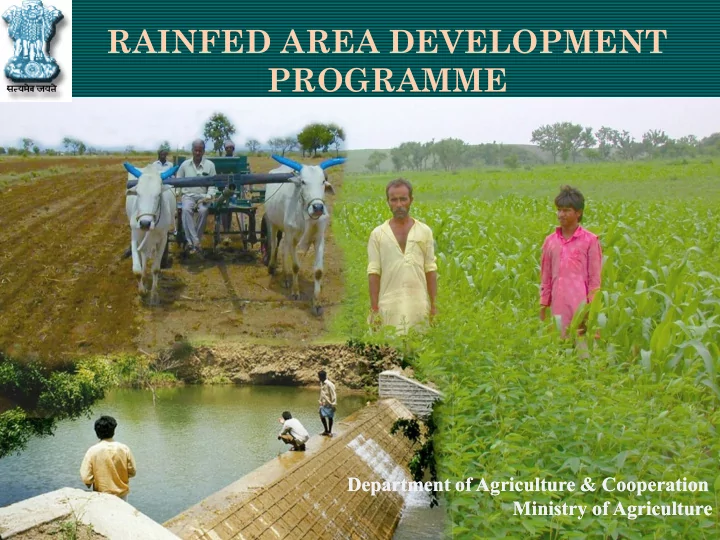
RAINFED AREA DEVELOPMENT PROGRAMME Department of Agriculture & - - PowerPoint PPT Presentation
RAINFED AREA DEVELOPMENT PROGRAMME Department of Agriculture & Cooperation Department of Agriculture & Cooperation Ministry of Agriculture Ministry of Agriculture C ONTENTS PREAMBLE-RAINFED AREAS OBJECTIVE- HIGHLIGHTS CATCHMENTS -
Department of Agriculture & Cooperation Ministry of Agriculture Department of Agriculture & Cooperation Ministry of Agriculture
RAINFED AREA DEVELOPMENT PROGRAMME
PREAMBLE-RAINFED AREAS OBJECTIVE- HIGHLIGHTS CATCHMENTS - COVERAGE APPROACH- FEATURES- OPTIONS ILLUSTRATIONS INSTITUTIONS-IMPLEMENTATION-OUTCOME WHY RADP AS A SEPARATE SCHEME COMPONENTS-ASSISTANCE
The Food Bowl of India (North West) is
becoming Unsustainable
Groundwater Depletion and Climatic
Variability threatens Food Security
India Needs to Sustain Agricultural Growth
to ensure Food Security
Urgent need for ‘Second Green’ revolution
from ‘RAINFED AREAS’
Are Rainfed Areas Prepared ?
Erratic Rainfall, Floods, Droughts, Inadequate Irrigation Infrastructure Land Degradation, Poor Soil Fertility High Risk Less Investment in Inputs Small Land Holdings, Poor Farmers Lower Credit off take Low Productivity Under developed Market Infrastructure, Poor Post Harvest Management Poor Socio-Economic growth, Illiteracy, Poverty
N A T U R A L S O C I O
C O N O M I C
High Risk-Low High Risk-Low Yield Business
Wider Spatial Coverage
Rainfed agro ecologies cater to Rice, Coarse Cereals, Pulses,
Oil seeds, Cotton besides Plantation Crops
Harnessing untapped potential
12 m. ha is under mono crop rice Water Resources (Ground Water, Rainfall) Scope for productivity enhancement Need of the Hour Mitigating the Risks Crop Diversification Farmer Centric Interventions A new Scheme focusing on development of Rainfed
farming system 60% Net Sown Area 60% Net Sown Area
To Transform rain-fed agriculture into Low
Risk- High Yield activity:
Improving agricultural productivity in a
sustainable manner
Mitigating the Risks associated with
Climatic Variability
Presenting more options for enhancing
income generation
Convergence
Farmer Centric Approach Opening up Farming System Composite Farming Maximizing Farm Income
WATERSHED NREGA RKVY NFSM
Location Specific Farming System Location Specific Farming System Institutional Support Institutional Support Diversification Diversification
Harnessing Potential Harnessing Potential Maximizing Value Maximizing Value Prosperity Prosperity
Energizing Rural Economy
Clusters Technology Skills Convergence
Crop based
Rice- fish farming system Cropping system+ fish + poultry/Duck Cereal crops+ Fiber crops/ root crops+ LS Cropping system + horticulture+ Silvipasture
Livestock based
Dairy/goat + Cropping system + aquaculture Livestock + Silvipasture Small ruminants+ Cropping system Livestock + Horti+ Crops
Horticulture based
Hort.+ Crops +Cattle/dairy Hort.+ fishery+ apiculture + Crops Hort.+ Crops +Floriculture+ apiculture Hort.+ fish+ Poultry/duck Horti+ pasture+ livestock
Fish based
Sericulture+ fishery+ Crops Poultry+ fish + Crops Cattle+ fishery +fodder/Crops Pig+fishery+ fodder/ Crops Goat+ fish +fodder Rabbit+ Fishsery + fodder
Creating More Creating More Choices
Crop & Plant Live Stock Bio digester
Mandi
Farm pond Crops & plants
Integration
Agri- Horti System with Micro Irrigation
Livestock based Farming System
National
State
for RADP
District
coordinated by concerned Line Dept.
DAP / SAP / SLSC STATE LINE DEPT BENEFIC IARY CARD NGO/SHG/CO- OPERATIVES/ ATMA PANCHAYAT/ KVK /SAU / ICAR/ WATERSHED COMMITTES PLANNING EXECUTING MONITORING CO-ORDINATING SUPPORT PROVIDER
Energizing Rural Economy Reversing Migration Resilience to Climate Change
WHY RADP AS A SEPARATE SCHEME?
Objective: Restore
Ecological Balance by harnessing, conserving and developing degraded natural resources
Outcome: Prevention
regeneration of natural vegetation, rainwater harvesting, recharging of groundwater
Objective: Improving
Quality of life of farmers especially Small and Marginal farmers through a package of activities
Outcome: Higher
income to farmers, higher agricultural production and mitigating the risk of climate change
IWMP IWMP RADP RADP
Focus: Natural
Resources
Approach: Area
Development
Coverage: Primarily
Waste and Degraded Lands (Non Arable)
Focus: Farming
System
Approach: Farmers’
Centric
Coverage: All Rainfed
areas (Arable)
IWMP IWMP RADP RADP
RADP aims at leveraging the outcome of other schemes and make use of the developed natural resources of IWMP and other development programmes for increasing the production and productivity of Rainfed areas as watershed plus measures
WHY RADP AS A SEPARATE SCHEME?
COMPONENTS & PATTERN OF ASSISTANCE
Sl Activity Cost Assistance
1 Rice based Cropping system Rs.40,000 /ha 25%, limited to
2 Coarse cereal based Cropping system
25%, limited to
3 Oilseed based Cropping system
25%, limited to
4 Fibre based Cropping system
25%, limited to
5 Pulses based Cropping system
25%, limited to
6 Horticulture Based farming system
50% limited to Rs. 50000/farmer. Boundary plantation:
year & Rs10/survived plant/yr for 3 yrs
CONT..
Sl Activity Cost Assistance 7
Tree/ Silvi-Pastoral
50%, limited to Rs. 30000/farmer. Boundary plantation: Rs. 15 / plant in the Ist year & Rs. 5/survived plant/yr for 3 yrs
8
Livestock based farming system
animals+ 1 ha CS 50% limited to Rs. 40,000 /farmer
/ 50 birds + 1 ha CS 50% limited to Rs. 25000 /farmer
9
Fishery based farming system
Rs.40,000 /ha without pond 50% limited to 2 ha per farmer
10 Bee Keeping
50% limited to 12 colonies per 2 ha farm
11 Silage making for
increased availability of green fodder Silo Rs. 40,000 Equip Rs. 25000 W0rk Cap Rs.12000 75% for group efforts and 25% for individual
12 Seed Production
mainly for Coarse cereals, Pulses, oil seeds & vegetables Project based with a limit of Rs. 50,000/ha (As per prevailing schemes) 100% assistance to Public Sector Org / SAU and 50% to growers association/ farmer’s company/ groups/individuals with credit linked back ended subsidy.
Sl Activity Cost Assistance
13 Poly house
50% maximum upto Rs. 50000
14 Water Harvesting and Management
Construction of farm ponds Rs.6000/ 100m3 (Un lined) 50% limited to Rs.30,000 only if not possible through convergence Lining of tanks/ponds As per estimate 50% to maximum of Rs. 30,000 Community tank Up to Rs. 5 lakh 75%, if not possible through convergence Shallow tubewells
50%, if not possible through convergence Bore-well
50% limited to Rs. 10,000 Restoration/ Renovation of tank As per estimate 50% limited to Rs. 10,000 Recharge of defunct bore well As per estimate 50% limited to Rs. 4000 per one unit Pipe/pre-casted distribution system Rs.20000/ha 50% limited to 4 ha per farm family Water Lifting (Electric/ Diesel/ Wind/Solar) Up to Rs. 20000 50% limited to one unit for one farm family Pressurized / micro irrigation As per MI Scheme Pattern of Assistance as per MI Scheme
CONT..
Sl Activity Cost Assistance
15 In-situ
moisture conservation
90% limited to 2 ha/farmer
16 Nutrient
Management 50% limited to Rs. 4000/farmer Rs.1000/ha
17 Post
harvest & Storage Up to Rs. 1,00,000 25% to growers association/ farmer’s company/ group of farmers with credit linked back ended subsidy.
18 Farm Mechinery
Bank
Prevailing subsidy pattern but limiting to Rs. 10 lakhs per unit.
19 Crop insurance
Premium amount for first 2 years
20 Conveyance
to storage/marketing Tempo Rs.1 lakh pick up van Rs.6 lakh 25% subsidy
21 Management
State level National level Admn./Cont/Consultant s Capacity Building Awareness/Ex/WS/Conf Admn/Cont/Consultancy 10% of Annual Exp 4% of Annual Exp 1% of Annual Exp
High potential rainfed areas :
Horticulture and Plantation based farming system
Sub humid regions: Fishery based
farming system
Arid
and semi arid regions: Livestock based farming system
Problem soils: Farming system with
livelihood support activities
Horizontal layer The farm land is divided in to different sections to
carry out different farm operations. It may be also in strips with in a plot
Vertical layer Below the trees plants not direct sunlight-needy.
Below these plants, crops that need very little or no
Use of arable and non arable land as one
unit
Cultivation in arable land, non- arable land used
for pastures, shrubs, livestock farm, infrastructure etc.
COVERAGE DETAILS
Zone Ecology States Dist
Arid <500 mm Rainfall 7 (AP, Gujarat, Haryana, J&K, Karnataka, Punjab, Rajasthan 31 Semi-Arid 500-750mm Rainfall 12 ( AP, Gujarat, Haryana, HP, J&K, Karnataka, MP, Maharashtra, Punjab, Rajasthan, TN, UP) 133 Sub Humid 750-1150 mm Rainfall (Rainfall <ET) 15 (AP, Bihar, Chhatisgarh, Gujarat, HP, J&K, Jharkhand, Karnataka, MP, Maharashtra, Orissa, Uttarakhand, UP, TN, WB) 175 Backward Humid >1150 mm Rainfall (Rainfall >ET) 9 ( Kerala, 7 NE States, Sikkim) 85