Railroads and other stuff Presented by: William H. Reetz Origin of - - PowerPoint PPT Presentation

railroads and other stuff
SMART_READER_LITE
LIVE PREVIEW

Railroads and other stuff Presented by: William H. Reetz Origin of - - PowerPoint PPT Presentation

Railroads and other stuff Presented by: William H. Reetz Origin of Railroads Wagonways reduced friction Earliest locomotives built around 1800 George Stephenson Father of Railways 4 ft. 8 gauge Prompted social and


slide-1
SLIDE 1

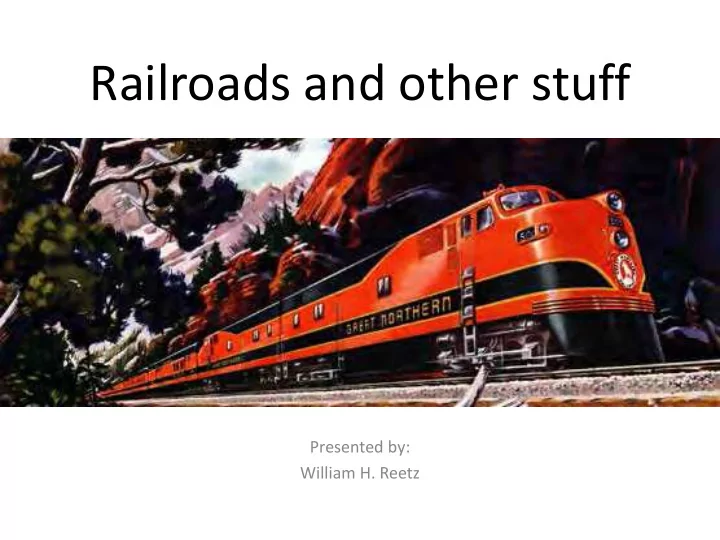
Railroads and other stuff

Presented by: William H. Reetz
slide-2
SLIDE 2

Origin of Railroads

  • Wagonways reduced friction
  • Earliest locomotives built around 1800
  • George Stephenson “Father of Railways” 4 ft. 8 ½ gauge
  • Prompted social and economic change
slide-3
SLIDE 3

Railroads in North America

  • Future lay in westward expansion
  • Baltimore and Ohio – competition with New York
  • Networking in North but Short Lines in South
  • Transcontinental vision
slide-4
SLIDE 4

Railroad History in the Northwest

  • Chenowith
  • Merger of Short Lines
slide-5
SLIDE 5

Northern Pacific

  • Chartered in 1864 by Act of Congress signed by President Lincoln
  • Generally followed Lewis and Clark Trail
  • Difficulties: Supplies, Weather, Native Americans
  • Construction begins in Kalama
  • Line from Minnesota to Portland substantially completed in 1883
slide-6
SLIDE 6

Great Northern and Milwaukee Road Routes

  • Competing Northwest Routes
slide-7
SLIDE 7

Financial Issues

  • Land grants of 60 million acres but only used 40 million
  • Company reorganized and extended Tacoma line to Puyallup
  • Stampede Pass discovered and tunnel completed
  • Competition between Harriman and Hill
  • Answer was Chicago, Burlington & Quincy
  • Hill wins and GN and NP acquire Chicago, Burlington, & Quincy
slide-8
SLIDE 8

Milwaukee Road

  • Incorporated in1847 as Milwaukee & Waukesha
  • Vision west – shorter route but lack of land grants brought expense
  • Merger sought but not approved
  • BN merger was approved but conditions improved profitability
  • Filed bankruptcy proceedings in 1977
  • Hyak Ski Bowl
slide-9
SLIDE 9

Great Northern Railway

  • James J. Hill “The Empire Builder”
  • Acquired RR’s in Minnesota and part of Mesabi Range and looked westward
  • Chose farthest northern route
  • John Stevens discovers Marias Pass and Stevens Pass
slide-10
SLIDE 10

Cascade Difficulties

  • Original Cascade tunnel
  • Wellington avalanche 1910
  • Electrification and new tunnel
slide-11
SLIDE 11

Mergers

  • GN, NP, & Burlington Route form BN
  • SP&S Merger
  • Merger with AT&SF form BNSF
slide-12
SLIDE 12

Bakken Crude Controversy

  • Bakken Formation
  • Oil discovered in 1951
  • Extracted by hydraulic fracturing and horizontal drilling
  • Lac Megantic Rail disaster in Quebec
  • Swinomish Tribe’s lawsuit filed in U.S. District Court
slide-13
SLIDE 13

Federal Regulation

  • General Railroad Right-of-Way Act of March 3, 1875
  • Interstate Commerce Act of 1887
  • 4-R Act of 1976 and Staggers rail Act of 1980
  • Interstate Commerce Commission Termination Act of 1995 (“ICCTA”)
slide-14
SLIDE 14

Overview of Washington & Federal Case Law

  • Morsbach and Swan: Fee or Easement?
  • Zobrist v. Culp
  • Veach v. Culp
  • Roeder Company v. Burlington Northern, et al.
  • Brown v. State of Washington
  • City of Auburn v. United States Government
  • Lake Whatcom Railway v. Alar
slide-15
SLIDE 15

Federal Decisions

  • Northern Pacific Railway v. Townsend
  • Great Northern Ry. Co. v. United States
  • Marvin Brandt Rev. Trust v. United States
slide-16
SLIDE 16

Railbanking and Rails to Trails

  • Abandonment under ICC Administration
  • 4-R Act and Staggers Act Exemptions
  • National Trails System Amendments of 1983
  • Opposition
slide-17
SLIDE 17

Federal and State Decisions

  • Preseault v. ICC (Preseault I)
  • Preseault v. ICC (Preseault II)
  • Preseault v. State of Vermont (Preseault III)
  • Lawson v. State of Washington, et al.
  • King County v. Rasmussen
slide-18
SLIDE 18

Conclusion

  • Issues relating to the evolution of railroads have changed over time
  • Economic and social progress
  • Settlement of the West
  • Land Barons
  • Regulation and Deregulation
  • Recreational Trails