Radiation Therapy Planning in Low- and Middle- Income Countries - - PowerPoint PPT Presentation

radiation therapy planning in low and middle income
SMART_READER_LITE
LIVE PREVIEW

Radiation Therapy Planning in Low- and Middle- Income Countries - - PowerPoint PPT Presentation

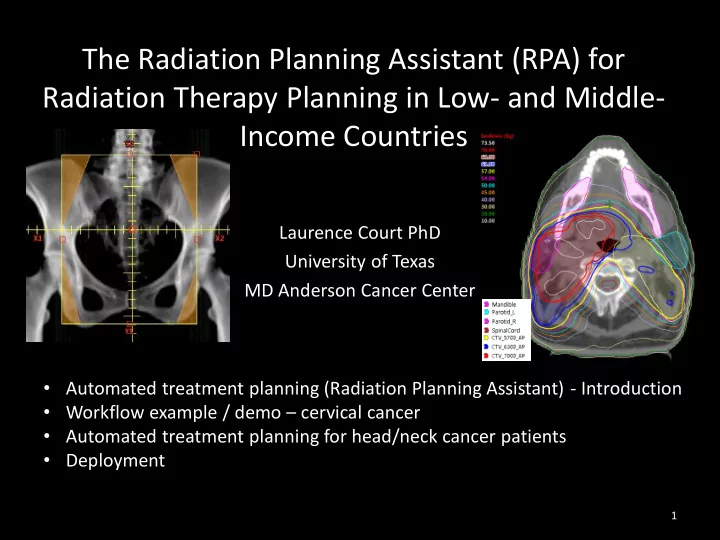
The Radiation Planning Assistant (RPA) for Radiation Therapy Planning in Low- and Middle- Income Countries Laurence Court PhD University of Texas MD Anderson Cancer Center Automated treatment planning (Radiation Planning Assistant) -


slide-1
SLIDE 1

Laurence Court PhD University of Texas MD Anderson Cancer Center

The Radiation Planning Assistant (RPA) for Radiation Therapy Planning in Low- and Middle- Income Countries

1

  • Automated treatment planning (Radiation Planning Assistant) - Introduction
  • Workflow example / demo – cervical cancer
  • Automated treatment planning for head/neck cancer patients
  • Deployment
slide-2
SLIDE 2

Conflicts of Interest

  • Funded by NCI UH2 CA202665
  • Equipment and technical support provided by:

– Varian Medical Systems – Mobius Medical Systems

  • Other, not related projects funded by NCI, CPRIT, Varian,

Elekta

2

slide-3
SLIDE 3

MD Anderson Cancer Center, Houston

  • Laurence Court, PhD - PI
  • Beth Beadle, MD/PhD - PI
  • Joy Zhang, PhD – algorithms and integration
  • Peter Balter, PhD – radiation physics
  • Jinzhong Yang, PhD - atlas segmentation
  • Ryan Williamson, MS – software tools
  • Rachel McCarroll – H&N algorithms
  • Kelly Kisling, MS – GYN, breast algorithms
  • Ann Klopp, MD/PhD – GYN planning
  • Anuja Jhingram, MD – GYN planning
  • David Followill, PhD – audits/deployment
  • James Kanke and dosimetry team

Primary Global Partners

  • Santo Tomas University, Manila

– Michael Mejia, MD – Maureen Bojador, MS (physics) – Teresa Sy Ortin, MD

  • Stellenbosch University, Cape Town

– Hannah Simonds, MD – Monique Du Toit – physics – Vikash Sewram, PhD Global testing sites

  • University of Cape Town

– Hester Berger, PhD – Jeannette Parkes, MD

  • University of the Free State

– William Rae, PhD – William Shaw, PhD – Alicia Sherriff, MD

  • 4 additional centers in South Africa

& The Philippines

3

Commercial Partners

  • Varian Medical Systems (providing 10

Eclipse boxes for UH2 phase + API technical support)

  • Mobius Medical Systems (providing 10

Mobius boxes for UH2 phase)

slide-4
SLIDE 4

<10 11-20 21-50 51-100 >100

No RT/Details not available Non LMIC setting

Number of Physicists needed by 20201 Figure by Rachel McCarroll, based on data in Datta NR, Samiei M, Bodis S. Radiation Therapy Infrastructure and Human Resources in Low- and Middle-Income Countries: Present Status and Projections for 2020. International Journal of Radiation Oncology*Biology*Physics. 2014;89(3):448-57.

Staff shortages

slide-5
SLIDE 5

Country Additional number of radiotherapy infrastructure and staffing required by 2020 Treatment units Radiation

  • ncologists

Medical physicists Radiation therapy technologists Philippines 140 141 133 382 South Africa 56 93 82 82 All LMI regions 9169 12,147 9,915 29,140

Datta NR, Samiei M, Bodis S. Radiation Therapy Infrastructure and Human Resources in Low- and Middle-Income Countries: Present Status and Projections for 2020. International Journal of Radiation Oncology*Biology*Physics. 2014;89(3):448-57.

  • Large deficit in resources – including medical physicists and technologists
  • Staff retention is also a problem (anecdotal)
  • Many international guidelines suggest that medical physicists need 2+ years residency,

typically following graduate school – so 4+ years per person.

  • Approximately 50% of physicist time is spent doing treatment planning
  • If planning was automated, then the deficit of medical physicists could be reduced to

~5000.

Motivation for automated planning 1: Staff shortages

slide-6
SLIDE 6
  • All our partner institutions are treating chest walls using standard opposed
  • blique open fields (i.e. not optimized for the individual patient’s geometry)
  • Automated planning could change this

9

Motivation 2: 3D planning

Comparison of the dose distribution for a chest wall treatment with optimized wedges (right) and with open fields (left). The non-optimized plan has a large region of soft tissue receiving 60Gy (6000cGy), compared with 52Gy (5200cGy) in the optimized plan.

slide-7
SLIDE 7

Specific goals of the Radiotherapy Planning Assistant (RPA)

  • Automatically create high quality radiation plans for cancers of the:

– Uterine Cervix – Breast (intact and chest wall) – Head and neck (nasopharynx, oropharynx, oral cavity, larynx, etc.)

  • Generate treatment plans that are:

– Generated from scratch (including transfer to the local machine) in less than 30 minutes. – Compatible with all treatment units and record-and-verify systems. – Internally QA’d in an automated fashion within the system.

  • Limit need for the radiation oncology physician to:

– Delineate the target (location). – Provide the radiation prescription. – Approve the final plan.

  • Create a system that can be used by an individual with:

– A high school education. – ½ day of training (online and video) on the RPA itself.

10

slide-8
SLIDE 8

RPA project schedule – from NCI UH2/UH3 mechanism

Phase 1 (UH2): Development Phase – 2 years – to April 2018

  • System development at MDACC
  • Local testing at Santo Tomas (Manila) and Stellenbosch (Cape

Town) [MDACC sister institutions]

  • Additional testing at other centers in The Philippines, South

Africa Phase 2 (UH3): Validation Phase – 3 years

  • Full patient testing (same centers, 12 months)
  • Then other centers across Southeast Asia and Sub-Saharan

Africa

11

slide-9
SLIDE 9

12

slide-10
SLIDE 10

Workflow overview (user’s perspective)

CT Physician’s Plan Order

approve approve

Autoplanner Radiotherapy treatment plan QA report

slide-11
SLIDE 11

Big Picture of RPA 2.0 Workflow

An approved CT An approved PO RPA PO Database RPA CT Database DICOM CT RPA Job Mobius 3D

DICOM JSON DICOM ESAPI DICOM ESAPI

Eclipse & ARIA RPA Engine Plan order (PO) PDF report DICOM plan RPA Client RPA Plan Database

Lifei Zhang

slide-12
SLIDE 12

WORKFLOW EXAMPLE: CERVICAL CANCER

15

slide-13
SLIDE 13

16

slide-14
SLIDE 14

17

slide-15
SLIDE 15

CT Table Removal

Method 1: Peak Detection

By finding peaks slice by slice at sum projection signal along lateral direction.

Method 2: Line Detection

By detecting Hough lines at maximum intensity projection image. Table top as a peak Table top as a line

  • Average difference between two approaches: 2.6 ± 1.6mm (max: 4.9mm)

Work by Lifei Zhang

slide-16
SLIDE 16

Body Contour

Method 1: Active Contour

By contracting initial active contour to the body edge.

Method 2: Intensity Thresholding

By thresholding CT image into binary mask.

Work by Lifei Zhang

  • Average agreement = 0.6mm, Average max: 7.6mm
slide-17
SLIDE 17

Marked Isocenter Detection

Method 1: Body Ring Method

By searching BB candidates in the body ring domain.

Method 2: BB Topology Method

By searching BBs that constitute the triangle topology.

  • Average difference between two approaches: 0.4 ± 0.8mm (max: 3.0mm)
slide-18
SLIDE 18

Determine the jaws and blocks

21

Input: Patient CT And Isocenter Output: treatment fields Output: treatment fields

1st Algorithm “3D Method” 2nd Algorithm “2D Method”

Inter-compare Work by Kelly Kisling

slide-19
SLIDE 19

Segment bony anatomy using multi- atlas deformable registration Project these 3D segmentations into the 2D plane of the BEV On the projections, identify landmarks (e.g. inferior edge of the

  • bturator foramen)

“3D Method” algorithm

Define the treatment field borders based on these landmarks

Inputs: Patient CT and Isocenter

“2D Method” algorithm

Output: 4-field box treatment fields

Inputs: Patient CT and Isocenter

Output: 4-field box treatment fields 22

Work by Kelly Kisling

slide-20
SLIDE 20

Segment bony anatomy using multi- atlas deformable registration Project these 3D segmentations into the 2D plane of the BEV On the projections, identify landmarks (e.g. inferior edge of the

  • bturator foramen)

Create DRRs at each beam angle from the patient CT Deform an atlas of DRRs to the patient DRRs. The atlas DRRs have corresponding treatment fields.

“3D Method” algorithm

Define the treatment field borders based on these landmarks

Inputs: Patient CT and Isocenter

“2D Method” algorithm

Define the treatment field borders by least-squares fitting to the set of deformed blocks Output: 4-field box treatment fields

Inputs: Patient CT and Isocenter

Apply deformations to the treatment fields to obtain deformed blocks Output: 4-field box treatment fields 23

Work by Kelly Kisling

slide-21
SLIDE 21

Segment bony anatomy using multi- atlas deformable registration Project these 3D segmentations into the 2D plane of the BEV On the projections, identify landmarks (e.g. inferior edge of the

  • bturator foramen)

Create DRRs at each beam angle from the patient CT Deform an atlas of DRRs to the patient DRRs. The atlas DRRs have corresponding treatment fields.

“3D Method” algorithm

Define the treatment field borders based on these landmarks

Inputs: Patient CT and Isocenter

“2D Method” algorithm

Define the treatment field borders by least-squares fitting to the set of deformed blocks Output: 4-field box treatment fields

Inputs: Patient CT and Isocenter

Apply deformations to the treatment fields to obtain deformed blocks Output: 4-field box treatment fields 24

Work by Kelly Kisling

slide-22
SLIDE 22

a.) 3D Method algorithm

Anterior Right lateral

b.) 2D Method algorithm

Anterior Right lateral

Physician Rating 3D Method 2D Method Per Protocol 62% 17% Acceptable Variation 34% 62% Unacceptable Deviation 4% 21%

Results of 39 test patient CTs (now tested on ~200)

25

Work by Kelly Kisling

slide-23
SLIDE 23

MDA clinical version deployed 15 patients so far

Fields with Physician edits Fields from the Auto-planner Right Lateral Field Anterior Field

26

slide-24
SLIDE 24

Beam weight

  • ptimization
  • Least-squares
  • ptimization to give a

uniform dose distribution within the 95% isodose volume

  • Tested on 21 patients
  • Average hotspot

reduction 106.4% to 104.9%

  • No loss in coverage

27

104% 103%

Work by Kelly Kisling

slide-25
SLIDE 25

28

slide-26
SLIDE 26

Mobius dose verification

29

slide-27
SLIDE 27

Initial technical review

  • Double check of vital plan check functions
  • Only get to this point if passes all internal QA checks
  • Technical items checked:

– Marked isocenter – Patient orientation, laterality and site – Body contour – CT processing (couch removal) – Field apertures – Any significant artifacts or differences – Dose calculation complete

  • Purpose designed document to lead the user through the

checks

30

slide-28
SLIDE 28

Technical review paperwork

slide-29
SLIDE 29

Marked isocenter

Patient results Library examples

Checklist Yes No : Are all 3 fiducials visible on at least one of the slices shown? Yes No : Do the central axis lines touch each fiducial on at least one slice?

slide-30
SLIDE 30

Body contour

Patient results Library examples Checklist Yes No : On the CT slices, is the body correctly contoured (e.g. not including the couch)? Yes No : Is the body contour smooth, like the library case? Yes No : Is the orientation consistent with the library case?

slide-31
SLIDE 31

Field apertures

Checklist Yes No : Is the patient orientation and body part consistent with the reference case Yes No : Are the blocks/MLCs in the acceptable region? Yes No : Are there any significant differences between the patient and library images?

slide-32
SLIDE 32

Completeness of dose calculation

35

slide-33
SLIDE 33

38

Lifei Zhang

slide-34
SLIDE 34

39

Lifei Zhang

slide-35
SLIDE 35

40

slide-36
SLIDE 36

41

slide-37
SLIDE 37

Plan QA: Comparison with population ranges

  • Some ranges are quite tight, so provide reasonable (backup) QA

– E.g. Total range of MU is 10%

  • Some ranges are much looser

– Range of jaw positions is ~2.5cm in lateral and AP directions, 6cm in SI direction Jaw positions – population statistics Total MU – population statistics

42

slide-38
SLIDE 38

43

slide-39
SLIDE 39

Status of cervical cancer autoplanning

  • 3D algorithm deployed to MDACC clinical use
  • Workflow designed and integrated
  • Secondary (verification) algorithms developed
  • Starting testing on 600+ patients

– ~95% pass rate (first 200 patients) – QA criteria

  • Then testing using local data at Stellenbosch, Santo

Tomas, and others

44

NEW: We now have a 2D algorithm for use with digital simulator images – looking for collaborators to help check these…. (we don’t have many images…..)

slide-40
SLIDE 40

Head and neck treatments

  • Range of complexities in treatments

– VMAT or IMRT – Opposed laterals / off-cord cone-downs – Complex conformal plans

  • Starting with VMAT (IMRT)

– Auto-contouring normal tissue – Auto-contouring low-risk CTV – Manual contouring of GTV – RapidPlan (Eclipse)

45

slide-41
SLIDE 41
  • 1. Add GTV
  • 2. review / edit contours

Workflow overview (user’s perspective)

CT Physician’s Plan Order

approve approve

Radiotherapy treatment plan QA report Autoplanner

slide-42
SLIDE 42

Plan Orders for head/neck

47

slide-43
SLIDE 43

Normal tissue auto-contouring

Data from Rachel McCarroll. Algorithm by Jinzhong Yang and team

48

Brain Brainstem Cochlea Esophagus Eye Lung Mandible Parotid SpinalCord

Multi-atlas segmentation – deformable registration (accelerated “Demon”) followed by STAPLE algorithm to fuse contours

slide-44
SLIDE 44

Normal tissue auto-contouring

  • Tested on 128 patients
  • Scored by Radiation
  • ncologist.
  • 4+ is acceptable

without edit

  • Fails for non-standard

head positions

  • Otherwise all pass,

except esophagus (and lung)

  • Now deployed this to

clinical practice

Multi-atlas segmentation – deformable registration (accelerated “Demon”) followed by STAPLE algorithm to fuse contours Data from Rachel McCarroll. Algorithm by Jinzhong Yang and team

49

slide-45
SLIDE 45

Deployed to clinical use at MDA

  • 150+ patients since May 2016

n DSC MDA (cm) Brain 10 0.98 0.07 Brainstem 10 0.88 0.14 Cochlea 18 0.65 0.09 Esophagus 10 0.62 0.30 Eye 20 0.87 0.11 Lung 10 0.92 0.25 Mandible 10 0.90 0.08 Parotid 19 0.84 0.18 SpinalCord 10 0.81 0.14

Data from Rachel McCarroll

>0.7 is considered acceptable

50

DSC: Dice similarity coefficient

Compare auto-contour pre- and post-edits

slide-46
SLIDE 46

Addition of Varian Deeds algorithm (a new algorithm, not in Eclipse) Comparison with physician contours (in clinical plan)

  • First scored Varian atlas applied to our patients
  • (note difference in patient setup)
slide-47
SLIDE 47

52

Dice MSD (mm)

Structure N In House MACS Varian Deeds with MDACC Atlas In House MACS Varian Deeds with MDACC Atlas

Brain 26 0.98 0.97 1.06 1.36 Brainstem 75 0.80 0.81 2.38 2.24 Cochlea 104 0.50 0.59 1.61 1.46 Esophagus 34 0.64 0.51 3.13 5.90 Eye 68 0.84 0.79 1.42 1.75 Lungs 12 0.76 0.88 8.98 4.33 Mandible 39 0.85 0.80 1.71 2.36 Parotid 140 0.79 0.72 2.37 3.03 SpinalCord 74 0.73 0.71 3.76 5.83

  • Next step is to evaluate the use of Deeds for secondary verification of contours
  • Second, used our atlas with Varian Deeds, applied to our patients

Addition of Varian Deeds algorithm (Tomas Morgas) Comparison with physician contours (in clinical plan)

slide-48
SLIDE 48

VMAT planning

53

  • Average time: 48min (n=30)
  • Physician pass rate: >90% (14/15)
  • Contour review
  • Dose distribution review
  • DVH review
slide-49
SLIDE 49

Structure specific population models for automated QA – works-in-progress

  • Example metrics

– Volume, HU – Separation – Agreement with Rigidly Registered Contours – Slice to Slice Characteristics (“shape”)

  • Bagged classification tree model

54

Rachel McCarroll

slide-50
SLIDE 50

Predicting the need for edits…..

55

slide-51
SLIDE 51

Summary for head and neck cancer treatments

  • VMAT/IMRT

– Normal tissue segmentation

  • complete, tested, and deployed

– CTV2,CTV3 segmentation

  • Complete and tested

– Automated planning using RapidPlan

  • mostly complete, but additional assessment needed

– Automated QA – needs more work

  • Opposed laterals

– Longer timeframe (use similar tools as 4fld cervix)

56

slide-52
SLIDE 52

RPA Deployment process

  • Demographics questionnaire
  • Facility questionnaire
  • OSLD output check

– all photon beams, low-energy electron beams

  • Virtual visit
  • Send historic commissioning data to MDACC (no wedges)
  • Send patient data to MDACC

– Initial testing of RPA (10 patients per cancer site)

  • Shipping (unless web-based setup)
  • Site visit

– Measurements for DLG and MLC transmission – End-to-end tests – Workflow verification – Training

57

IROC Houston

slide-53
SLIDE 53

Radiotherapy Beam Audit Device

  • Use together with TLD output checks on as-needed basis

Phantom built at IROC-Houston, with David Followill

58

slide-54
SLIDE 54

End-to-end tests

  • Will create tests based on

IAEA-TECDOC-1583

  • On-site testing

59

slide-55
SLIDE 55
  • At the end of the UH3 phase, we will have deployed to up to 14 treatment

centers where the RPA will be used clinically (possibly more if we team with the IAEA).

  • Productivity gains

– At institutions where the physics staff is responsible for the treatment planning, this will translate to a gain in productivity of ~50%. – Additional gains from auto-contouring

  • Safety gains

– All head and neck, breast/chest wall, and cervical cancer patients treated at institutions where we deploy the RPA will have thorough secondary QA checks.

  • Quality gains

– All chest wall patients will be treated with optimized plans, reducing acute skin reactions which are correlated with pain and quality of life.

  • Further deployment/gains through partnership with Varian

60

Vision: For end of UH3 Phase (2021)

slide-56
SLIDE 56

Automation of treatment planning: Summary

  • Automatic treatment planning may help reduce the planning

burden, reducing staff shortages

  • Fully automated cervical cancer 4-field box treatments –

almost ready (aiming for January)

– Field aperture task already deployed at MDA

  • Fully automated H/N IMRT/VMAT treatment planning –

almost ready (aiming for January)

– Normal tissue contouring task already deployed at MDA

  • Breast / chest wall – next
  • (and also work on 2D plans, not mentioned today……)
  • Still identifying additional test sites (mostly for phase 2)

Contact: lecourt@mdanderson.org

61

slide-57
SLIDE 57

One big challenge

  • Every institution is different –

– Equipment – Treatment approach – Staffing (backgrounds etc) – Etc…..

  • To ensure wide applicability, we need:

– Collaborators who use digital simulators for GYN – People interested in testing our training program (online) and workflow – Anyone interested in giving general feedback at certain time points throughout the project

62