Rabies risk Dr. Philippe Gautret Institut Hospitalo Universitaire - - PDF document

rabies risk
SMART_READER_LITE
LIVE PREVIEW

Rabies risk Dr. Philippe Gautret Institut Hospitalo Universitaire - - PDF document

6/19/2019 Rabies risk Dr. Philippe Gautret Institut Hospitalo Universitaire Mditerrane Infection, Unit de Recherche en Maladies Infectieuses et Tropicales Emergentes URMITE CNRS IRD UMR6236 EuroTravNet Marseille, France


slide-1
SLIDE 1

6/19/2019 1

Rabies risk

‐‐

  • Dr. Philippe Gautret

Institut Hospitalo‐Universitaire Méditerranée Infection, Unité de Recherche en Maladies Infectieuses et Tropicales Emergentes URMITE CNRS‐IRD UMR6236 EuroTravNet Marseille, France

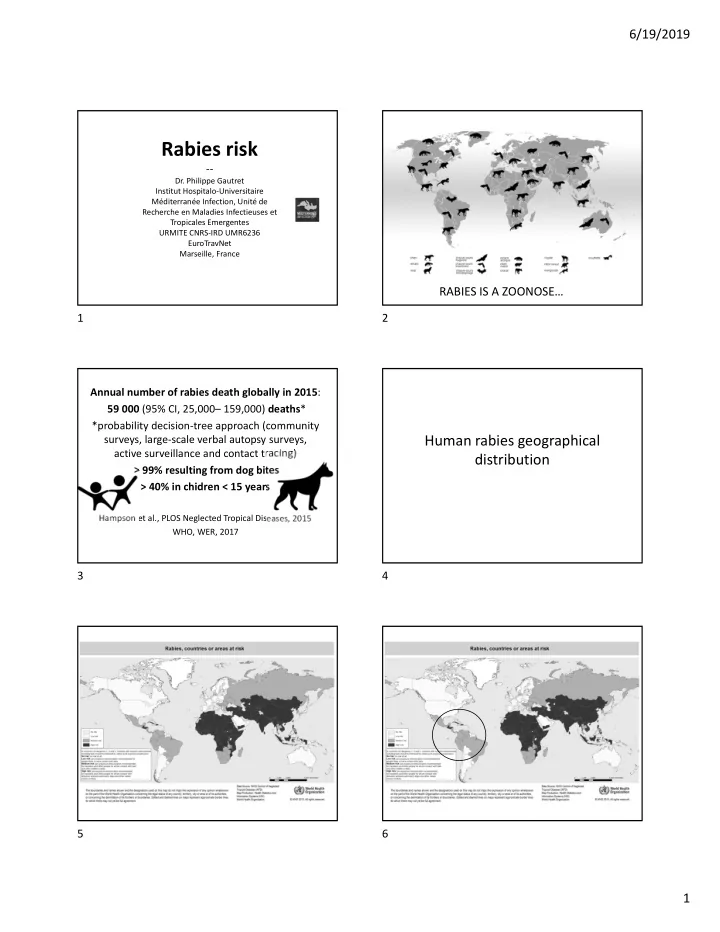
RABIES IS A ZOONOSE…

Annual number of rabies death globally in 2015: 59 000 (95% CI, 25,000– 159,000) deaths* *probability decision‐tree approach (community surveys, large‐scale verbal autopsy surveys, active surveillance and contact tracing) > 99% resulting from dog bites > 40% in chidren < 15 years

Hampson et al., PLOS Neglected Tropical Diseases, 2015 WHO, WER, 2017

Human rabies geographical distribution

1 2 3 4 5 6

slide-2
SLIDE 2

6/19/2019 2

World : 59000 Asia: 59.6% Africa: 36.4%

Number of rabies death globally in 2015

TOP COUNTRIES ASIA: INDIA (35%), CHINA, THE PHILIPPINES AFRICA: NO RELIABLE DATA AMERICA: HAITI & BOLIVIA MIDDLE EAST: YEMEN & IRAQ

4 %

Rabies Bulletin Europe, 2013 De Benedictis et al., EuroSurv, 2008

Résurgence de la rage du renard en Italie (2008)

Tsiodras et al., EuroSurv, 2013

Résurgence de la rage du renard en Grèce (2012)

Travel‐associated human rabies

7 8 9 10 11 12

slide-3
SLIDE 3

6/19/2019 3

60 cases in 1990‐2012 10 new cases in 2013‐2019

  • Taiwan ex. Philippine (migrant)
  • US ex. Guatemala (Migrant)
  • The Netherlands ex. Haïti (not documented)
  • The Netherlands ex. India (Indian married a Dutch)
  • France ex. Mali (VFR)
  • UK ex. India (not documented)
  • France ex. Sri Lanka (Tourist)
  • UK ex. Morocco (Tourist)
  • Qatar ex. Nepal (Migrant)
  • Norway ex. Philippines (Tourist)
  • 2.6 cases per year, increase from 2004

29

17

7

14

1

Rabies cases among international travelers 1990‐2015

Main points

  • Adult travelers (83%)
  • Men (75%)
  • Residence in Europe (57%)

and US (27%)

  • Tourists + business +

expatriates (57%) ‐ VFR + migrants (43%)

  • Dogs (85%)
  • Mean incubation time 274

days (9 months)

  • 9 case < 30 days
  • 1 case 12 days after dog bite

in India

  • 1 case 15 days after bat bite

in Mexico

  • 1 case 5 years after

immigration from China

  • 1 case 8 years after dog

exposure in Brazil

  • 1 case 10 years after dog

bite in Myanmar

13 14 15 16 17 18

slide-4
SLIDE 4

6/19/2019 4

  • 8% rabies PEP in country of exposure, 100% mortality
  • Diagnosis chalenging with multiple missed

diagnosis

– Low index of suspicion – Negative history of animal bite – Atypical presentation (Guillain‐Barré, sore‐throat infection, orthopedic, acute psychiatric disorder…) – Long incubation time

Conclusions Animal‐related injuries requiring rabies PEP among travelers Meta‐analysis

  • 1970‐2008 (38 year period study)
  • 9 published surveys
  • > 1 270 000 tourists (denominator)
  • > 11 000 expatriates (denominator)
  • > 600 injured travelers
  • Exposure in Africa, Asia, Latin America and

The Middle East

The Steffen tree monthly incidence per 100 travelers

0.4% (our estimate)

1997‐2012 2697 injured travelers receiving rabies PEP (1.5%) 45 sites 74% seen after travel 25% seen during travel Origin: Western Europe: 32%, North East Asia: 17%, Australia New Zealand: 17%,South East Asia: 14%, North America: 10%

19 20 21 22 23 24

slide-5
SLIDE 5

6/19/2019 5

0.0% 0.5% 1.0% 1.5% 2.0% 2.5% 50 100 150 200 250 300 2003 2004 2005 2006 2007 2008 2009 2010 2011 2012 Percent of GeoSentinel Patients Number of GeoSentinel Patients Year Dog NHP Cat Bat Other % of records "y=0.0015x+0.006"

  • 42% in South East Asia, 32% other Asian

countries, 9% Africa, 7% Latin America, 3% Middle East : top countries : Thailand, Indonesia, Nepal, China, India.

  • Median travel duration : 15 days (patients

seen after travel), 20 days before presenting (patients seen during travel)

  • Animal species: 60% dog, 24%, NHP, 10% cat,

2% bat

  • 2/3 of NHP exposure occured in Asia, 90%
  • ccured in tourists
  • Most injured individuals reported to GeoSentinel

are relatively young tourist travelers originating from developed countries, corresponding to the

  • verall traveler population seen at GeoSentinel
  • sites. Travelers injured by potentially rabid animals

do not present specific demographic characteristics compared to other ill travelers and therefore targeting reinforcement of preventive measures cannot be based on demographic factors alone.

Age, gender, reason for travel and duration of travel are not good indicators for risk‐based decisions. Geographic destination is the strongest determinant of rabies exposure in travelers and should be considered in preventive vaccination decisions.

25 26 27 28 29 30

slide-6
SLIDE 6

6/19/2019 6

Post‐exposure prophylaxis

WHO Stategic Advisatory Group of Experts (SAGE) on immunization

  • Rabies vaccines: WHO Position paper – April

2018 (WER, 16, 2018, 93:201‐220)

Risk assessment

31 32 33 34 35 36

slide-7
SLIDE 7

6/19/2019 7

37 38 39 40 41 42

slide-8
SLIDE 8

6/19/2019 8

D0 D3 D7 D14-28

4‐dose ESSEN IPC

2x 1x 1x 1x 1x 1x

Naive individual

+ RIG in category III exposure

1x

D0 D3 D7 D14 D21

IM (1 ml) ID (0.1 ml)

D0 D3 D7 D14 D21

2x 2x 2x

ESSEN

Not recommanded anymore by WHO

D0 D3 D7 D14 D28

1x 1x 1x 1x 1x

ZAGREB

D0 D3

1x 1x

Immunized individuals

IM (1 ml)

D0 D3

1x 1x

ID (0.1 ml)

D0

ID (0.1 ml)

4x

RIG is not indicated

43 44 45 46 47 48

slide-9
SLIDE 9

6/19/2019 9

Effective 100%

  • Additional IM administration of any remaining

RIG at a site distant to the wound is a common

  • practice. Its benefits are likely to be very
  • limited. Not recommended anymore.
  • Data from rabies‐endemic setting have shown

that even in the absence of RIG, with thorough wound washing plus immediate vaccination and completion of the PEP course > 99% patients survive.

A few points

  • PEP should be administered as soon as

possible

  • There is no time limit to administer PEP in

case of type III exposure (however, if vaccine supply is limited, vaccine can be reserved for exposure that occured within 12 months)

  • There are no contra‐indications to PEP
  • In case of repeted exposure < 3 months after

previous PEP, only wound treatment is required

For dog, cat and ferret‐related injuries

  • If the animal remains healthy for 10 days

starting from the date of the bite, PEP can be discontinued

In any case

  • When possible, suspect animals should be

humanely euthanized and tested for rabies. PEP can be discontinued if the animal is proved by appropriate laboratory examination to be free

  • f rabies

Potentially immunocompromized patients

  • If CD4 < 200/mm3, use RIG in both category II

and III exposure, even in previously immunized patients.

  • A 3‐visit vaccination schedule should be

followed (ID or IM – D0, 7, 21‐28) or a 2‐visit schedule (ID or IM, D0, 7) with serological testing 2‐4 weeks after first rabies vaccine administration to assess whether an additional vaccine administration is needed.

RIG

  • Compartment syndrome may limit the

amount of RIG that can be used when infiltrating fingers.

  • Can be diluted with physiological buffered

saline for large and multiple wounds.

49 50 51 52 53 54
slide-10
SLIDE 10

6/19/2019 10

Making things more complicated

Same protocole for category II and III exposure (ESSEN + RIG in naive patients and D0, 3 in immunized patients) 4‐dose ESSEN instead of 5 doses

D0 D3 D7 D14

4‐dose ESSEN (US)

1x 1x 1x

Naive individual

+ RIG in category II and III exposure

1x

IM (1 ml)

D0 D3

1x 1x

Immunized individuals

IM (1 ml)

RIG is not indicated

55 56 57 58 59 60

slide-11
SLIDE 11

6/19/2019 11 ZAGREB

2x 1x 1x

Naive individual

+ RIG in category III exposure

D0 D3 D7 D14 D21

IM (1 ml) ID (0.1 ml)

D0 D3 D7 D14 D21

2x 2x 2x

ESSEN

D0 D3 D7 D14 D28

1x 1x 1x 1x 1x

D0 D3

1x 1x

Immunized individuals

IM (1 ml)

D0 D3

1x 1x

ID (0.1 ml)

D0

ID (0.1 ml)

4x

RIG is not indicated

D0 D3 D7 D21

4‐dose ESSEN (UK)

1x 1x 1x

Naive individual

+ RIG in category II and III exposure

1x

IM (1 ml)

D0 D3-7

1x 1x

Immunized individuals

IM (1 ml)

RIG is not indicated

61 62 63 64 65 66

slide-12
SLIDE 12

6/19/2019 12 Thank you for your attention

philippe.gautret@ap-hm.fr

67