Ra Radiation T Therapy Kirk Bertsche, Accuray, Inc. For the 2018 - - PowerPoint PPT Presentation

ra radiation t therapy
SMART_READER_LITE
LIVE PREVIEW

Ra Radiation T Therapy Kirk Bertsche, Accuray, Inc. For the 2018 - - PowerPoint PPT Presentation

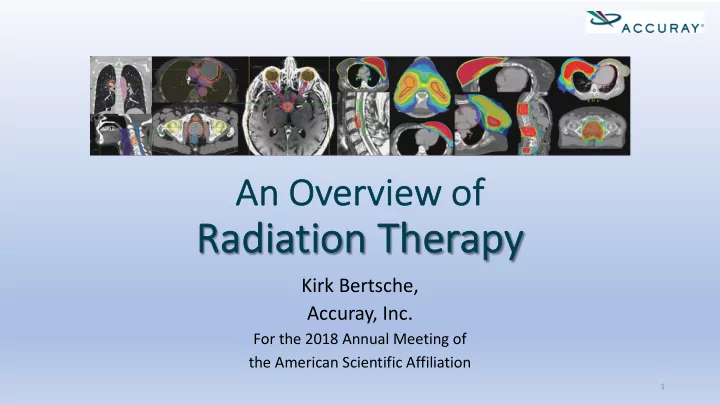
An An Over erview of Ra Radiation T Therapy Kirk Bertsche, Accuray, Inc. For the 2018 Annual Meeting of the American Scientific Affiliation 1 Ca Cancer Facts Leading cause of death worldwide 40% in this room will be diagnosed

slide-1
SLIDE 1

An An Over erview of

Ra Radiation T Therapy

Kirk Bertsche, Accuray, Inc.

For the 2018 Annual Meeting of the American Scientific Affiliation

1

slide-2
SLIDE 2

Ca Cancer Facts

  • Leading cause of death worldwide
  • 40% in this room will be diagnosed with cancer
  • >1.7 million new cancer cases in the US annually
  • Men: if live long enough, will get prostrate cancer
  • 2/3 of cancer patients will have radiation therapy (RT)
  • >40% of those cured will be cured with RT

2

slide-3
SLIDE 3

Ca Cancer 5-yr yr Prevalence, , per 100,0 ,000

3

slide-4
SLIDE 4

Cancer Statistics, North America

4

slide-5
SLIDE 5

Ca Cancer and Ra Radiation

  • n Therapy (RT)
  • What is CANCER?
  • Uncontrolled, rapid cell division
  • What is RADIATION THERAPY (RT)?
  • Therapeutic use of ionizing radiation
  • Kills cells and/or halts reproduction
  • How did RT begin?

5

slide-6
SLIDE 6

Di Discovery o

  • f X

X-Ra Rays: Wilhelm m Roe

  • entgen, 1895
  • Discovered X-rays in experiments with early cathode-ray tubes
  • Awarded first Nobel Prize in Physics, 1901.

Crookes tube

(D-Kuru/Wikimedia Commons)

Early X-ray tube used by Roentgen, c. 1896

(Smithsonian National Museum of American History)

6

slide-7
SLIDE 7

X-Ra Rays for

  • r Ra

Radiation

  • n Therapy: 1896
  • X-ray treatments within 1

year of discovery!

  • Leopold Freund: RT for hairy

moles on 5 year old girl.

  • Victor Despeignes: RT for

stomach cancer.

  • Emil Grubbe: RT for breast

cancer.

  • No understanding of physics
  • r biology of X-rays

Early X-ray RT for epithelioma of the face

(Sinclair Tousey, 1915. Medical electricity..., Saunders)

7

slide-8
SLIDE 8

Di Discovery o

  • f R

Radioact ctive M Materi rials: H : Henri ri Be Becquerel, 1896

Henri Becquerel

  • Becquerel discovered radioactivity in 1896 in uranium salts.
  • Becquerel’s student, Marie Curie, with husband Pierre, discovered

polonium and radium in 1898.

  • All three shared third Nobel Prize in Physics, 1903.

Marie & Pierre Curie

8

slide-9
SLIDE 9

Ra Radium m RT befor

  • re Wor
  • rld War II
  • 1901: Radium therapy

begins

  • 1911: Claudius Regaud

begins introducing low dose rate and fractionated therapy with radium

  • Radium use gradually

declines due to cost

  • J. Murdoch, British Journal of Radiology 1931

4(42): 256-284

9

slide-10
SLIDE 10

Ot Othe her Uses for Radium dium

10

slide-11
SLIDE 11

X-Ra Ray RT befor

  • re Wor
  • rld War II
  • 1916: “Orthovoltage” (50-

500 kV) RT using hot cathode X-ray tubes invented by William Coolidge at GE

  • 1937: “Megavoltage” (>1

MV) RT using 1.2 MV Van de Graaff driven X-ray tube in Boston

Van de Graaff driven X-ray tube for RT Coolidge-type tube with water cooling added

11

slide-12
SLIDE 12

X-Ra Ray RT after Wor

  • rld War II
  • RF linear electron

accelerators (linacs) enabled by WW2 advances in radar and microwaves

  • 1953: D.W. Fry’s 8 MeV travelling-

wave (TW) linac used for RT at Hammersmith Hospital, London

  • 1956: Henry Kaplan & Ed Ginzton’s

6 MeV TW linac used for RT at Stanford-Lane Hospital, San Francisco

Fry’s 8 MeV linac at Hammersmith Hospital, London

(P. Howard-Flanders (1954) Acta Radiologica 41:sup116, 649-655.)

Kaplan & Ginzton’s 6 MeV linac at Stanford-Lane Hospital, San Francisco

(Stanford Report, April 18, 2007)

12

slide-13
SLIDE 13

Ot Othe her RT T Develo lopm pments

  • 1938: Neutron therapy with 37-inch cyclotron, Berkeley
  • 1949: X-Ray RT with 20 MeV betatron at U Illinois
  • 1951: Harold Johns begins RT with cobalt-60
  • 1954: Proton therapy begins at 184-inch cyclotron, Berkeley
  • 1957: Particle therapy (He ion) begins, Berkeley

13

slide-14
SLIDE 14

Mod Modern Me Medical Linacs for

  • r RT

Varian TrueBeam Accuray RadiXact Accuray CyberKnife Elekta Synergy

14

slide-15
SLIDE 15

Ho How D w Does es A An R RF L F Lin inac ac W Work?

  • RF (Microwave) Power
  • Electron Source
  • Electron Acceleration
  • X-Ray Production

15

slide-16
SLIDE 16
  • Microwave Power Source
  • Magnetron (or Klystron)
  • 3 or 9 GHz
  • 1-6 MW peak, 1-6 kW avg
  • RF Circulator
  • Protects source from power

reflecting from linac

  • Electron Linac
  • Automatic Frequency Control

(AFC)

  • Tracks source frequency to

resonant frequency of linac

RF RF Power

Part #

Block Diagram

Load AFC Circuit High-Power Load Circulator Linac Microwave Power Source Tuning Motor

16

slide-17
SLIDE 17
  • Electrons orbit in

uniform axial magnetic field

  • Electrons excite
  • scillations in

resonant cavities

  • Cavities radiate

microwave power

  • Microwave power

is transmitted to linac

RF RF Power Sou

  • urces

Magnetron: High-Power Microwave Oscillator Klystron: High-Power Microwave Amplifier

  • Electron velocity is modulated

in buncher cavity

  • Electron density becomes

modulated downstream

  • Modulations excite oscillations

in output cavity

(Charly Whisky at English Wikipedia) http://hyperphysics.phy- astr.gsu.edu/hbase/waves/magnetron.html

17

slide-18
SLIDE 18

El Electron n Sour urce (“Gun”) un”)

Part #

http://www2.l-3com.com/edd/products/r_linear.htm

Filament Cathode Grid Electrons Anode

  • Cathode: -9kV to -15 kV (typ)
  • Filament heats cathode
  • (Optional) grid controls gun current

18

slide-19
SLIDE 19

El Electron n Acceleration

Ba Basic Pillbox RF Ca Cavity

Part #

  • Hollow “pillbox”-shaped

conductive cavity has electromagnetic standing- wave resonant modes

  • If L<2R, lowest frequency

resonant mode is TM010 mode (shown)

R c R c J

TM

405 . 2

1 ,

010

» = w ÷ ø ö ç è æ = r c J E r Ez w ) (

http://uspas.fnal.gov/materials/09UNM/Unit_4_Lecture_9_RF_Cavities.pdf

19

slide-20
SLIDE 20
  • Add holes on axis for beam to

pass through

  • Add “noses” to concentrate Ez

along beam

  • Round outside corners to reduce

power loss

El Electron n Acceleration

Pr Practica cal RF Cavities for Linacs

http://uspas.fnal.gov/materials/09UNM/Unit_4_Lecture_9_RF_Cavities.pdf

Ez

20

slide-21
SLIDE 21

El Electron n Acceleration

p/2 Co Coupled Ca Cavity y Mode (idea due to Knapp et al at LANL in 1960s)

E.A. Knapp, “High Energy Structures”, in Linear Accelerators, ed. P.M. LaPostolle and A.L. Septier, p. 607.

21

slide-22
SLIDE 22
  • Wave “Surfing”
  • Bunching
  • Focusing

El Electron n Acceleration

http://www.particleadventure.org/accel_particles.html

22

slide-23
SLIDE 23

Va Varian System

  • Gantry rotates around patient
  • Horizontal linac
  • Bend magnet

23

slide-24
SLIDE 24
  • Linac and RF

components are mounted in linac head at end of robotic arm

  • MLC = Multi-Leaf

Collimator

Cy CyberKnife X-Ra Ray Head

Standing Wave Linac Magnetron Electron Source (Gun) Target Circulator Transmission Waveguide Primary Collimator MLC Pulse Transformer (not shown)

slide-25
SLIDE 25
  • Relativistic electrons strike dense (hi-Z) material
  • Deceleration near atomic nuclei produces Bremsstrahlung = “Braking

radiation” (high-energy X-rays)

Photon spectrum: 6 MeV avg, 6.7 MeV max electrons on tungsten target

X-Ra Ray Prod

  • duction
  • n

25

Br Bremsstrahlung

slide-26
SLIDE 26
  • High-energy X-ray/ g-ray beam is masked by high-Z collimator
  • Most modern systems offer a multi-leaf collimator (MLC) to conform

radiation shape to tumor

X-Ra Ray Prod

  • duction
  • n

26

Co Collimation

slide-27
SLIDE 27

En Energy Deposit itio ion vs. Depth

  • Energy deposition (Dose) drops off with depth, due to absorption

and scattering

  • So how do we kill a deep tumor without killing good tissue?

0.2 0.4 0.6 0.8 1 50 100 150 200 250 300

PDD Depth (mm)

27

slide-28
SLIDE 28

Mod Modern Treatme ment Planning

  • Use beams from multiple

“ports” to overlap on tumor

  • Shape beams with MLC (3D

Conformal RT)

  • Modulate beam intensity

(IMRT)

  • Image guidance (IGRT) allows

“4D” RT

  • Prostate, e.g.
  • Limit dose to good tissue,

especially to rectum and heads

  • f femurs

7 beam IMRT prostate treatment plan

(http://karenkrueger.weebly.com/)

28

slide-29
SLIDE 29

Ne New Trends and De Develop

  • pments
  • Better treatment plans
  • Faster computers, improved algorithms
  • Better imaging
  • Most systems now incorporate diagnostic X-rays
  • Incorporation of MRI, PET, ultrasound
  • Allow motion tracking (https://youtu.be/dbM2b6vTGb8)
  • “Flash”
  • Very high dose rate may be beneficial (300x normal!)
  • Radiosensitizers
  • Particle therapy
  • Protons, ions
  • Takes advantage of “Bragg peak”

29

slide-30
SLIDE 30

Br Bragg Peak in Particle Therapy

  • Bragg peak--sharp

distal edge

  • Particles also give

sharper lateral edges

  • Usually need to

spread out the peak

30

slide-31
SLIDE 31

Su Summary

  • Radiation therapy is beneficial in treating cancer
  • A number of disciplines together enable radiation therapy
  • Basic physics (electromagnetism, relativity, quantum mechanics)
  • Applied physics and engineering (particle accelerator design, high

power microwave components, high vacuum systems)

  • Medical physics
  • New developments will continue to improve radiation

therapy

  • Radiation therapy enables us, created in the imago dei, to

better exercise dominion over disease and to help subdue it (Gen 1:26-28)

31

slide-32
SLIDE 32

Re References

  • Barletta, William (2009) USPAS, http://uspas.fnal.gov/materials/09UNM/.
  • Bernier, Jacques, Eric J. Hall and Amato Giaccia (2004) “Radiation oncology: a century of achievements” Nature Rev. Cancer 4 737-

747.

  • Connell, Philip P. and Samuel Hellman (2009) “Advances in radiotherapy and implications for the next century: a historical

perspective” Cancer Res. 69:2 383-392.

  • Ginzton, Edward L. and Craig S. Nunan (1985) “History of microwave electron linear accelerators for radiotherapy” Int. J. Radiation

Oncology Biol. Phys. 11, 205-216.

  • Howard-Flanders, P (1954) “The development of the linear accelerator as a clinical instrument” Acta Radiologica 41:sup116, 649-

655.

  • Humphries, Stanley Jr. (1986) Principles of Charged Particle Acceleration (Wiley) http://www.fieldp.com/cpa.html.
  • Karzmark, C.J., Craig S. Nunan, and Eiji Tanabe (1993) Medical Electron Accelerators (McGraw-Hill).
  • Robison, Roger F. (1995) “The race for megavoltage X-rays versus telegamma” Acta Oncologica 34:8, 1055-1074.
  • Thwaites, David I and John B Tuohy (2006) “Back to the future: the history and development of the clinical linear accelerator” Phys.
  • Med. Biol. 51:R343-362
  • Wangler, Thomas P (1998) Principles of RF Linear Accelerators (Wiley)

http://physics.ut.ac.ir/~shafiei/pub/PrincipleOfRFLinearAccelerators.pdf.

  • Whittum, David (1998) USPAS, http://uspas.fnal.gov/materials/14Knoxville/.

32